





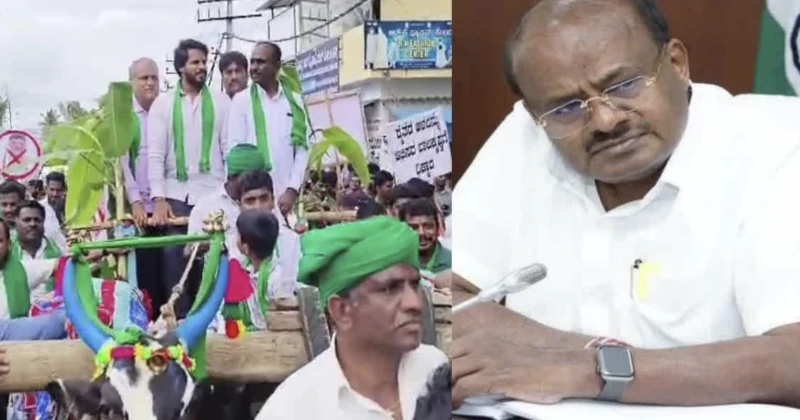
The farmers’ protest against the proposed Greater Bengaluru Integrated Township (GBIT) around Bidadi escalated on September 28 as Janata Dal (Secular) leaders mounted vocal support for aggrieved cultivators, warning the state government against forcibly acquiring agricultural land. Speaking to hundreds of villagers and supporters, Union Minister H. D. Kumaraswamy vowed he would stand with the farmers “as long as I live” and warned Deputy Chief Minister D. K. Shivakumar that those who trample farmers’ rights would be held to account.
The JD(S) has framed the dispute as one between smallholders and powerful interests behind an ambitious plan to convert nearly 9,000–9,600 acres of farmland in and around Bidadi into an integrated, AI-focused township. Party youth leader Nikhil Kumaraswamy — speaking both at the protest site and via a live virtual address — accused officials of conducting coercive surveys and intimidation, and said the party would support any non-violent action the villagers choose, including marches to the Vidhana Soudha if the project is not withdrawn.
“If the authorities and police oppress the farmers and conduct surveys, they will have to pay a price in the future,” H. D. Kumaraswamy said in a live address transmitted to the gathering, adding that the issue is “not political” but “a question of people’s lives.” Nikhil Kumaraswamy echoed the charge that land is being targeted for real estate profiteering and accused the Deputy Chief Minister of being “drunk with power” and dismissive of farmers’ concerns.
Farmers in Bhairamangala and nearby villages claim that they were not consulted meaningfully and that many families rely on the contested plots for their livelihoods. JD(S) leaders put the number of resisting farmers as high — claiming roughly 80% are unwilling to part with their land — and demanded public disclosure of the project report, transparent social impact studies, and credible compensation and rehabilitation guarantees before any acquisition proceeds. Protestors also warned that agricultural communities fear irreversible loss of orchards, irrigation and income if large tracts are converted to urban use.
The state government, represented publicly by Deputy Chief Minister D. K. Shivakumar, has defended the GBIT as a legally framed development aimed at easing congestion in Bengaluru and generating jobs. Shivakumar has insisted that a majority of landowners have accepted compensation offers and accused the JD(S) of politicising the issue, while disputing claims of widespread farmer opposition. He has repeatedly stated that denotification is not on the table and that any acquisition will be conducted in accordance with the law.
Political fault lines have widened: JD(S) leaders condemned what they called a “land grab” and alleged that the project benefits private real estate actors at the expense of small farmers, while the ruling party counters that the plan follows long-established proposals for regional economic expansion. Opposition voices from other parties have also weighed in, with criticism of the government’s handling of consultations and calls for greater transparency.
Local leaders say tensions rose after the administration began conducting surveys and identifying plots for acquisition. Protest organisers insist that their movement will remain peaceful but intense, vowing to maintain pressure until concrete safeguards for farmers are implemented or the project is reassessed. “We will stand as the farmers’ voice until the end,” Nikhil Kumaraswamy told the crowd, promising the party would not abandon the struggle.











Comments