





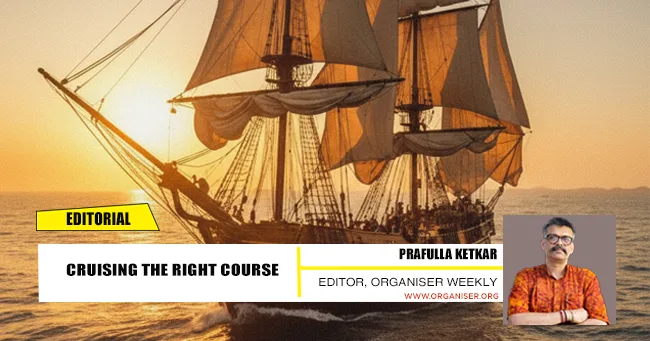
“There was no lack of energy on the part of Indians of old in utilising to the full the opportunities presented by nature for the development of Indian maritime activity -the fine geographical position of India in the heart of the Orient, with Africa on the west and the Eastern Archipelago and Australia on the east, her connection with the vast mainland of Asia on the north, her possession of a sea-board that extends over more than four thousand miles, and finally the network of rivers which opens up the interior. In fact, in India there is to be found the conjunction or assemblage of most of those specific geographical conditions on which depends the commercial development of a country”. –Radha Kumud Mookerji, Indian Shipping: A History of Seaborne Trade and Maritime Activity of the Indians from the Earliest Times, Kitab Mahal Pvt Ltd, Allahabad, 1962, p. 6
In a significant boost to the maritime ecosystem, the Union Cabinet has given its approval to the comprehensive four-pillar approach to strengthen shipbuilding, maritime financing, and domestic capacity. To revitalise the shipbuilding industry, Rs 69,725 cr has been approved, while the financial assistance scheme to the sector has been extended until March 31, 2036, with a corpus of Rs 24,736 cr. Just before these landmark Cabinet decisions, PM Narendra Modi laid the foundation stone for multiple development projects related to the sector, with revitalisation of multiple ports with new container terminals and cargo handling facilities. Ship repair facilities at Patna and Varanasi have also been initiated, indicating the revival of the river routes. Bharat, with a coastline of more than 7,000 km and 12 major and over 200 non-major ports, and an overall trade volume of 95 per cent and a trade value of 65 per cent, the primacy of maritime strategy, in terms of commerce, connectivity, security, and culture, should have been the natural course. Then why has this new emphasis on the maritime ecosystem become a crucial course correction?
The answer lies in the colonial history and psyche.
All historical evidence from Periplus of Erythraean Sea to modern historians, such as Radha Kumar Mookerji’s masterwork on the shipping industry, indicates with sufficient and irrefutable evidence that Bharat had a glorious maritime tradition involving diverse communities, with centuries of trade and seafaring activities that connected this vast landmass to the world. The mother of heavy industry – that is, shipbuilding – finds a clear presence on Bharat’s coastline much before Europeans claimed this great land. The average share of 25 per cent in global trade during the first fifteen centuries of the Common Era is attributed to this maritime dominance. Garments, metals, and spices found a huge market across Asia, the African coast and even the Roman Empire. From Gulf of Kutch in Gujarat to Bay of Bengal, a thriving maritime ecosystem existed. The Bali Yatra, starting from the Puri coast in Odisha, is a testament to this. The corridors built by great leaders like Rajrajendra Chola still have cultural and commercial footprints across the Indian Ocean Region.
It is only after the arrival of the Mughals, who came via land route and hardly had exposure to the sea routes, that Bharat became Delhi-centric and sea-blind. Their atrocious and cruel religious policies turned the locals inward. European colonisers, especially the British, used it as a reference point and created a colonial narrative of Bharat lacking maritime history and culture.
Unfortunately, the colonised minds and Delhi-centric approach continued the conscious or unconscious neglect of the maritime potential. Consequently, we are paying nearly $75 billion — approximately Rs six lakh crore — as annual freight charges to foreign shipping companies for their services.
When we strive to maintain strategic autonomy with the objective of an Atmanirbhar and developed Bharat, the maritime sector holds the key. The rise of any country has been directly proportional to its maritime prowess and technological innovations. The recent attempt on the upgradation and linkages of ports, reconstruction of the shipbuilding industry, and reinvigorating the green economy is a process to reclaim the glorious maritime heritage of Bharat. The creation of the National Maritime Heritage Complex (NHMC) at Lothal is a significant step in the right direction, as it celebrates and preserves Bharat’s ancient maritime traditions, serving as a centre for tourism, research, education, and skill development. The museum dedicated to the world’s oldest dockyard can become an inspirational lighthouse for reclaiming its pivotal status in the comity of nations. The paradigm shift in the maritime sector is the prerequisite for achieving Atmanirbharta in logistics and providing new momentum in making our coastlines the gateways of prosperity.












Comments