





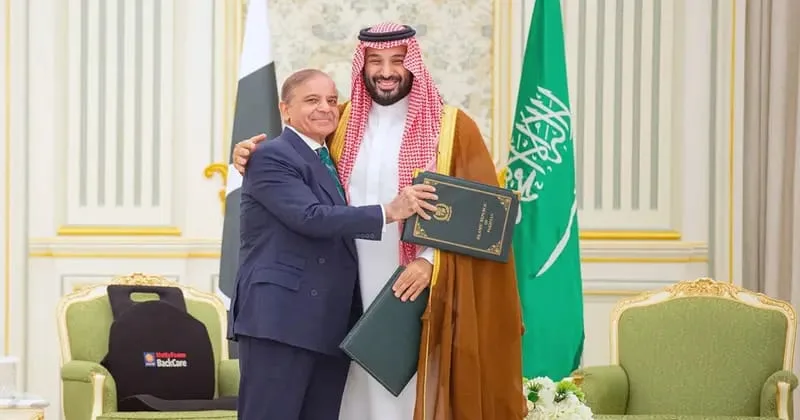
In an unexpected development, Pakistan and Saudi Arabia signed a “Strategic Mutual Defence Agreement” recently. The agreement states that “any aggression against either country shall be considered an aggression against both”. The defence pact is actually a marriage of convenience between Pakistan and Saudi Arabia, where both partners are pursuing different aims. This marriage of convenience is not surprising considering the unpredictable security situation in the Middle East.
The immediate catalyst for Saudi Arabia to sign a defence pact is a likely threat from Israel. Israel successfully targeted the senior leadership of Hamas on September 9, with a precision strike at Doha, Qatar. Israel demonstrated its ability to strike at any target inimical to its interests through an air strike which flew undetected over the Saudi airspace. Saudi Arabia boasts of highly advanced air defence cover provided by the Americans, but their radars failed to detect 12 Israeli fighter jets. With such a threat to themselves, Saudi Arabia quickly walked into a military alliance with Pakistan.
Pakistan has had a close military relationship with Saudi Arabia since the 1960s. Pakistan trains the personnel from the Saudi armed forces, and Pakistan has positioned a considerable number of troops in Saudi Arabia. As per a military protocol signed between the two countries in December 1982, Pakistan keeps an infantry division worth of troops (roughly 15000 all ranks) in Saudi Arabia for their internal and external security. Most of the Saudi fighter jets are flown by Pakistani air force pilots. This sort of deputation to Saudi Arabia is very popular with the Pakistani troops, as they are paid handsomely for their service by the Saudis.
Even the advanced US military equipment held by Saudi Arabia is largely operated by Pakistani troops, putting a question mark on the quality of training provided by them to the Saudi troops. Saudi armed forces are not that professional, with their senior leadership holding their position based on loyalty to the monarchy. Pakistan, on the other hand, has been smart to utilise the American defence equipment of the Saudis against India during the 1965 and 1971 wars. Former Pakistan Army Chief, General Raheel Sharief, heads a military alliance of nine Sunni Arab countries, which is based in Riyadh, for conducting operations against the Houthi rebel group in South Yemen.
Pakistan is a failed state economically and is virtually bankrupt. It is surviving on the financial assistance of the Gulf countries, the World Bank and China. China is already having second thoughts about the success of its Belt and Road Initiative through Pakistan, where it has sunk billions of dollars. Saudi Arabia, with its deep pockets, is perceived as the natural saviour of Pakistan, another Sunni Muslim majority country. Saudi Arabia is also the unquestioned leader of the Organisation of Islamic Countries (OIC), and a formal military pact with Pakistan helps its dominance in the region.
So, the aims of this marriage of convenience are totally different. Saudi Arabia is seeking close protection from Pakistan against any threat from Israel, as well as Pakistani troops to do the dirty job of fighting the Houthi rebels. In essence, Saudi Arabia has outsourced its internal and external security to Pakistan. Pakistan, on the other hand, is looking at the petrodollars of Saudi Arabia to bail itself out financially. Pakistan is also looking at the latest US military hardware held with Saudi armed forces for use against India. Saudi Arabia till recently was the world’s largest arms importer, with 75% of arms being imported from the US.
Pakistan is still cooling its heels after it received a severe beating from India during Operation Sindoor. Even after some face-saving exercise by the Pakistani military, they know that their relevance in the power structure in Pakistan would diminish considerably if they lose again to India anytime soon. The Pakistani military, therefore, must be conspiring for suitable revenge against India. It is here that they need the financial might of Saudi Arabia to upgrade their military capability, particularly the air defence cover. It is inconceivable that any Saudi troops are going to fight alongside Pakistani troops in any future conflict with India.
Officially, the defence pact between Pakistan and Saudi Arabia builds on the historic partnership extending for nearly eight decades between the two countries. The joint statement further states that the defence pact is based on the bonds of brotherhood and Islamic solidarity, as well as shared strategic interests and close defence cooperation between the two countries. The agreement is more in line with the NATO alliance, where Saudi Arabia sincerely hopes that Pakistan is able to take on the threat from Israel and other security threats.
Behind all this, there is also a hidden agenda to the contest of Islamic leadership in the world. Pakistan, right after independence, presumed itself to be the natural leader of the Islamic Ummah. Saudi Arabia, Turkey and Iran have also staked a claim for the Islamic leadership role. Pakistan acquired nuclear weapons primarily towards this role and not necessarily against India alone. The statement of Pakistani Defence Minister Khawaja Asif that Pakistan’s nuclear weapons are available for Saudi Arabia’s use has dangerous connotations for the uncontrolled use of weapons of mass destruction. A lot of such a messy situation has to do with American reluctance to deploy boots on the ground in West Asia, particularly under the Trump 2.0 administration.
India has done well to carefully respond to the defence pact, stating that it will study the implications of the move for its national security as well as for regional and global stability. In fact, India and Saudi Arabia now share close diplomatic relations, with the push given by PM Modi. The commercial ties have also improved considerably between the two countries. In April 2024, Saudi Arabia even issued a statement that the Kashmir dispute is bilateral between India and Pakistan, which aligned with India’s long-standing position on the issue. The defence cooperation between India and Saudi Arabia has also increased much more in recent years, something that I witnessed personally during my military career.
India’s strategic intelligence community has to closely watch how this defence pact is given shape on the ground. India has to closely monitor how much Saudi military hardware comes to Pakistan. Pakistan already seems emboldened with this pact. There was a ceasefire violation with India reported on September 20 in Kupwara’s Nowgam sector. Pakistan Air Force has even bombed a village in Khyber Pakhtunkhwa on September 22, killing at least 30 innocent civilians. Even the Pakistani Cricket Team is throwing uncivilised tantrums in the ongoing Asia Cup, that too after losing to India comprehensively.
It has to be understood that a soldier fights for his or her motherland. No amount of money can bring that fighting spirit in a soldier to die for another country, particularly in the modern world. The idea of outsourcing security through a defence pact is not a great solution, particularly with an unreliable partner like Pakistan. Even a well-established security grouping like NATO is facing challenges to stay afloat. Saudi Arabia should realise this fundamental truth and concentrate on building a professional military like India.















Comments