





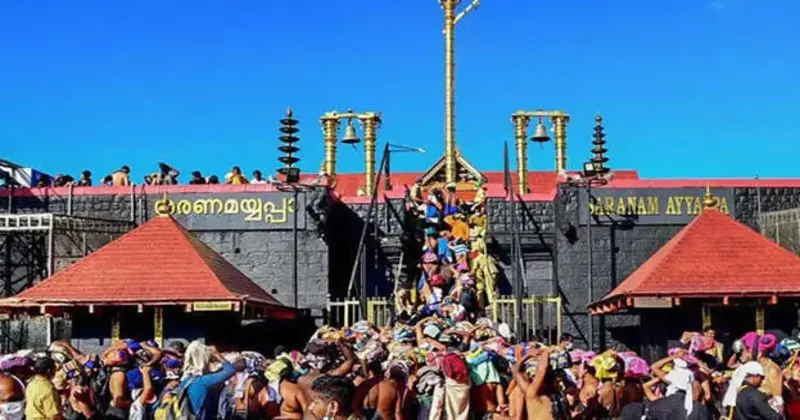
The 2018 Sabarimala agitation was not merely a legal dispute but a seminal moment in Kerala’s history, where the fundamental conflict between judicial overreach and religious faith came to a head. Framed as a defense of tradition and the deity’s celibate nature, the devotee-led resistance was met with an unprecedented display of state power under the Left Democratic Front (LDF) government. This perceived ‘anti-faith’ campaign by the state culminated in a significant political backlash, a fact starkly demonstrated five years later. In 2025, the LDF’s calculated attempt to win back Hindu voters through a state-sponsored ‘Global Ayyappa Sangamam’ at Pampa was met with a resounding rejection, symbolically encapsulated by the visuals of empty chairs. In direct contrast, the ‘Ayyappa Bhakta Sangamam’ organized by the Hindu organizations in Pandalam and the pan-Indian ‘Ayyappa Jyothi’ in New Delhi witnessed a massive, organic outpouring of support. This report confirms that the “Ayyappa Factor” has become an undeniable and enduring force in Kerala’s sociopolitical landscape, with the faithful rejecting political opportunism in favor of genuine spiritual conviction. The events of 2025 served as a public referendum, reaffirming that the power of tradition and belief can withstand political maneuvering and ideological imposition.
The Sabarimala agitation and the Supreme Court verdict: A legal analysis from a Dharmic viewpoint
The catalyst for the monumental socio-religious upheaval in Kerala was the September 28, 2018, verdict by a five-judge bench of the Supreme Court of India. In a 4:1 majority ruling, the court held that the age-old tradition of prohibiting women of menstruating age (10-50 years) from entering the Sabarimala temple was unconstitutional. The verdict struck down Rule 3(b) of the Kerala Hindu Places of Public Worship (Authorization of Entry) Rules, 1965, on the grounds that it was discriminatory and in violation of fundamental rights, specifically the right to equality under Article 14 and the freedom to practice religion under Article 25. The majority opinion, spearheaded by Chief Justice Dipak Misra and supported by Justices R.F. Nariman, A.M. Khanwilkar, and D.Y. Chandrachud dismissed the practice as not being an “essential religious practice” of the Ayyappan faith.
This verdict was seen by many as a classic case of judicial overreach, where the court attempted to impose a modern, liberal and secularist view of “constitutional morality” onto a deeply rooted religious tradition. Justice Chandrachud’s opinion, in particular, proved highly contentious from a Dharmic perspective. He likened the exclusionary practice to a form of “untouchability” prohibited under Article 17, a comparison that was widely perceived as an affront to the sanctity of the temple’s customs. Furthermore, the majority ruling declared that the worshippers of Lord Ayyappa did not constitute a “separate religious denomination,” thereby stripping the community of constitutional protections afforded to religious denominations under Article 26.1. This legal interpretation was viewed as a deliberate and deeply wounding act that dismantled the very framework of the tradition.
In stark contrast to the majority’s decision stood the sole dissent of Justice Indu Malhotra. Her opinion provided a crucial and much-lauded defense of religious autonomy, arguing that courts should not be arbiters of faith. She maintained that the court must respect a religious denomination’s right to manage its internal affairs, regardless of whether their practices seem “rational or logical” to outsiders. From a traditionalist viewpoint, Justice Malhotra’s stand was a crucial acknowledgment that the collective spiritual beliefs of a community and the sanctity of the deity’s celibate nature, must take precedence over external, secular impositions. She held that the right to religion under Article 25 should not be overridden by the right to equality under Article 14, regardless of the rationality of the religious practice. She also questioned the standing of the petitioners to challenge the practice, as they were not worshippers of the temple. Her dissent became a rallying point for devotees, symbolizing the legal embodiment of the resistance to a verdict that they believed infringed upon their fundamental right to practice their faith as defined by their own traditions.
The LDF government’s stance: From progressive to persecutory
The LDF government, led by Chief Minister Pinarayi Vijayan, embraced the Supreme Court’s verdict with a stance of firm resolve, branding its implementation as a move towards “progressive values” and social reform. However, for millions of Ayyappa devotees, this was seen not as a progressive step but as a state-sanctioned assault on their faith. The government’s actions transformed the legal dispute into a widespread sociopolitical conflict.
The administration’s subsequent crackdown on protests was widely described as “police raj” and a brutal display of state power. The government was accused of using police force against peaceful devotees who were chanting prayers in protest of the verdict. Thousands of individuals were charged in police cases, with estimates from the Sabarimala Karma Samithi suggesting over 6,000 cases were registered against nearly 16,000 activists. The charges ranged from unlawful assembly to rioting and even attempted murder. While some counter-narratives emerged claiming certain photos of police brutality were old and unrelated, the sheer scale of the arrests and the harshness of the charges cemented the public perception that the government was actively persecuting believers. The fact that the process of withdrawing these “non-serious” cases has been slow and legally complicated, remaining a contentious issue as of September 2025, is seen as a persistent signal of the government’s enduring “anti-faith” stance.
The most inflammatory moment occurred when two women, Bindu Ammini and Kanaka Durga, entered the temple on January 2, 2019, escorted by police in the pre-dawn hours. This “forceful entry” was confirmed by the Chief Minister himself, who stated that the police were bound to provide protection to anyone wanting to enter the shrine. This event was immediately followed by the temple priests closing the shrine for a “purification ceremony,” a move that devotees saw as a symbolic and literal cleansing of the sanctuary after its desecration. For the Ayyappa devotee, this sequence of events—the state’s aggressive implementation, the police crackdown on peaceful protestors and the perceived disrespect for a core religious ritual—confirmed their worst fears: that the LDF government was not a neutral arbiter of the law, but a hostile force actively working against their faith.
The 2025 Sangamams – A political and spiritual barometer
The political and religious tensions of 2018-2019 found a new, contemporary manifestation in the three Ayyappa Sangamams held in September 2025. These events served as a powerful barometer of the shifted public sentiment and the political fallout of the previous agitation.
The Left’s Global Ayyappa Sangamam in Pampa: A political gimmick exposed
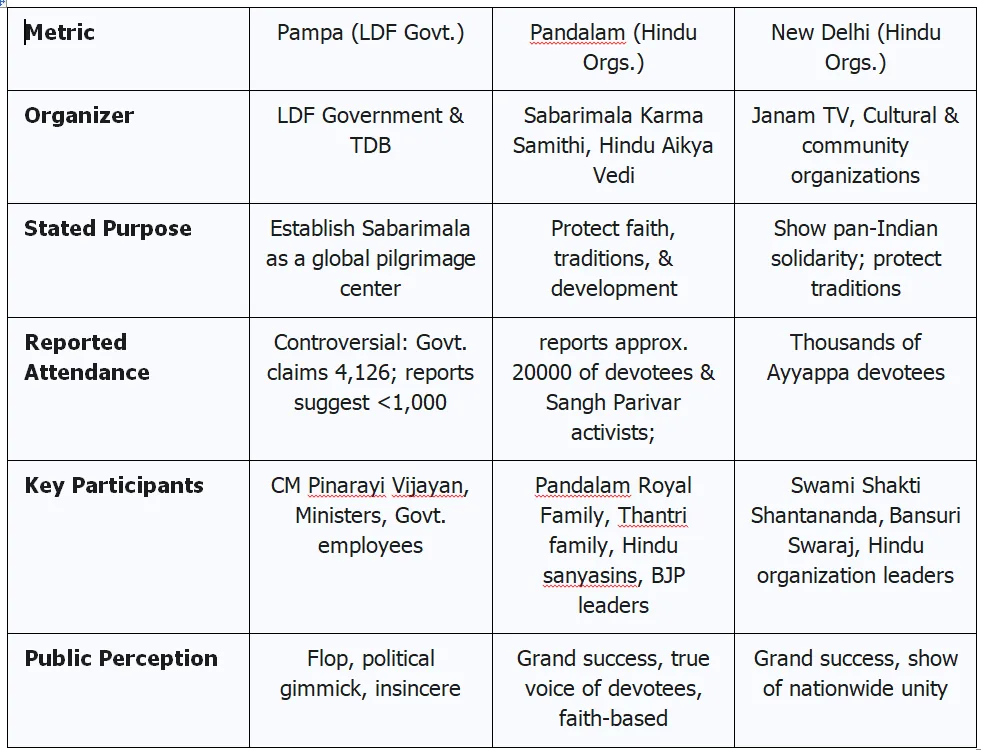
The ‘Global Ayyappa Sangamam’ organized by the LDF government and Travancore Devaswom Board (TDB), was held in Pampa on September 20, 2025, to coincide with the TDB’s 75th anniversary. Its stated purpose was to establish the Sabarimala shrine as a global pilgrimage centre. It was widely viewed as a cynical political stunt aimed at winning back Hindu voters ahead of upcoming elections. From its inception, the event was plagued by controversy and a clear lack of genuine devotee participation.
The most damning evidence of its failure was the visuals of “empty chairs” that were widely circulated in the media. While the Devaswom Board Minister V.N. Vasavan and Board President Adv. P S Prasanth are claimed that over 4,126 delegates had registered and participated, reports indicated that the actual attendance was “below one thousand,” a stark contradiction that underscored the event’s rejection by the devotees. The government’s defense—that the photos were taken before the sessions began or were “AI-generated”—was dismissed as a desperate and insulting attempt at propaganda, further damaging its credibility. The public could see that the majority of attendees were government (KSRTC, KSEB, Police etc.) and Devaswom Board employees, not genuine devotees, proving that the event was a contrived spectacle rather than a spiritual gathering.
The financial and legal controversies surrounding the Sangamam further exposed its opportunistic nature. Opposition parties alleged a wasteful expenditure of ₹7 crore, and the Kerala High Court had to intervene to stay a Malabar Devaswom Board order that would have allowed temple funds to be used for the travel and food expenses of officials attending the event. This legal action highlighted the perception that the government was willing to misuse temple resources for a political event. The LDF’s political desperation was further evidenced by its controversial invitation to Tamil Nadu Chief Minister M.K. Stalin, a leader who has repeatedly insulted the Hindu faith. The backlash was so severe that Stalin ultimately withdrew from the event. The government’s move to read a message from Uttar Pradesh Chief Minister Yogi Adityanath at the event was also perceived as a blatant political maneuver aimed at appealing to a Hindu vote bank, a complete reversal from their past ideological stand. The collective symbolism of these actions and the public’s boycott affirmed the view that the Pampa Sangamam was an insincere and transparent attempt at electoral engineering that had completely failed to deceive believers.
The Triumph of faith: Ayyappa Bhakta Sangamam in Pandalam and New Delhi
In stark contrast to the Pampa debacle, the parallel events organized by Hindu organizations demonstrated the enduring strength and unity of the Ayyappa devotees.
The ‘Sabarimala Samrakshana Sangamam’ in Pandalam, organized by the Sabarimala Karma Samithi and Hindu Aikya Vedi, drew thousands of devotees and activists from within and outside Kerala. The event’s legitimacy was solidified by the active participation of the Pandalam royal family—the traditional custodians of Lord Ayyappa’s sacred lore—and the Sabarimala Thantri family. Their presence provided an indisputable stamp of authenticity, reinforcing the gathering as the true voice of the faith. The fact that the Pandalam royal family conspicuously boycotted the LDF’s event while actively participating in this one was a powerful statement of support for the devotee-led movement. The Sangamam focused on key resolutions demanding the withdrawal of false cases against protestors and firm assurances on preserving temple traditions, demonstrating a clear and unified objective.
The participation of BJP state president Rajeev Chandrasekhar, former Tamil Nadu BJP President K Annamalai and Bengaluru South MP Tejasvi Surya added political weight to the event. The seminars began with chanting of slokas and were inaugurated by Swami Prajnananda Theerthapadar of Vazhoor Theerthapada Ashram. Three sessions followed. Swami Ayyappadas, founder secretary of Ayyappa Seva Samajam, spoke on ‘The Faith of Sabarimala’; former Travancore Devaswom Board president G Raman Nair addressed ‘Development of Sabarimala’; and former DGP T P Senkumar led a session on ‘Protection of Sabarimala.’
The Delhi ‘Ayyappa Bhakta Sangamam & Ayyappa Jyothi’ and gathering proved that the issue was no longer confined to Kerala but had become a matter of pan-Indian Hindu solidarity. The event, inaugurated by Swami Shakti Shantananda Maharshi (Chenkottukonam Sree Ramadasa Ashram, President), saw thousands of Ayyappa devotees from Delhi and surrounding areas participate. The presence of political figures like Bansuri Swaraj (Deli MP), Anil Kumar Sharma (Delhi R K Puram MLA, BJP) and Janam TV Executive Director & film producer G. Suresh Kumar added to its significance. The resolutions passed at the Delhi event echoed those in Pandalam, demanding an end to government meddling, the withdrawal of cases and the protection of Sabarimala as a national pilgrimage center. The synchronized, large-scale support for these two events stands as a testament to the unmanufactured, organic and widespread spiritual conviction that fueled the original agitation and continues to animate the faithful.
Comparative Analysis of the 2025 Ayyappa Sangamam
The stark contrast between the three Sangamams can be seen in the table below, which highlights their fundamental differences in purpose, participation and perception.
Impact, implications and the rise of the Ayyappa Factor
The events of 2018 and 2025 demonstrate a fundamental recalibration of Kerala’s political and social landscape with the Sabarimala agitation serving as a catalyst for a new political consciousness among Hindus.
The political recalibration in Kerala
The LDF’s initial hardline stance on the Sabarimala verdict proved to be an electoral disaster. The Communist Party of India (Marxist) [CPI(M)], the leading party of the LDF, saw a significant loss of Hindu vote share, which contributed to the front’s dismal performance in the 2019 Lok Sabha elections, where it secured only one of the 20 seats in Kerala. The political fallout was not a coincidence; it was a direct consequence of the government being perceived as “anti-Hindu” and “anti-faith” by a significant portion of the electorate.
The LDF’s shift in stance and its organization of the 2025 Sangamam is a direct response to this electoral reality. The government’s pivot from a progressive agenda to one of apparent appeasement is an admission that it needs to win back the Hindu vote bank it lost. This political maneuver, however, carries its own risks, as it could lead to the alienation of minority voters, who are a traditional support base for the LDF and UDF. The entire episode underscores how the “Ayyappa Factor” has become a central and non-negotiable part of Kerala’s political calculus.
The Sabarimala agitation forced Hindu Keralites to reflect on their religious sentiments and to consider which party truly respects them. This brought them closer to the already existing BJP in the state, strengthening its presence in a political landscape long dominated by the so-called atheist Communists of the CPM-led LDF and the Congress-led UDF. The party’s vote share has risen to nearly 20 percent. The victory in the Pandalam local body elections, which was propelled by the momentum of the 2018 protests, is a tangible example of the BJP’s growing influence. This rise is not confined to central Travancore; the Ayyappa factor has helped the party make inroads into new territories, signaling a fundamental transformation in Kerala’s political dynamics. The agitation served to politicize a large segment of Kerala’s Hindu population, turning a religious issue into a powerful electoral variable. For the first time, Hindus in Kerala once apathetic or even averse to the BJP are now openly declaring their support, a phenomenon previously unseen in Kerala’s political history.
Socioreligious transformation
Beyond the political realm, the Sabarimala agitation has forged a new sense of unity among Hindu communities in Kerala. The protests were a powerful expression of a collective identity, uniting diverse groups under a shared banner of faith. Organizations like the Nair Service Society (NSS) and the Sree Narayana Dharma Paripalana (SNDP) Yogam, once divided along caste lines, found a common cause in defending temple traditions. This collective effort, which led to the formation of umbrella organizations like the Sabarimala Karma Samithi, transcended traditional social divisions and created a more consolidated Hindu front.
The widespread participation of women, who formed a significant part of the protests, was a powerful counter-narrative to the liberal argument that the tradition was inherently patriarchal. For these women, the defense of Ayyappa’s celibacy was not a matter of oppression but one of spiritual conviction and respect for the deity’s vow. This grassroots movement proved that for many believers, faith is not something to be discarded at the behest of modern jurisprudence but is a central pillar of their identity and a source of profound strength.
The unwavering strength of tradition and the path forward
The Ayyappa Sangamams of 2025 were a public and political referendum on the events of 2018. The LDF government’s failed attempt at a politically convenient comeback was starkly exposed by the public’s widespread boycott, as symbolized by the visuals of empty chairs. This rejection confirms a crucial lesson: genuine devotion cannot be manufactured for electoral gains and public memory of perceived betrayal is long and unforgiving.
In contrast, the massive, organic turnout at the devotee-led events in Pandalam and New Delhi confirmed that the power of tradition and faith remains unwavering. The “Ayyappa Factor” has proven to be an enduring force that has not only reshaped Kerala’s political landscape but has also forged a stronger, more unified Hindu identity. The issue has become a national-level religious and political point of focus, capable of mobilizing supporters far beyond Kerala’s borders. As Kerala looks toward future elections, the actions of the devotees have made it clear that any political party hoping to succeed must first earn the trust of devotees and respect the sacred traditions that underpin their way of life. The path forward for Kerala’s politics is inextricably linked to the ‘Ayyappa Factor,’ a testament to the idea that in a Dharmic society, faith, once awakened, cannot be silenced.















Comments