





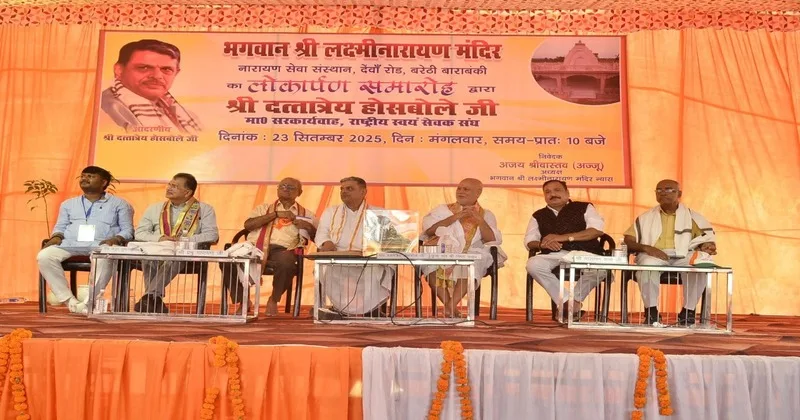
“Our temples are not merely places to earn merit or to ask for favours, but centers for awakening inner consciousness. Temples awaken the inner self of man, instil the spirit of serving others, and inspire one to relieve the suffering of society,” said Rashtriya Swayamsevak Sangh Sarkaryavah Dattatreya Hosabale at the inauguration of Lakshmi Narayan Mandir of Narayan Seva Sansthan in Barethi, Barabanki, Uttar Pradesh.
Referring to the Corona pandemic, Dattatreya Hosabale said, “During the COVID-19 pandemic, when humanity was in deep distress, several organisations took up the task of serving people and providing employment. Sangh Swayamsevaks too engaged in service at that time. Inspired by that very period, ‘Narayan Sanstha’ came into being.”
He underlined that any institution in society does not become great because of its bank balance but because of the vision, magnanimity, and work of those who run it. What began as a small initiative during the pandemic later took the shape of a trust, which, while carrying out diverse activities in this village, has now construct this temple.
Dattatreya Hosabale said that, Temples are meant to awaken inner consciousness. Narrating a known anecdote, he said, “Someone once asked, if God is present in Jad-Chetan, and is omnipresent, then why we go to worship in a temple? A devotee replied, when the air in your cycle is low, why do you pump air into it? Air is everywhere.
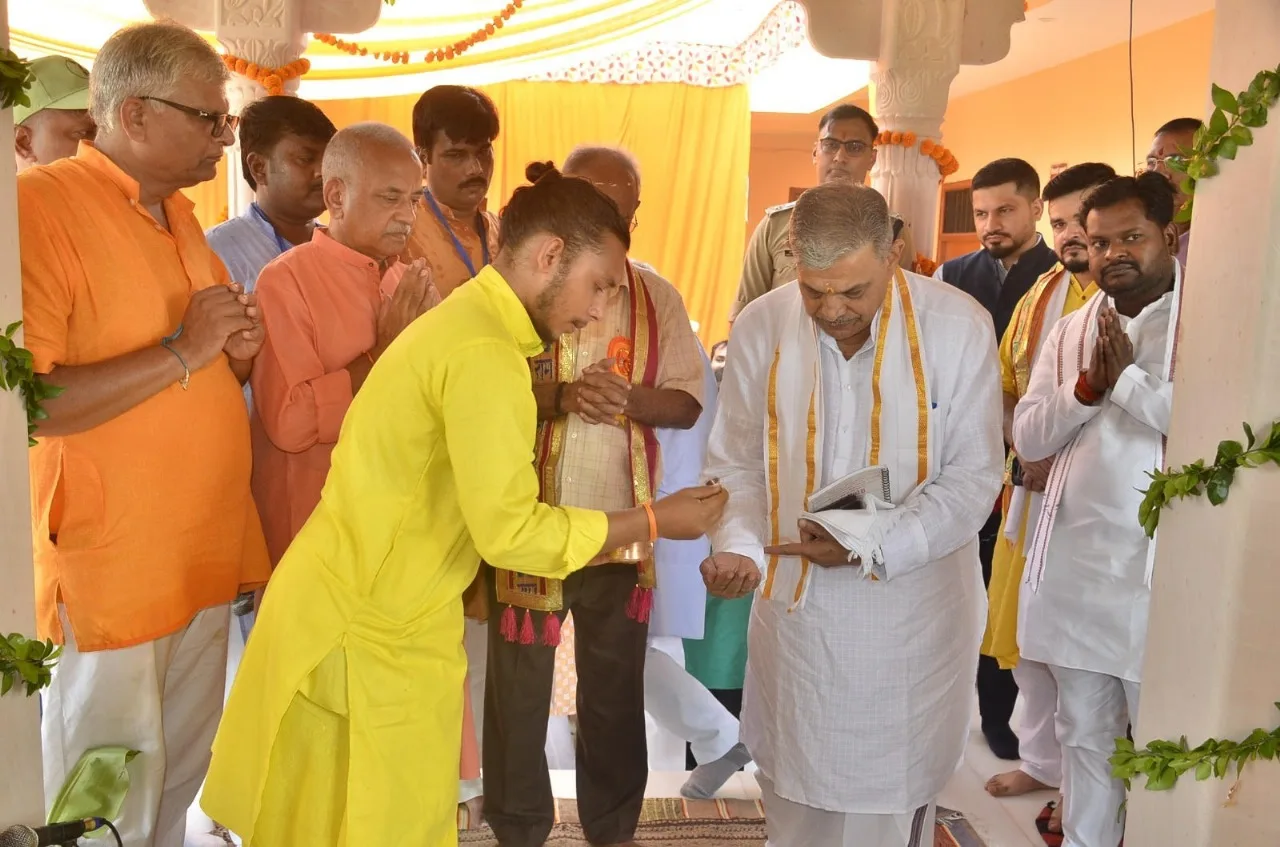
Similarly, though God is omnipresent, temples are essential.” He further emphasised that temples are not just stones or structures but are established as per Agama Shastra and spiritual injunctions. They inspire unity, bring alive Bharatiya art and architecture, and connect the individual to the supreme power.
Speaking on temple-centered rural development, he recalled that, Anna Hazare began temple-centered development work at Ralegan Siddhi, awakening social consciousness through the temple. Once, when asked, Anna Hazare himself acknowledged that his inspiration came from temple-centric organisation. Dattatreya Hosabale also gave the example of a swayamsevak who left his government job and restored a 900-year-old Sitaram temple in a village of Karnataka. He even published a booklet on its ancient architecture, and within five years, the temple had become a center of village awakening.
He stressed that villages must develop around health and education. Prime Minister too is striving to promote rural development and cottage industries, and Sangh Swayamsevaks are constantly working towards this mission.
Education, healthcare, and employment should be available within villages themselves, he asserted, adding that Bharat must not be limited to Delhi but should begin from its villages. “Narayan is both conscious (Chetan) and unconscious (achetan) states. Our vision must be aligned with the principle of Nar Sewa Hi Narayan Sewa Hai. Lakshmi-Narayan represents the union of Prakriti and Purush,” he said.
Quoting Kautilya, Dattatreya Hosabale stated, “Dharmasya moolam arthah- the basis of dharma is artha (wealth); and Sukhasya moolam dharmah- the basis of happiness is dharma.” Explaining this, he said, “The relation between life and wealth is like that of a boat and water. Water is essential to sail the boat, but if the water seeps inside, the boat sinks. Similarly, wealth is essential for life, but if wealth overwhelms life itself, destruction is certain.”
He underlined that truth, purity, compassion, and austerity are the four pillars of dharma. Every village and locality must have places of worship where one can free oneself from ego and arrogance. Such temples should become centers of inspiration for society.













Comments