





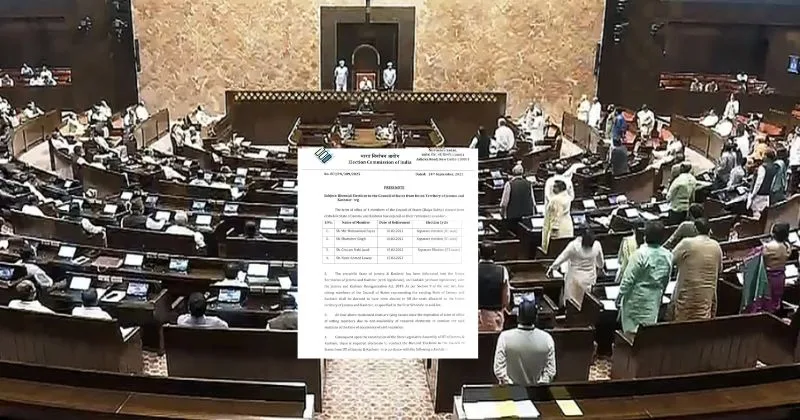
The Election Commission of India (ECI) has announced that elections to fill four vacant Rajya Sabha seats from the Union Territory (UT) of J&K will be held on October 24, a month from now. These seats have remained vacant for over four years now. Earlier, there was no elected Legislative Assembly in the Union Territory from 2018 to last year. Despite an assembly getting elected last year in August-September elections, the results for which were declared on October 8, 2024, the seats have remained vacant for a variety of reasons.
In the assembly elections held last year after a decade, 90 legislators were elected, but the effective strength of the House is 88 now. This has happened as Omar Abdullah got elected on a National Conference (NC) ticket from two assembly segments. Later, he vacated the seat he had won from a Budgam constituency and retained the Ganderbal seat. One BJP MLA, D S Rana, died soon after getting elected bringing the number of party legislators to 28 (from 29). By-elections to these two assembly segments have not been held till date, for a period of a full year.
Incidentally, Lieutenant Governor of J&K has powers to nominate five MLAs but these powers have not been exercised mainly due to opposition from the Congress and the NC. Technically therefore, the strength of the J&K Legislative Assembly is thus 95 (90 elected, plus five nominated).
ECI announces schedule for biennial Rajya Sabha elections to 4 vacant J&K seats.
Notification: Oct 6,
Nominations: Oct 13,
Scrutiny: Oct 14,
Withdrawal: Oct 16,
Date of Poll: Oct 24, Hours: 9AM-4PM
Counting : Oct 24, – AT 5 PM
Process ends by Oct 28,@ECISVEEP @SpokespersonECI pic.twitter.com/iJOzV1ExMt— CEO UT OF J&K (@ceo_UTJK) September 24, 2025
In August, the Union Law and Justice Ministry had turned down a proposal from the Election Commission to stagger the terms of the four seats from J&K. As a result, the elections for all these seats will have to be held together through one notification unlike the past. It needs to be mentioned here that three separate notifications were issued for these four seats one for two seats, and two more for other two seats.
As such, the electoral calculations done for the past Rajya Sabha elections held in J&K do not remain valid any longer. In the 90-member assembly, the ruling NC has 42 seats, with six members of the Congress supporting it from outside. Then there are three Peoples’ Democratic Party (PDP) legislators and a few independents.
The EC had sought a presidential order to ensure that one-third of the seats would retire every two years, in line with the Rajya Sabha’s structure. However, the Law Ministry had said that there was no provision in law to allow such an order to be issued.
The four Rajya Sabha seats from Jammu and Kashmir were vacant during the recently-held vice presidential elections in which BJP leader was elected. Members of Legislative Assemblies (MLAs) elect Rajya Sabha members of their respective states. In states with bicameral legislatures, MLCs also get to vote. However, the Legislative Council of J&K was abolished when it was made into a UT some years ago when the Central government abrogated Article 370 in August 2019.
Article 83 of the Indian Constitution lays down the duration of Parliament. It says that the Rajya Sabha (Council of States) is a permanent body and is never dissolved. Instead, one-third of its members retire every two years, and each member serves a six-year term. Thus a Rajya Sabha member has an additional year to serve as a parliamentarian as compared to an MP elected to the Lok Sabha.
The UT of J&K has been unrepresented in the Rajya Sabha since February 15, 2021, the day when Ghulam Nabi Azad, elected on a Congress ticket, and PDP parliamentarian Nazir Ahmed Laway finished their terms. Two other members, Fayaz Ahmed Mir of the PDP and late Shamsheer Singh Manhas of the BJP, had completed their terms on February 10, just five days earlier.
In all, there are six Rajya Sabha seats which are lying vacant at present, four from J&K, one from neighbouring Punjab and one from Jharkhand. The Punjab seat fell vacant after AAP leader Sanjeev Arora had to resign following his election to the state assembly in a recent by-poll. In Jharkhand, the demise of JMM leader Shibu Soren had created another vacancy in the Upper House.










Comments