





Politically, the reforms showcase Modi Govt’s ability to build consensus. Despite diverse political and fiscal interests, GST Council unanimously backed the new framework, a true reflection of cooperative federalism in action.
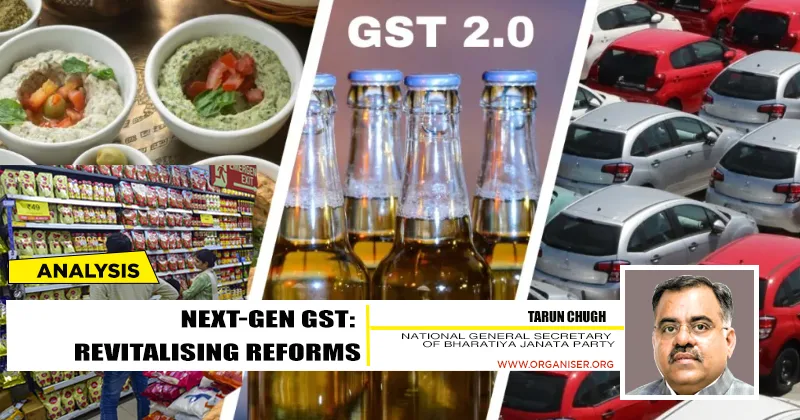
In a decisive and visionary move, our Government under Prime Minister Narendra Modi has delivered on its promise of a “double Diwali” for the nation with the landmark approval of Next Generation GST reforms. This sweeping overhaul, which simplifies India’s tax system into a modern two-tiered structure, is a testament to the Prime Minister’s steadfast commitment to citizen welfare and economic growth.
Far more than a technical adjustment, these reforms represent a bold reset of India’s fiscal architecture, one that is politically astute, economically potent, and socially inclusive. Industry bodies such as the Confederation of Indian Industry (CII) have hailed this move as a visionary step that empowers businesses while directly benefiting consumers through a simpler, transparent, and growth-oriented tax regime. Citizens will feel the impact in their household budgets, while businesses will gain from predictability and reduced compliance burdens.
Glimpse Into Historical Background
The idea of GST itself has a long history. It was first proposed by Atal Bihari Vajpayee’s NDA Government in 2000 when an empowered committee of State Finance Ministers was established to reform the sales tax regime. But the reform languished for years without serious follow through. It was only with Prime Minister Modi’s conviction and consensus-building approach that the dream of “One Nation, One Tax” finally turned into reality. Within two years of being tabled in Parliament in 2014, the GST-related 101st Constitutional Amendment was passed and ratified by the States, paving the way for the midnight launch of GST on July 1, 2017. This reform stitched together India’s fragmented indirect tax system, subsuming more than 17 taxes and 13 cesses into a single system. It eliminated the cascading tax-on-tax effect, eased interstate trade, and created a unified national market, fulfilling Sardar Vallabhbhai Patel’s dream of building an economically integrated India.
By its 8th anniversary on July 1, 2025, GST had proven its worth. India’s taxpayer base expanded from Rs 66.5 lakh in 2017 to Rs 1.51 crore in 2025. Revenues doubled in just four years, touching Rs. 22.08 lakh crore in Financial Year 2024–25, with an average monthly collection of over Rs. 2 lakh crore compared to just Rs. 82,000 crore in 2017–18. Compliance improved, evasion dropped, and MSMEs found formalisation easier. A Deloitte survey revealed that 85 per cent of respondents, including small enterprises, expressed satisfaction with GST, marking it as one of the most widely accepted structural reforms of the last decade.
Achieving Historic Consensus
The recent reform marks the most ambitious rationalisation since its introduction. At the 56th GST Council meeting, a historic consensus was reached to collapse the complex multi-slab structure into just two principal rates: 5 per cent for essentials and 18 per cent as the standard rate. Certain necessities have been exempted entirely while a special 40 per cent rate will continue for sin and super-luxury goods. This new structure will be implemented from September 22, 2025, and is nothing less than a re-engineering of the Indian tax system. Nearly 99 per cent of items previously under the 12 per cent slab are moving to 5 per cent, and about 90 per cent of goods taxed at 28 per cent will now fall under 18 per cent. This reform is not tinkering at the margins but a wholesale simplification that aligns India’s tax regime with global best practices, ensuring long-term stability, predictability, and direct relief to citizens.

The timing is as significant as the substance. India today faces global trade headwinds ranging from volatile oil markets to tariff wars. Instead of retreating, the Government has leaned into India’s biggest strength, its robust domestic consumption engine which makes up 61 per cent of GDP. The GST cuts are designed as a consumption-led booster shot to increase household disposable income, drive demand, and cushion external shocks. Rolling out just ahead of the festive season is deliberate and strategic, ensuring immediate benefits to consumers and stimulating spending during India’s peak demand cycle. The virtuous cycle that follows—higher consumption leading to higher production, larger tax base, and stronger revenues—will sustain the
broader growth story.
Bonanza for Households
For households, the relief is visible and immediate. A wide array of daily-use essentials has shifted to the 5 per cent slab or nil rate. Soaps, toothpaste, hair oil, shampoos, and shaving products are now cheaper. Packaged food like namkeens, biscuits, chocolates, jams, pickles, juices, and coffee have all dropped in rate, as have kitchen staples like butter, ghee, cheese, sugar, and dry fruits. Educational supplies such as exercise books, pencils, crayons, erasers, maps, and atlases have been brought to zero tax, making education more affordable for families. For the aspirational middle class, consumer durables such as air conditioners, refrigerators, dishwashers, and large TVs have shifted from 28 per cent to 18 per cent, while services like hotels, gyms, salons, and yoga sessions are now at 5 per cent, boosting both affordability and sectors like hospitality and wellness.
Sectors across the economy have been targeted with precision. Farmers benefit directly with tractors, harvesters, and irrigation equipment all moved down to 5 per cent, reducing their input costs and stabilising food prices. Medicines and life-saving drugs for cancer and rare diseases are now fully exempt, while all other medicines including Ayurveda, Unani, and Siddha are taxed at just 5 per cent. Diagnostic kits, thermometers and essential medical devices have also seen major reductions. For households, health and life insurance premiums have been exempted entirely, advancing the government’s long-term vision of Mission Insurance for All by 2047. Automobiles are another big winner, with two-wheelers up to 350cc and small cars now taxed at 18 per cent instead of 28 per cent. Three-wheelers, passenger vehicles, and auto components have all seen similar reductions, providing a much-needed push to both domestic demand and exports.
MSMEs, textiles, and handicrafts stand to gain immensely. Labour-intensive sectors like man-made fibres and artisan goods see duty corrections and lower rates, improving competitiveness and preserving rural livelihoods. Renewable energy adoption too will accelerate as solar heaters, cookers, bamboo flooring, and eco-friendly building materials now fall under the 5 per cent slab, aligning fiscal incentives with India’s COP climate commitments. Construction inputs like cement have been cut from 28 per cent to 18 per cent, reducing costs for housing and infrastructure, while materials like granite, particle boards, and wooden pallets have also seen reductions, easing the burden on small builders and the construction industry.
The reform is not just about rate cuts but about fixing long-standing structural issues. Inverted duty structures, which trapped working capital and hurt MSMEs, are being corrected. A new technology-driven GST registration scheme ensures approval within three days for 96 per cent of low-risk applicants, cutting red tape for small businesses and startups. Exporters, who previously faced months-long delays in receiving refunds, will now be reimbursed within seven days under a new enhanced mechanism. The introduction of E-Way Bill 2.0 with real-time synchronisation guarantees zero downtime for logistics operators, strengthening India’s digital backbone for trade and transport.
From Vajpayeeji’s pioneering idea in 2000 to Prime Minister Modi’s historic rollout in 2017 and now this bold rationalisation in 2025, GST embodies India’s journey of economic integration. It is the story of moving from a fragmented tax system to a unified and modern regime aligned with the dream of Viksit Bharat, a developed India. The Next-Gen GST is not just about simplifying tax rates, it is about reducing household burdens, spurring industry, encouraging MSMEs, empowering farmers, and making healthcare affordable. It is about stability, predictability, and fairness in taxation. Above all, it is about building a nation where growth and prosperity are shared by all citizens.
These reforms will be remembered as a landmark in India’s economic journey. They consolidate eight years of progress, double down on citizen welfare, and set the foundation for a stronger, more resilient economy. By simplifying processes, reducing compliance burdens, and easing the cost of living, the Modi Government has once again placed the common man at the heart of reform. The Next-Gen GST is not merely a fiscal reset but a historic step that will leave behind a lasting legacy of affordability, inclusivity, and prosperity for generations to come.
















Comments