




“Absorbing completely all the thought-currents of the West as well as the development of all indigenous thought-systems, Pt. Deendayal Upadhyaya spelt out ‘Integral Humanism’ which is the manifestation of Sanatana Dharma in keeping with requirements of the post-second-industrial-revolution period. That has to be the point of reference in the matter of national reconstruction. Dharma in practice comprises the unchanging, eternal universal laws and the ever-changing socio-economic order in the light of these universal laws”. – Dattopant Thengadi, Third Way, Sapt Sindhu Prakashan, Bangalore, 1998, p. 133
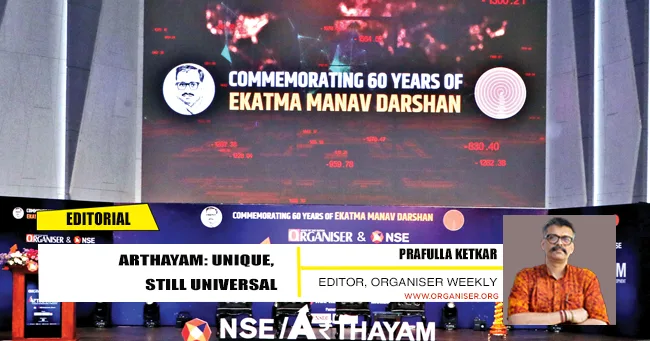
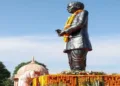
This year marks 60th anniversary of the landmark framework for governance and development propounded by Pt Deendayal Upadhyaya – Ekatma Manav Darshan (Integral Humanist Philosophy). When Deendayal Ji presented his thoughts, bipolarity based on Capitalism vs Communism was the norm. This theory of holistic development, entitled ‘Integral Humanism’, was adopted in 1965 as the doctrine of the economic philosophy of the Bharatiya Jana Sangh, aimed to overcome the prevailing shortcomings of Capitalism and Communism. Then, the Bharatiya Model of development was not even considered an option by intellectuals influenced by Western ideals. Today, when Communism has failed to provide an alternative to Capitalism that has been facing a cycle of crisis without any sustainable development, revisiting Deendayal ji’s Ekatma Manav Darshan framework to realise the quest for the Swadeshi model of development is no longer a choice but a necessity. In this context, Arthayam – the economic dimensions of the Dharmic model became the core theme for a day-long deliberation organised by Organiser Weekly in collaboration with the National Stock Exchange at the financial and economic hub of Bharat.
Nature and culture are two integral elements that shape the development model. According to the Integral Humanist approach, every nation and society has a distinctive consciousness and culture. Hence, any attempt to impose a one-size-fits-all approach will invariably be exploitative and unsustainable. After three decades of the American model of globalisation, this is all the more evident. The current model of globalisation is collapsing, but the alternative emerging is even more uncertain and destructive. In such a scenario, what is the relevance of Ekatma Manav Darshan? Can the wisdom of Vasudhaiva Kutumbakam provide economic an institutional alternative to the humanity? How can we address the emerging technological challenges and what are the policy initiatives based on Ekatma Manav Darshan? Deliberations on these questions would provide us a guiding light in this process, these and similar set of questions need an in-depth and consistent churning. What could have been a better place for this than Mumbai, where Deendayal Ji articulated his thoughts for four consecutive days in the year 1965?
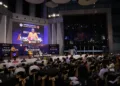
The day-long confluence brought together thinkers, investors, planners, policymakers, and economists to revisit Ekatma Manav Darshan in the post-globalisation world and deliberate on the Dharmic model of development. The practitioners presented their experiences on the ground, reiterating the conviction that Ekatma Manav Darshan is not just a philosophy but a living reality of Bharat. Strategic thinkers and policymakers highlighted the global expectations in the era of strategic and technological turbulence.
As Dattopant Thengadi, the profound commentator and practitioner of Ekatma Manav Darshan after Deendayal ji articulated, “The Hindu Seers visualised the emergence of the World State enriched by the growth and contribution of different national cultures as well as the flowering of the ‘Manav Dharma’ enriched by the perfection of all the religions including materialism”. It is the only familial model which allows every member of the global family to retain its originality while accepting universal values. Diversity is celebrated as a manifestation of the same cosmic energy, rather than as differences based on artificial borders of languages and ethnicities. When the world is undergoing regional conflicts, economic instability, environmental degradation, and technological transition, these Dharmic ideas of Bharat can serve as a guiding force – only if we accept the intellectual and policy challenge of making them contemporary and universal while retaining their uniqueness.
The best way to pay tribute to the Rishis, like Pt. Deendayal Ji, is to internalise, imbibe, and actualise the vision he stood for. Deendayal Ji prescribed a comprehensive philosophy for the socio-economic and cultural reconstruction of Bharat, departing from the colonial Western institutions aiming to make Bharat subservient to the Western cause. The Arthayam conclave was an attempt to envision that process by revisiting the fundamentals of Ekatma Manav Darshan and its contemporary relevance. It was not just an event, but a process to celebrate the unique Dharma-based model of Bharat and eventually universalise it.












Comments