





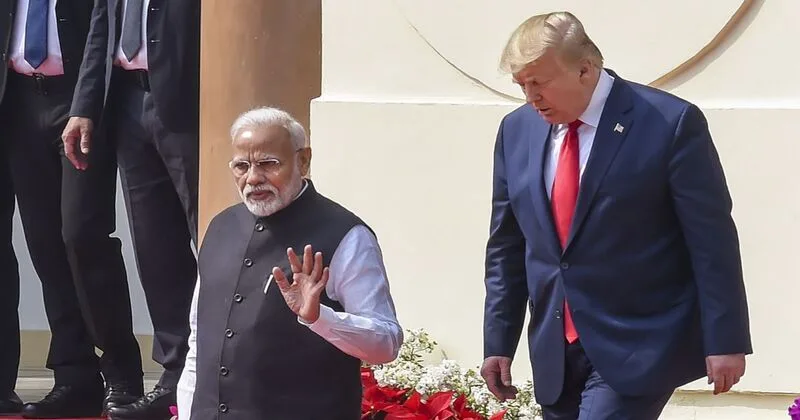
Prime Minister Narendra Modi received a phone call from US President Donald Trump on his 75th birthday. The call came shortly after a US trade delegation led by Assistant Trade Representative for South Central Asia Brendan Lynch held constructive talks with the Union Commerce Ministry in New Delhi on September 16. Union Commerce Minister Piyush Goyal also travelled to Washington on September 22 for further discussions. These developments signalled the first signs of a thaw in the Indo-US trade dispute. At a press conference in Washington, Trump described Modi as a “great leader” before his birthday greetings. This comes at a time when a German newspaper reported that the US President had tried unsuccessfully to contact Modi several times after imposing a 50 percent import tariff on India in August. Modi’s decision to take Trump’s call on his birthday was therefore viewed as a gesture that New Delhi was prepared to resolve disputes through dialogue.
The Trump administration has repeatedly accused India of undermining Western sanctions by importing oil from Russia, framing New Delhi’s purchases as indirect funding of the Russia–Ukraine war. In retaliation, Washington imposed an additional 25 percent punitive tariff on Indian goods on top of the earlier 25 percent levy, effectively doubling import duties. All trade talks with India were initially suspended, with US officials warning that discussions would resume only if Russian oil imports were halted.
India, however, adopted a firm stand. It stressed that cheap Russian oil was essential for its energy security, and argued that both Europe and the United States continued to maintain significant trade relations with Moscow. New Delhi indicated it would not give in to unilateral pressure. Trump further claimed that he had mediated to end “Operation Sindoor,” a reference that only deepened mistrust in India.
Meanwhile, other punitive steps were taken. India was placed on Washington’s list of countries allegedly linked to drug smuggling into the US. The waiver India had enjoyed since 2018 on sanctions related to Iran’s Chabahar port was revoked and H-1B visa fees for Indian professionals were hiked. The cumulative effect of these moves, coupled with tariffs, was widely seen as an attempt by Washington to force India into compliance. Yet, New Delhi’s defiance underscored that America could no longer dictate terms unchallenged.
Indian diplomacy outplays the calculations of the global police
New Delhi’s diplomacy was swift and sharper than Washington had anticipated. When the 25 percent tariffs came into effect on August 1, 2025, the Ministry of External Affairs issued a statement within days, on August 4, exposing Western double standards.
India highlighted that the European Union’s trade with Russia remained far larger than India’s. In 2024, EU–Russia bilateral trade stood at €67.5 billion, while in 2023, trade in services alone totalled €17.2 billion. In 2024, Europe imported 16.5 million tonnes of Russian LNG, up from 15.21 million tonnes in 2022. The EU also depended on Russia for fertilisers, mining products, chemicals, iron and steel, machinery and transport equipment. India pointed out that the US, too, continued to source uranium hexafluoride for its nuclear sector, palladium for electric vehicles, and chemicals and fertilisers from Russia. Moreover, Washington had imposed lower tariffs on China, despite Beijing being the single largest importer of Russian oil. The statement drove home the contradiction in US policy.
New Delhi also found support abroad. Brazilian President Luiz Inacio Lula da Silva telephoned Modi soon after the tariffs, expressing solidarity. Brazil too was hit with a 50 percent duty. India’s firm stance after the higher punitive duty came into effect on August 27 was reinforced by high-level visits. The very next day, National Security Advisor Ajit Doval was in Moscow, while Modi’s Chinese visit to attend SCO summit was announced. Although the trips were pre-planned, they acquired strategic symbolism. Soon after, External Affairs Minister S. Jaishankar also visited Russia, emphasising that India would not compromise on national interests. Reports of expanding defence cooperation with Moscow further rattled Washington.
The Prime Minister’s back-to-back visits to Japan and China further underlined India’s diplomatic balancing. His stop in Tokyo demonstrated continued ties with a key US ally. But his subsequent journey to China for the Shanghai Cooperation Organization (SCO) summit was more consequential. At the summit, the SCO collectively rejected Pahalgam terror attack, even in the presence of Pakistan’s Prime Minister. This was a diplomatic setback for US-backed Islamabad. Modi also held bilateral talks with both Russia and China, reaffirming India’s independent foreign policy posture. His camaraderie with President Vladimir Putin was noted with displeasure in Washington. Simultaneously, India worked to diversify economic partnerships. A free trade agreement was signed with Britain, negotiations with the European Union were intensified, and relations with Canada improved. Crucially, European capitals declined Trump’s appeal to impose 100 percent import duties on India.
India also broadened its export reach to fifty new countries in response to American tariffs. Meanwhile, oil imports from Russia continued to climb—from 1.59 million barrels per day in July to 1.66 million in August, and 1.73 million by mid-September. Later reports suggested an additional 300,000 barrels per day were being purchased. India also emerged as the largest supplier of diesel to Ukraine, accounting for 15.5 percent of its total diesel imports in July. Washington attempted to apply further pressure by threatening tariffs on Indian pharmaceuticals and restrictive measures in the IT sector. Yet none of these steps succeeded in forcing a change in New Delhi’s stance.
Tariff war backfires and exposes cracks in American power
While India absorbed the tariff shock, the US economy began showing signs of strain. Inflationary pressures grew steadily. Retail inflation, measured by consumer prices of everyday goods, rose from 0.2 percent in July to 0.4 percent in August, the sharpest monthly increase since Trump returned to power. Expectations of 0.3 percent were overshot. Year-on-year, inflation touched 2.9 percent, an eight-month high. Core inflation, excluding volatile food and energy, hit 3.1 percent, well above the US Federal Reserve’s 2 percent target.
Criticism mounted at home that Trump’s aggressive tariff war had needlessly soured ties with India, a key strategic partner. Many US politicians warned that worsening relations with New Delhi risked undermining broader American influence in Asia. Under pressure, Trump himself appeared eager to reopen dialogue, culminating in the birthday call to Modi.
The unfolding dispute offered a window into shifting global power equations. In the 1990s, after the collapse of the Soviet Union, the United States stood unchallenged as the world’s sole superpower. Its military interventions in Afghanistan in 2001 and Iraq in 2003 showcased unrivalled dominance.
But the tariff war with India revealed how far that dominance had eroded. Washington’s inability to compel New Delhi to abandon Russian oil, its failure to rally allies to impose harsher measures on India, and the visible economic costs at home all highlighted the decline of unilateral American power.
For India, the tariff war became an opportunity to assert strategic autonomy. Through deft diplomacy, outreach to multiple partners, and refusal to bow under pressure, New Delhi projected itself as an emerging pole in a multipolar world order. For the US, the episode reinforced the perception that its era of unchallenged hegemony was drawing to a close.










Comments