





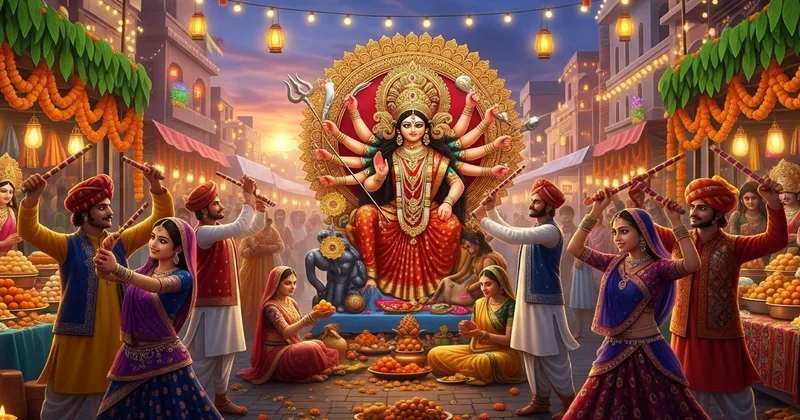
The various festivals observed over the years according to Hindu Dharma have many elements, including scientific, spiritual, social, economic, and health parameters. Navratri, like other festivals, is widely celebrated throughout the country and in many other countries. Navratri has a clear message for all those who believe in “Bharatiyatva”: “Shatru Bodh” is an essential factor in keeping the nation safe from adversaries, followed by valour to build individual and social strength, and most importantly, developing a victorious mindset when we have to fight against Adharma to uphold dharma. In short, the nine Devis teach us to celebrate life with awareness, courage, and a victorious spirit.
Navratri is not only a Dharmic celebration, but it also has agricultural implications in many parts of Bharat. It signifies the conclusion of the monsoon season and the start of harvest. Many farmers celebrate Navratri as a time to seek blessings from the goddess Durga for a bountiful crop, combining spirituality with the agricultural calendar. One of the distinguishing features of Navratri is its regional diversity. with West Bengal, the event culminates with Durga Puja, an elaborate and magnificent celebration of the goddess Durga. In Gujarat, the festival is associated with Garba and Dandiya Raas, two energetic dance traditions that are central to the festivities. In Tamil Nadu, Navratri is celebrated with the presentation of Golu, or artistic arrangements of dolls. This cultural flexibility illustrates the festival’s capacity to cross geographical and social boundaries while adhering to its essential objectives. Navratri represents the unity in diversity that defines Bharat. Although the event is celebrated differently in different places, its essence remains the same: it brings people from varied backgrounds together to enjoy. This cultural mosaic represents Bharat’s larger social fabric, in which tradition and modernization live peacefully.
What message does nine Devis convey to our communities?
Navaratri is all about the various Devis. Some of them are very sensitive and lovely. Some of them are fearsome, revolting, or terrifying. This is the only culture that celebrates women who rip your head off. This is because we did not wish to compromise one’s intelligence, creativity, genius, or other ability solely for the sake of good behavior. We must also fight against Breaking Bharat elements that seek to ruin the magnificent culture and national integrity. Sensitivity and love are the foundations of our Dharma, yet becoming blind to detrimental factors caused us to suffer greatly as a nation socially, economically, and culturally, thus Ma Durga should also be recognized for instilling courage and a victorious spirit. The most crucial aspect of human development is for a person to reach their maximum potential as a living being. These nine days are dedicated to that, and the tenth day is Vijayadashami, which signifies the day of victory. That implies you have blossomed!
These nine days and nine Devis teach us a valuable lesson about being vigilant every day and protecting our families, society, and nation against internal and external evil forces that seek to ruin our beautiful culture and nation. Peace, prosperity, growth, and celebration of life are only conceivable if every member in society is strong enough to combat the breaking Bharat forces that strive for selfishness. “Vasudhaiv Kutumbakam” does not imply that we accept antisocial characters, religious zealots, and terrorists in order to show the world faux humanity and hence infiltration of Pakistani, Bangaladeshi, Rohingya Islamic extremists should be stopped. Humanity does not imply demolishing the existing social fabric and a nation of over 100 crore to accommodate antisocial elements that are antihuman.
Killing of Mahishasura
Mahishasura, one of the deadliest daemons, did rigorous penance in order to obtain a boon that would protect him from being killed by a male, but he underestimated the might of the female form and began wreaking havoc all over. To stop him, Shakti took on the appearance of Ma Durga and promised to marry him if he defeated her in combat. Ma Durga is said to have killed Mahishasura on the tenth day of their nine-day struggle. As a result, the tenth day is known as Vijayadashmi, or “Victorious Day.” One of the most famous idols in temples depicts Ma Durga slaying Mahishasura, who appears as a half bull.
Dandiya is also known as “THE SWORD DANCE”. It is the performance of the combat between Maa Durga and Mahishasura using intense dance and movements. The dandiya sticks represent the swords used by the two during their combat. The musical background instruments, such as dhol and percussion, represent the metallic clangs heard on battlefields. Dandiya’s moves are much more sophisticated and intricate than Garba. Garba represents the beginning of life, whilst Dandiya represents the end of evil. Both are required for the Navratri Puja, and one is considered incomplete without the other.
While Garba is performed at the beginning and before the aarti, Dandiya is played after the aarti as a means of satisfaction and completion. The steps to garba are calming, as are the lyrics, however Dandiya songs have much more beat and excitement. Both are odes to Ma Durga, one in her sweet, compassionate loving form as the universe’s mother, and the other as a powerful warrior who destroys all evil.
Three Gunas Relationship with Nine Devis
Durga, Lakshmi, and Saraswati are considered three dimensions of the feminine, representing the earth, the sun, and the moon, or tamas (inertia), rajas (activity, passion), and sattva (transcendence, knowledge, purity). Those seeking strength or power worship feminine deities such as Mother Earth, Durga, or Kali. Those seeking prosperity, passion, or material possessions worship Lakshmi or the sun. Those seeking wisdom, dissolution, or transcendence of the constraints of the mortal body worship Saraswati or the moon. The nine days of Navratri are grouped based on these fundamental characteristics. The first three days are dedicated to Durga, the following three to Lakshmi, and the final three to Saraswati. The tenth day, Vijayadashami, represents triumph in all three spheres of life.
The first three days of Navratri are called tamas, and the goddesses are violent, such as Durga and Kali. Tamas represents the nature of the Earth, and she is the one who gives birth. Tamas refers to the gestation period in the womb. It is a state similar to hibernation, except we are growing. So tamas is the essence of the Earth and our birth. You’re sitting on the earth. You must simply learn to become one with her. You are already a part of her. When she wants, she throws you out; when she wants, she takes you in.
When Rajas arrives, you want to do something. When you begin doing something, if there is no awareness or consciousness, the nature of rajas is such that it is fine as long as the going is good. When things get bad, Rajas is going to be extremely bad. A rajasic individual has a lot of energy. It just needs to be channelized properly. Every action you take can result in either liberation or entanglement. If you perform a task with complete willingness, it is lovely and brings you delight. When you are deeply engrossed in something, nothing else exists for you. Passion denotes uncontrolled involvement with something. It might be anything: you could sing, dance, or simply walk enthusiastically but passion to keep Nation first should be permanent.
Moving from tamasic to sattva implies improving your physical, mental, emotional, and energetic bodies. If you polish this to the point where it is completely transparent, you will be unable to ignore the source of creation that exists within you. Right now, it is so opaque that you can’t see. The body has transformed into a barrier that prevents all communication. Something incredible – the source of creation – is sitting here, yet this wall can obscure it since it is so opaque. It is time to improve it. Otherwise, you’ll just know the wall, not who lives inside.
Benefits of Navratri Festival
Inner Cleansing: Fasting and self-control serve to remove bodily and mental impurities, allowing for spiritual progress.
Self-reflection: Navratri provides an opportunity to reflect, discover our inner demons, and attempt to overcome them.
Cultivating Virtues: During the Bharatiya holiday of Navratri, devotees attempt to nurture the virtues personified by the Navadurga within themselves, becoming more compassionate, courageous, victorious and wise in the process.
Awakening Shakti: Shakti, the divine feminine force, is the creative and transformational energy inside all beings. Navratri is a moment to awaken this Shakti and harness its enormous potential.
Building Community: The festival brings people together to pray, celebrate, and share prasad. This promotes a sense of community and improves social relationships.
Let us celebrate the celestial occasion with awareness, courage, solidarity among the masses, and a victorious mindset against the Breaking Bharat forces.













Comments