





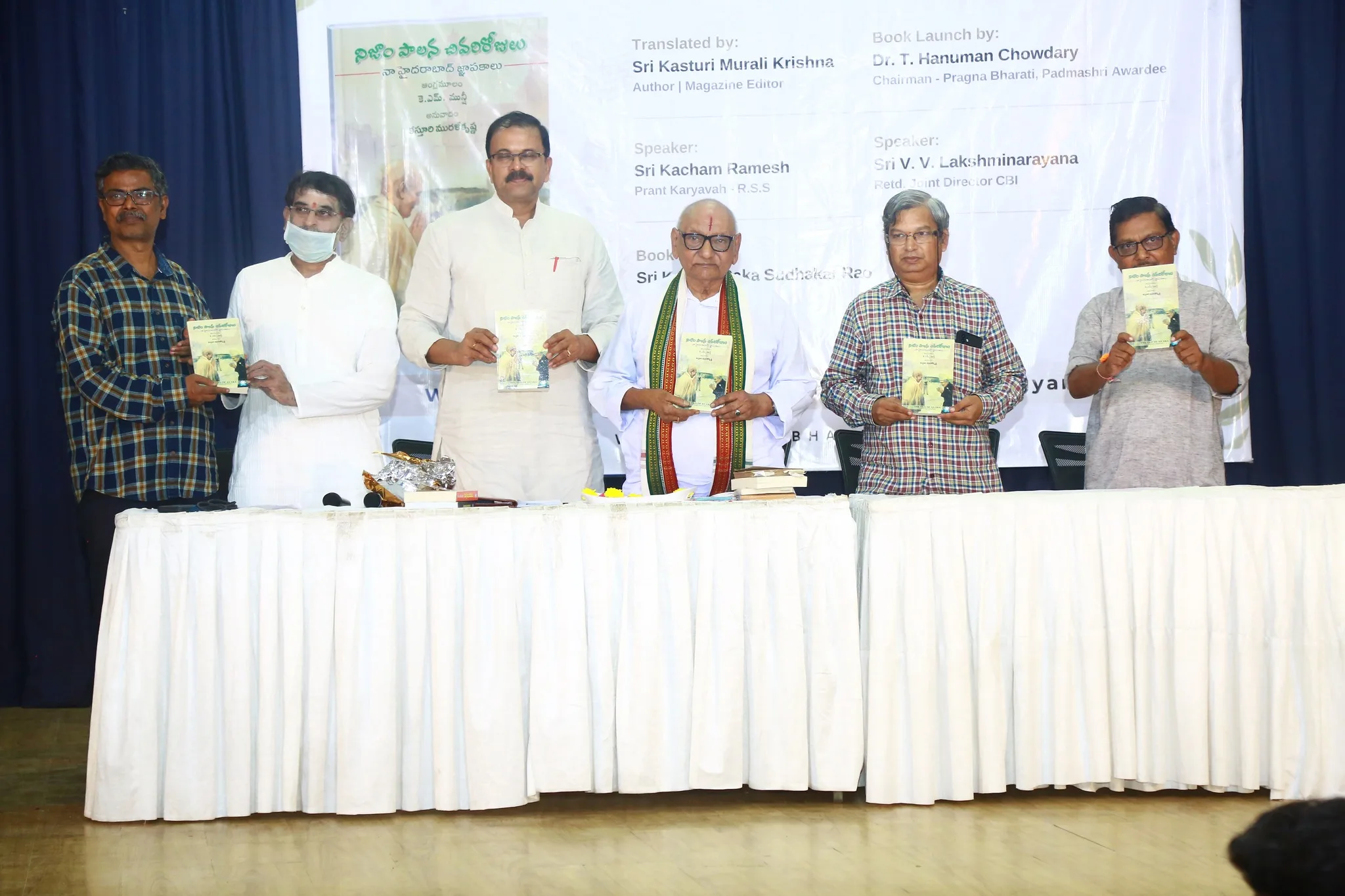
“Festivals and marriages required permission under the ‘Gasti Nishan’, and marriages during Moharram were disallowed. Those who praise the Nizam today do not understand how millions of Hindus lived under suppression,” said Raka Sudhakar Rao, author and producer of the Rakalokam YouTube channel, at a book launch event in Hyderabad on September 17.
The occasion was the release of Nizam Palana Chivari Rojulu, the Telugu translation of K.M. Munshi’s seminal work End of an Era, translated by Kasturi Murali Krishna. Organised by Pragna Bharati at Badruka College, the programme coincided with the 77th anniversary of Hyderabad’s Liberation Day, commemorating Sardar Patel’s decisive military campaign, Operation Polo, that integrated the princely state into the Indian Union in 1948.
Hyderabad Liberation Remembered
Padma Shri awardee Tripuraneni Hanuman Chowdary, chairperson of Pragna Bharati, in his opening remarks, traced the events leading up to Hyderabad’s liberation. He recalled the Nizam’s one-year Standstill Agreement with the Indian Union in November 1947 and dismissed what he described as the Communist falsehood that the event was a “merger” rather than a “liberation.” He added that Communists continued their rebellion against India until 1951, ending only after Stalin warned that Hyderabad could not exist independently in the heart of the country. Hanuman Chowdary also shared his personal memories of K.M. Munshi, highlighting his role as founder-chairperson of Bharatiya Vidya Bhavan.
Fragmented Histories
Sudhakar Rao, in his address, emphasised that Hyderabad’s liberation not only freed the state but also liberated millions of Hindus from severe restrictions. He pointed out that after 1948, the state was divided into Telangana, Maharashtra and Karnataka, fragmenting its history across regional literatures.
He recalled harrowing episodes, such as the burning alive of 200 Arya Samajis in Gorta, Karnataka, and the imprisonment of Triambak Rao Pathak of Nizamabad, whose wife urged him to sell her mangal sutra to buy a rifle. He spoke of Basava Manaiah, dismissed by Nehru as a madman for rebuilding a market destroyed by the Razakars, and praised the services of Alwal Bal Reddy, who reconverted Hindus forcibly converted to Islam. Bal Reddy’s great-grandson, Devender Reddy, was present at the event.
Countering Distorted Narratives
Sudhakar Rao criticised works like A.G. Noorani’s Destruction of Hyderabad, which blames the Indian Union, and noted that divisive narratives were deliberately propagated for decades. He lamented that the Andhra Pradesh government’s 1966 four-volume Freedom Struggle in Hyderabad reduced Munshi’s contribution to just two sentences, and pointed out that the much-touted Sundarlal Committee was never an official body.
Lessons from History
Former CBI Joint Director V.V. Laxminarayana spoke about the importance of preserving historical truth to avoid repeating past tragedies. He said the exploitation and oppression during the Telangana uprising made harrowing reading and warned that casteist and sub-regionalist sentiments being stoked today mirror earlier divisions.
Translator’s Reflections
Author and translator Kasturi Murali Krishna described the process of obtaining permissions from Bharatiya Vidya Bhavan and thanked B.S. Sarma and V.V. Laxminarayana for their support. He expressed gratitude to Pragna Bharati for hosting the launch, which was presided over by B.S. Sarma.










Comments