





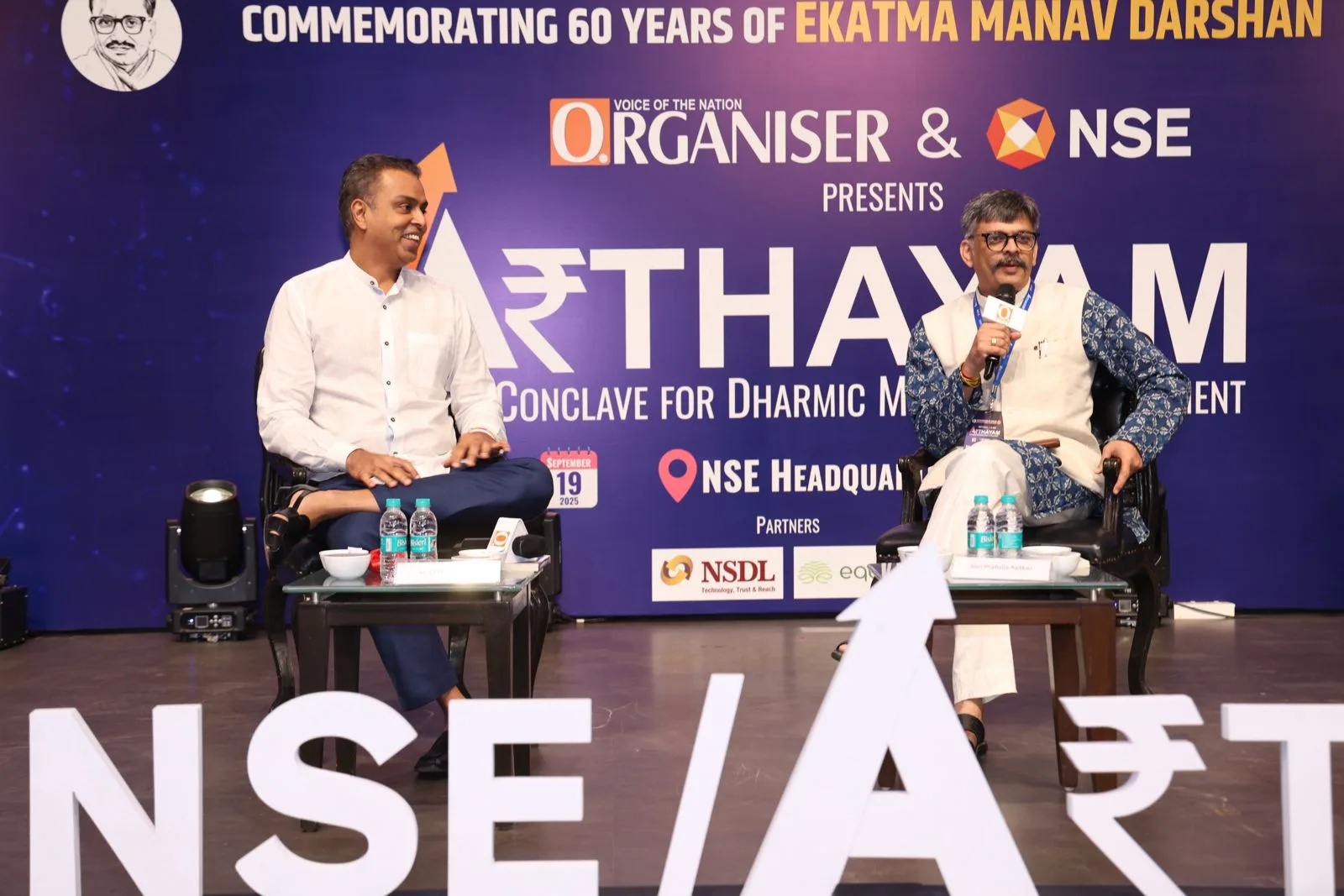
The Arthayam Conclave, jointly organised by Organiser and the National Stock Exchange (NSE) in Mumbai on September 19, marked sixty years of Pandit Deendayal Upadhyaya Ji’s philosophy of Ekatma Manav Darshan. The conclave was designed to reimagine Bharat’s developmental and global journey through the prism of Dharma, culture, and sustainability.
One of the most engaging sessions of the day unfolded in the form of a candid Q&A with Shri Milind Deora, Member of Parliament (Rajya Sabha). Speaking on the theme “Democracy and Diplomacy in the Turbulent World,” Deora shared a mix of policy insights, personal experiences, and cultural reflections, offering the audience a grounded yet forward-looking perspective on India’s place in today’s shifting global order.
The interaction touched upon pressing questions of trade, fiscal policy, global strategic alignments, rare earth dependency, America’s foreign policy, and India’s vision for 2047. What stood out was Deora’s ability to weave in anecdotes from his parliamentary delegations abroad with a clear sense of realism about India’s opportunities and challenges.
India’s position in the global trade order
The session began with a question on Deora’s earlier remark that tariffs could be a “blessing in disguise” and how India should position itself in today’s world. Deora responded with the authority of someone who has observed geopolitics up close.
He recalled his visits to Africa, Southeast Asia, and most recently, South America. “Whether it is Papua New Guinea, Brazil, or Colombia, every single country is tired of the Chinese model. They want India to offer them an alternative,” he added.
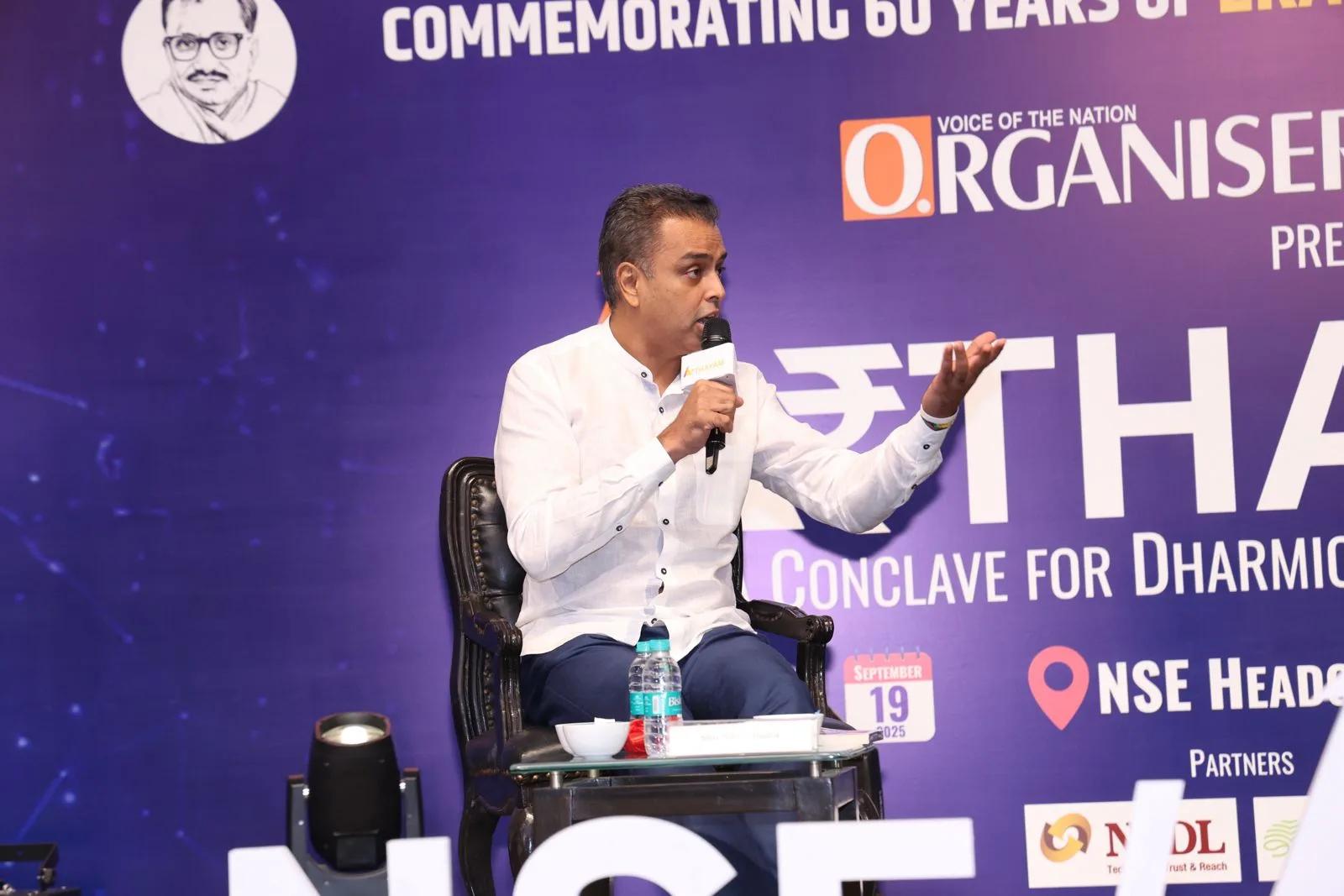
Deora argued that India’s globalisation in 1991 was not an act of choice but of compulsion. “We did not globalise because of technology; we globalised because our hands were tied. Today, we need to globalise on our own terms,” he said. For him, the two imperatives are clear, strategic innovation and a strong economy. “Only then will India command genuine respect globally,” he concluded.
Fiscal federalism and capital formation
When asked about fiscal challenges and his role in the Parliamentary Standing Committee, Deora called the question “very political” but responded with candour.
He compared the United States debt-to-GDP ratio of 120 percent with India’s 80 percent, warning that India cannot afford to be complacent. “Yes, our GDP is doing well. But how do we increase revenue while respecting federalism? That is the real question,” he noted.
He stressed that while reforms such as creating a unified market were important, India must strike a delicate balance between raising revenue, empowering states, and ensuring capital formation. “This is where politics meets economics and where prudence becomes most necessary,” he added.
Rare earths and reducing import dependency
On the question of reducing India’s dependency on critical imports like rare earth metals, Deora struck an optimistic tone. He highlighted how India is diversifying its industries and moving towards Atmanirbharta.
“We were once a net importer of defence equipment; today we are on the way to becoming exporters. Similarly, jobs are now being created in electric vehicles, renewable energy, and new-age industries,” he pointed out.
He hailed the government’s move to open the mining sector and encourage recycling of rare earths used in solar panels and wind turbines. “With the right push, India can become a global hub in rare earth extraction and recycling,” he said, underlining how such policies directly tie into job creation and global competitiveness.
U.S. foreign policy, Pakistan and Operation Sindoor
The discussion then shifted to America’s approach post-Operation Sindoor and its continuing engagement with Pakistan. Deora was forthright: “Tariffs are nothing but Dadagiri. I must credit the Prime Minister, 100 out of 100 marks for standing firm in the face of what could have been a major threat.”
Deora explained that America’s foreign policy today is increasingly shaped by domestic compulsions, from the fallout of 9/11 to the debate over illegal immigration. “Whether it is Republican or Democrat, shocks will keep coming. India needs a long-term strategy to weather them,” he said.
He warned of Saudi Arabia’s growing ties with Pakistan but also pointed to India’s own counter-strategy through the Chabahar Port in Iran, which opens the door to Afghanistan and acts as a counterweight to China’s CPEC.
Interestingly, Deora also brought culture into the conversation. “America has an obesity problem. Why can’t we promote Dharmic and Sattvik food globally? That too is soft power. That too is diplomacy,” he remarked, to applause.
Parliamentary diplomacy and brand India
Reflecting on his experience leading parliamentary delegations, Deora recalled the advice of his father, the late Murli Deora. “He always told me, politics and party are secondary; the nation comes first,” he said.
He praised colleagues like Shashi Tharoor for their clarity in international forums but also acknowledged the complexities of engaging with countries unfamiliar with India’s security challenges. “Latin America, for example, has no real understanding of radical Islamic terrorism. You need a different tone there,” he explained.
At the same time, he credited the Modi government for “holding the Indian brand with pride on the world stage.” According to him, this ability to project national confidence has strengthened India’s diplomatic standing.
Vision for 2047: India’s dharmic advantage
The final question centred on India’s vision for 2047, especially in a world where democracies appear increasingly fragile. Here, Deora was most philosophical.
“We should never be ashamed of our model. The West is struggling with dualism, they cannot reconcile internal differences. But India has always had Advaita, the philosophy that resolves duality. That unseen sword is what saves us,” he explained.
For him, India’s Dharmic ethos, rooted in pluralism and philosophical resilience, is not just cultural heritage but a strategic advantage. “While the West falters, we will endure. That is Bharat’s real strength,” he declared.
The session ended with applause from the audience, who were struck by Deora’s mix of realism, conviction, and cultural confidence. His responses reflected both a parliamentarian’s grasp of policy and a civilisational perspective on India’s role in the world.
In many ways, the session embodied the spirit of Arthayam, that India’s diplomacy, economics, and development cannot simply imitate Western templates but must emerge from its own Dharmic and cultural foundations, the true sense of Ekatma Manav Darshan.













Comments