





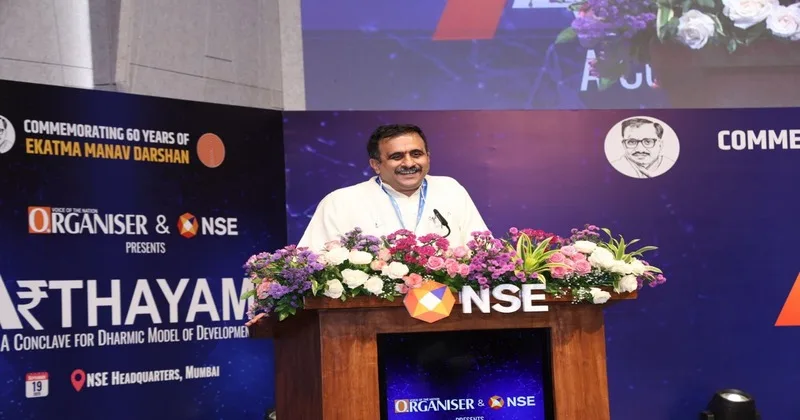
“That the ideas of Ekatma Manav Darshan and Pandit Deendayal Upadhyaya are being discussed in the office of NSE itself shows that Bharat is changing, awakening, returning to its roots and preparing to guide the world”, said Mukul Kanitkar, Akhil Bharatiya Karyakarini Sadasya of Rashtriya Swayamsevak Sangh, at the valedictory session of Arthayam: A Conclave For Dharmic Model of Development, held at NSE Headquarters, Mumbai.
Mukul Kanitkar reminded that when Sangh sent Pandit Deendayal Upadhyaya into politics, it was with the conviction that for neeti (policy) to be meaningful, it must stand on the firm foundation of darshan (vision). Without darshan, there can be no true politics.
Explaining the concept of Arthayam, he said, “Arth means Parakram, arth also means upadan (production), that is why in Chanakya’s Arthashastra, arth was not just economics but also political science, because governance in Bharat was always integral to economics. Together they became Arthashastra. Pandit Deendayal Upadhyaya called this dimension of life Arthayam, the economic dimension of existence.”
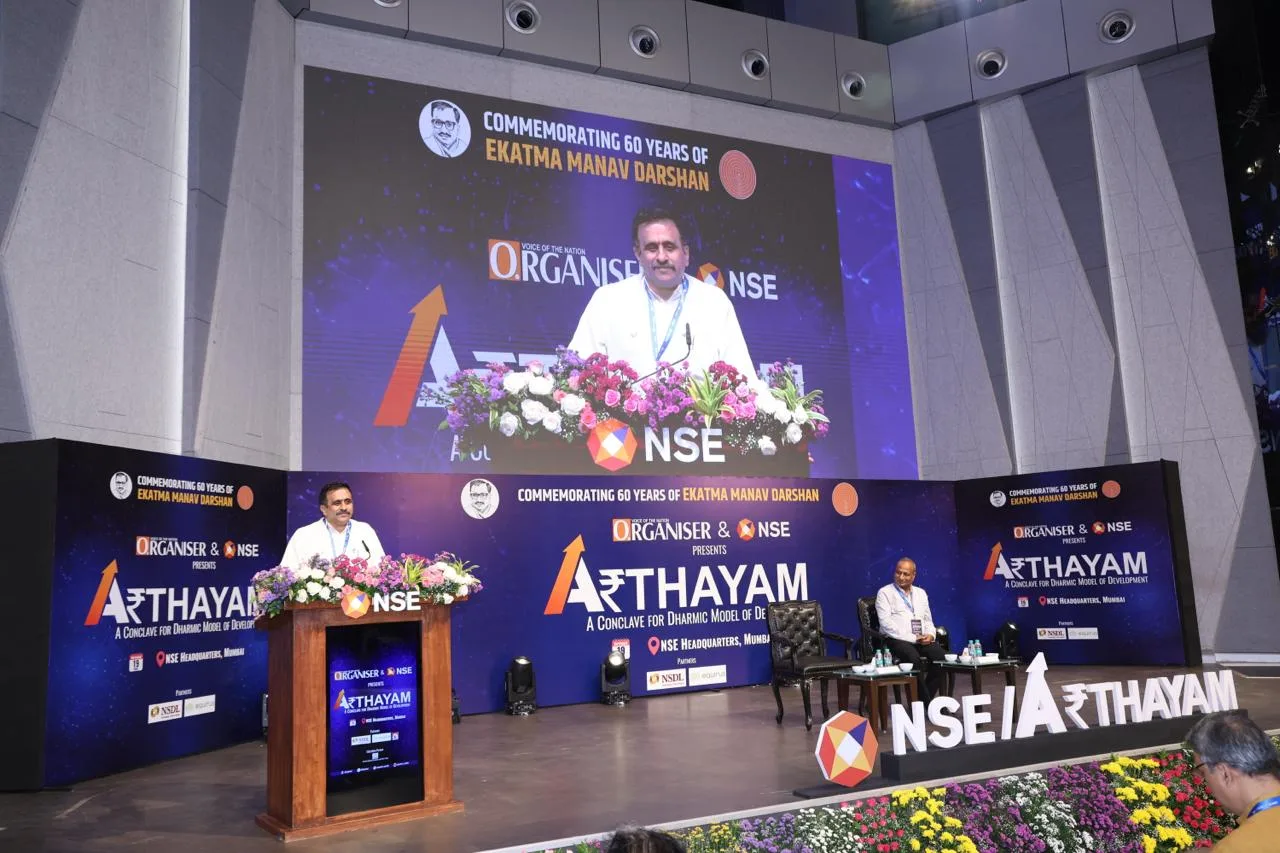
Quoting Chanakya, he said that the purpose of life is sukh (happiness). Bhagwan Buddha also declared that man lives only to attain sukh. Every human being ultimately desires sukh, so much sukh that dukh (sadness and problem) may never approach him.
“Sukh has its root in Dharma. Dharma has its root in Arth. Arth has its root in rajya. Rajya rests on indra vijay. From indra vijay comes vinay, from vinay comes vridhi, then Vigyan and through vigyan it culminates in jitatma (self-conquest). Without winning over the self, no sukh can be attained.”
Thus, if sukh is the aim of life, then every neeti, drishti, disha, path must ultimately lead to sukh. The path of sukh has two sides — kaam and arth. Kaam means iccha (desire) and its fulfillment. Arth is the effort undertaken to fulfill these rightful desires, he said.
He further said that, “here lies the difference between manushya and pashu. The animal is bound by programmed instinct, like Artificial Intelligence, it has limitations. Manushya, however, has the capacity to shape iccha in the light of dharma”.
Quoting Bhagwan Krishna from Vibhuti Yog, Mukul Kanitkar said, “In the life of man, desires that are not against Dharma.” He explained that Bhagwan Krishna did not say “desires according to Dharma”, but dharma-aviruddha bhooteshu kaam (desires not opposed to Dharma). That is why Shiksha (education) is to inculcate the sanskar that a person does not even generate such desires which cause harm, which are beyond his capacity, or which are not for welfare.
When desires arise in accordance with Dharma, the effort to fulfill it is Arth, and that Arth becomes Arthayam. Therefore, Arth too must remain aligned with Dharma, he said.
He further underlined that this is why Bharat’s task is to show the path to the world. “One born in this land (Bharat) is an ‘agrajanma’. As the Bhagwat Gita says, after roaming through 84 lakh yonis one gets human life. Swami Vivekananda had proclaimed at Lahore that when that punya doubles one is born in Bharat. Taking birth in this land itself is a privilege, Dharma automatically comes to you here through sanskar.”
Hence, Bharat’s aim is to give this Dharma to the world, not merely through lectures, scriptures, or models, but by behaviour and actions. That is the mission of this land, he said.













Comments