





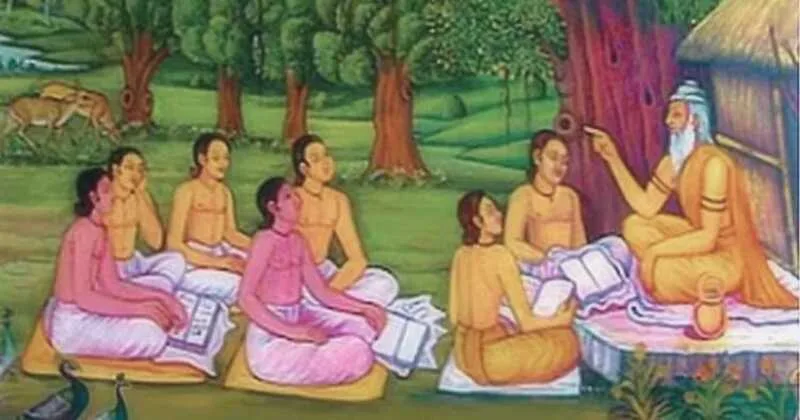
In every civilisation, the role of the teacher determines the destiny of the nation. In Bharat, this role transcends the classroom and is rooted in the eternal Guru–Shishya parampara. Teaching today is often dominated by technology, transnational schooling models, and a rush for information rather than wisdom. Yet, the Bharatiya understanding of the Guru has always been profound: “Gu” signifies ignorance and “Ru” is the dispeller of that ignorance. True knowledge, as our scriptures remind us, is “Sa Vidya Ya Vimuktaye”—that alone is knowledge which liberates.
The legacies of our Gurus are not limited to imparting lessons but to shaping Bharat’s destiny. They produced leaders who upheld dharma, inspired civilisational resilience, and guided the nation toward its role as Vishwaguru—a spiritual guide to the world.
The Guru in Bharatiya Parampara
Across millennia, the Bharatiya imagination has revered the Guru as a sculptor of character, a torchbearer of wisdom, and a guide to self-realisation. Education in this tradition is not passive transmission; it is Deeksha—a sacred initiation into wisdom, dharma, and inner awakening. The Guru Stotram beautifully encapsulates this paradigm:
“अखंड मंडलाकारं व्याप्तं येन चराचरम् ।
तत्पदं दर्शितं येन तस्मै श्री गुरवे नमः ॥”
(Salutations to the Guru, who revealed to me the supreme truth that pervades the entire universe.) Civilisational history affirms this bond: Lord Ram received guidance from Vashishtha and Vishwamitra; Krishna from Sandipani; Parshuram from Shiva; and Buddha from Alara Kalama. Likewise, Chandragupta Maurya rose as a Chakravarti Samrat under Chanakya’s mentorship; Swami Vivekananda found direction in Ramakrishna Paramahansa; Shivaji was inspired by Samarth Guru Ramdas; Sant Kabir by Ramananda. These stories highlight an eternal truth—behind every transformative leader stood a Guru, the invisible architect of destiny.
Teachers as the Nation’s Soul: Lessons from Chanakya and Vivekananda
Chanakya epitomised the teacher as a nation-builder. For him, the Guru was not confined to academic instruction but to shaping rashtriya charitra (national character). His dictum remains timeless: “A teacher is never ordinary; both destruction and creation rest in his lap.” He envisioned Gurus as custodians of knowledge (shaastra) and defenders of the nation (shastra), whose mission was to instil unity, ethics, and resilience.
Centuries later, Swami Vivekananda carried forward this vision, defining education as “the manifestation of the perfection already in man.” For him, the duty of teachers was not to produce clerks but men and women of strength, self-reliance, and service. His call was clear: “We want that education by which character is formed, strength of mind increased, intellect expanded, and by which one can stand on one’s own feet.”
Together, Chanakya and Vivekananda remind us that a nation’s destiny rests in the lap of its teachers—strategists of power and sculptors of character.
Guru–Shishya Parampara: Foundations of Civilisational Wisdom
The Guru–Shishya bond extended far beyond intellectual instruction. Gurukuls and ashrams imparted holistic education—philosophy, sciences, arts, martial training, and spirituality—guided by personal mentorship. This system emphasised samvad (dialogue), practical learning in agriculture, music, yoga, and statecraft, alongside moral and spiritual growth.
Sant Kabir expressed the Guru’s primacy with unmatched clarity:
“Guru Govind dou khade, kake lagu paye?
Balihari Guru apne, Govind diyo bataye.”
(When Guru and God both stand before me, whose feet should I touch first? I bow to the Guru, for he showed me the path to God.)
The Guru was thus revered above even the divine, for he revealed the path to truth. The celebration of Guru Purnima, honouring Ved Vyasa, exemplifies how deeply the Guru has been central to Bharatiya civilisation. The Bhagwa Dhwaj, too, stands as an eternal Guru for Swayamsevaks, symbolising sacrifice (tyaga), purity, and service.
Bharat’s Civilisational Gift: Vishwaguru for the Modern Age
Bharat’s aspiration to be Vishwaguru is no utopian dream—it is a civilisational responsibility. At times of global crisis, Bharat has offered the world pathways of compassion (karuna), non-violence (ahimsa), dialogue (samvad), and universal brotherhood (vasudhaiva kutumbakam). Today, as the world grapples with climate change, social fragmentation, and spiritual emptiness, Bharat’s civilisational toolkit—Yoga, Ayurveda, meditation, harmony—offers enduring solutions. The global embrace of International Yoga Day, Ayurveda, and Indian philosophies of sustainability shows that Bharat’s voice is being heard again. Vishwaguru Bharat is not merely about power, but about offering wisdom for humanity’s future.
Responsibilities of Today’s Teachers
Teachers remain the sculptors of destiny and the guardians of values. Inspired by the legacy of Chanakya, Vivekananda, and countless Gurus, today’s educators must see themselves as catalysts of transformation. Their responsibility is to nurture sanskar—patriotism, service, and dharma—alongside knowledge.
They must guide students to be not only job-seekers but value-creators, problem-solvers, leaders, and healers. In an age of Artificial Intelligence and technological replication, the irreplaceable role of teachers lies in shaping enlightened minds, instilling character, and igniting wisdom. As the old saying goes: “If one seeks to destroy a nation, it is enough to corrupt its teachers.”
The Guru–Shishya Parampara is the fountainhead of Bharat’s civilisation
Modern systems often prioritise information over wisdom, yet our destiny as Vishwaguru rests on reviving value-based education grounded in dharma, ethics, and holistic growth. Teachers must rekindle the light of inquiry, resilience, and compassion in their students. In today’s age of Artificial Intelligence, children are surrounded by limitless access to information but lack moral guidance. Technology cannot teach us what is right or wrong, nor can it nurture empathy, character, or inner balance. As families shrink into nuclear structures and parents and children alike are absorbed in digital worlds, the teacher’s role becomes even more sacred. The teacher must act as a bridge, restoring dialogue, instilling ethical clarity, and guiding the restless minds of 21st-century children toward peace and purpose. We acknowledge that no utopia ever existed in the past, but there was a bond of mutual respect and trust between Guru and Shishya. In an era of stress, fragmentation, and materialism, the Guru’s timeless role as a guide to inner peace and dharmic living is indispensable. As the ancient wisdom reminds us:
“पुराणमित्येव न साधु सर्वं
न चापि काव्यं नवमित्यवद्यम्।”
(All that is old is not necessarily true, and all that is new is not necessarily to be condemned.)
Thus, Bharat’s challenge today is not to reject technology or modernity, but to harmonise them with the eternal light of wisdom. Only then can we truly reclaim our role as Vishwaguru for the world.















Comments