





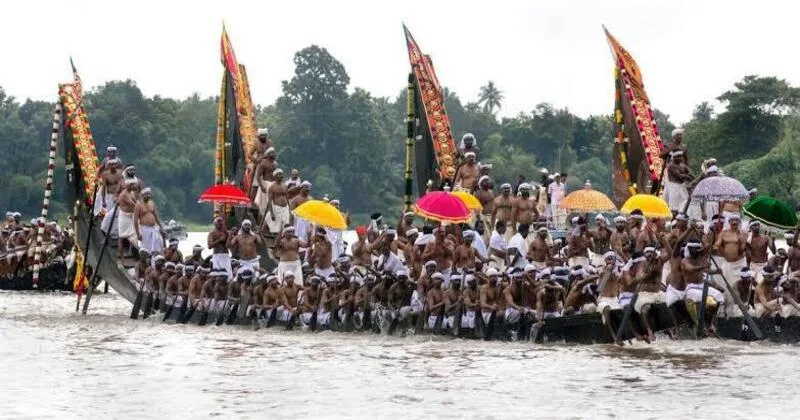
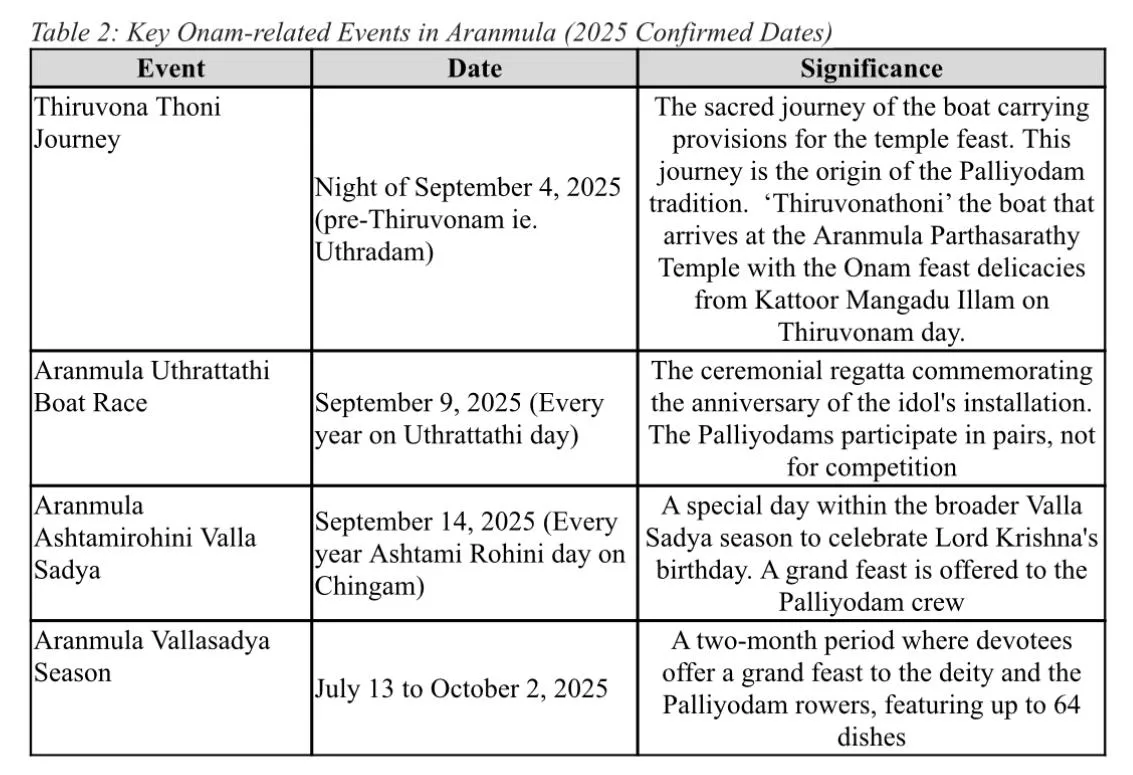
On September 9, 2025, the Pampa River in Aranmula, Pathanamthitta district, Kerala, transformed from a tranquil waterway into a vibrant venue for a deeply spiritual event. This date marks the annual celebration of the Aranmula Uthrattathi Jalotsavam, a festival that, while frequently described as a “boat race,” is more accurately a sacred regatta (utsavam) and a cherished act of faith. It is the oldest riverboat festival in Kerala, and its significance extends far beyond the spirited spectacle witnessed by the thousands of onlookers who gather on the riverbanks. Unlike its highly competitive counterparts, such as the Nehru Trophy Boat Race, the Aranmula event is a ritualistic offering, a devotional procession held to honor the presiding deity of the Aranmula Sree Parthasarathy Mandir.
The event’s timing is determined not by a fixed calendar date but by the Uthrittathi asterism (star) in the Malayalam month of Chingam. This astrological alignment connects the festival to the anniversary of the Mandirs murti consecration, a detail that underscores the deep spiritual foundation of the entire celebration. While some sources may list different dates for the 2025 event, news reports and official declarations published in the days leading up to the festival, such as the announcement of a local holiday in the Mavelikara and Chengannur taluks, confirm the September 9, 2025 date, validating its contemporary relevance. This attention to astronomical and religious timing, rather than fixed dates, is a crucial characteristic of Kerala’s Mandir festivals. The Aranmula Jalotsavam is a testament to how local traditions can be both deeply rooted in ancient myth and dynamically a part of modern life.
The Saga of the Thiruvona Thoni
The genesis of the Aranmula Uthrattathi festival is a rich tapestry of myth and history, woven together by two primary legends. The more prominent of these is the story of the Thiruvona Thoni, a sacred boat whose journey is commemorated by the annual water procession. The legend begins with a devout Bhattathiri (Brahmin pandit) from the Mangadu Illam in Kattoor, who, after being blessed with a child he believed was a gift from Bhagwan Parthasarathy, vowed to provide all the provisions for the Mandirs grand Onam feast every year.
This sacred promise led to an annual pilgrimage by boat, known as the Thiruvona Thoni, which would carry the feast’s delicacies, or Thiruvona Sadya, from his home to the Aranmula Mandir. On one fateful journey, the Bhattathiri and his precious cargo were ambushed by bandits. Hearing of the attack, local villagers rushed to the river in their own boats to protect the sacred vessel and its occupants. This act of community-driven defense is considered the origin of the ceremonial boat procession.
These protector boats, which were originally simple chundan vallams (snake boats), were later consecrated as divine vessels and came to be known as Aranmula Palliyodams. The water procession seen today is conducted as a living remembrance of this act of selfless protection, demonstrating a community’s enduring devotion to its deity and its foundational legends. The legend highlights how a local act of valour and unity, born from faith, became the central myth of a major cultural event. This narrative provides the sacred purpose for the presence of the boats on the river and is inextricably linked to the temple itself, which is the final destination for the feast and the spiritual epicentre of the town.
Sree Parthasarathy Mandir: The spiritual nucleus
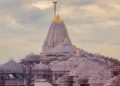
At the heart of the Aranmula festival and the village itself lies the Sree Parthasarathy Mandir, a monumental structure of immense spiritual and cultural significance. The Mandirs history is rooted in the Hindu epic, the Mahabharata, as it is one of five ancient shrines believed to have been built by the Pandava princes. The Aranmula Mandir, specifically, is credited to Arjuna, who dedicated it to Bhagwan Krishna in his role as Parthasarathy, or the divine charioteer.
The very name “Aranmula” holds a deep mythological meaning derived from this founding legend. The murti of Bhagwan Krishna is said to have been brought to the site on a raft made of “six bamboos” (Aru-Mula in Malayalam), giving the village its name and spiritual identity. The presiding deity is a six-foot-tall murti of Krishna in his Vishvarupa pose—the cosmic, all-encompassing form he revealed to Arjuna on the battlefield of Kurukshetra. This detail is not merely decorative; it connects the temple and the regatta directly to the central narrative of the Mahabharata, grounding the local tradition in a pan-Indian epic.
The Mandirs architecture is a narrative in itself, a prime example of the traditional Kerala style. Its elaborate roof and pillars are adorned with intricate wood carvings and early 18th-century murals that depict stories from the Ramayana and Mahabharata. Key architectural features, such as the Dwajasthambam (metal-plated flag post) and the Nalambalam (central structure), serve both functional and symbolic purposes, creating a physical space that is deeply connected to the spiritual practices it houses. This architectural splendour serves as the spiritual nucleus from which all other traditions, including the boat race and the famous Aranmula Kannadi, emanate. The Mandirs status as a Divya Desam, a sacred Vishnu Mandir revered by the Alwar saints, further solidifies its position as a central pilgrimage site and a repository of cultural heritage.
The Palliyodams: Vessels of the divine
The ceremonial snake boats that participate in the Aranmula festival are known as Palliyodams, a term that translates to “divine vessels”. Their name and purpose distinguish them from the chundan vallams used in other, more competitive races. The construction of a Palliyodam is a solemn, sacred process guided by ancient Vedic treatises on boat-building. Crafted from a single, large Anjili tree, these boats are impressive in scale, measuring between 100 and 138 feet in length with a towering rear portion that rises to a height of about 20 feet, resembling the raised hood of a snake. The careful annual maintenance with fish oil and carbon ensures their longevity and reverence.
The crew’s role is not that of athletes but of devotees. They are exclusively men from the villages that own the boats and must adhere to a strict dress code of a white cloth wrapped around the waist (Mundu) and turban, with no shirts or footwear. The crew is commanded by a Kaarnavar (village leader), with a specific hierarchy of three main oarsmen controlling the boat’s movement with a 12-foot-long rudder-oar. This hierarchical and ritualistic structure underscores that the Aranmula festival is a religious custom, not a sporting competition.
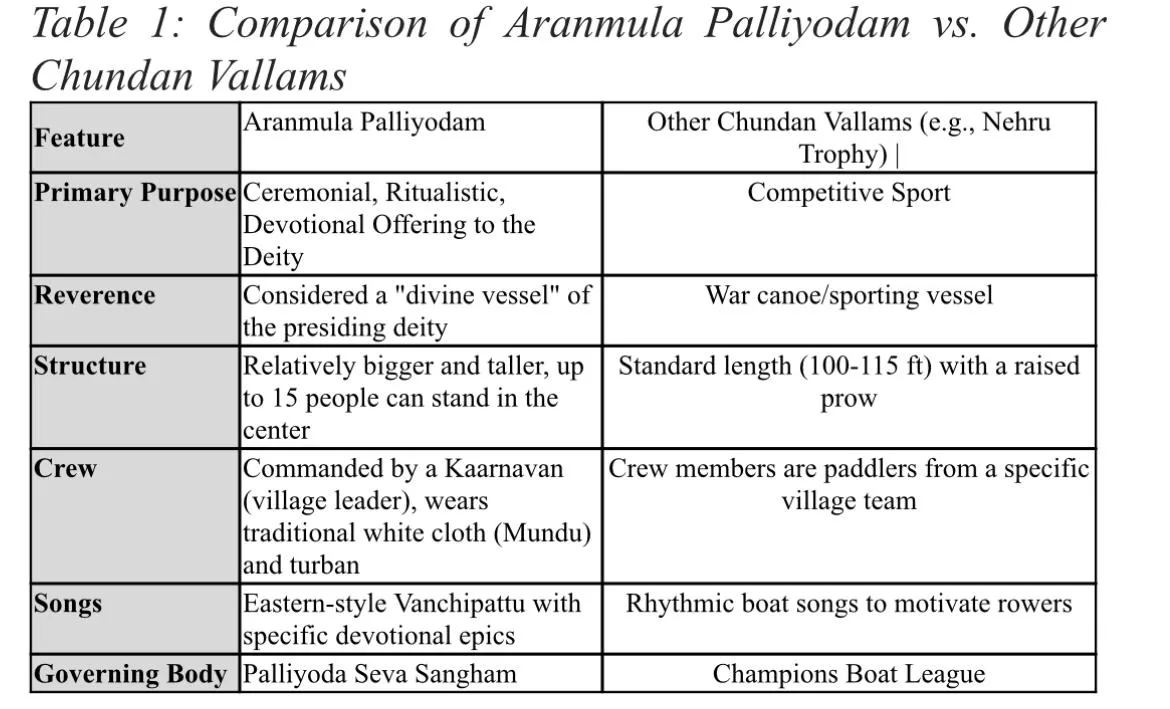
The profound difference in purpose between the Aranmula Palliyodams and the chundan vallams of other boat races is fundamental to understanding the nature of the festival. While other races, such as the Nehru Trophy Boat Race, are fiercely competitive and part of modern sporting leagues, the Aranmula regatta is a procession of devotion, where the boats glide in pairs to the rhythm of sacred songs. The following table highlights these distinctions.
 The Sacred Rhythm: Vanchipattu and devotional songs
A crucial element of the Palliyodam tradition is the Vanchipattu, or boatman’s song. While this form of poetry is used in all Kerala boat races to synchronise rowing, its function at Aranmula is elevated to a spiritual art form. The songs are not merely rhythmic chants; they are devotional compositions drawn from Hindu epics, including Kuchelavritham, Bheeshmaparvam, and Santhanagopalam. The rowers’ vigorous paddling is a physical manifestation of a spiritual narrative, turning the regatta into a form of worship in motion. This practice illustrates the deep cultural and literary underpinnings of the festival, highlighting a performance that blends physical exertion with profound religious expression. The fact that Aranmula has its own unique songs within this genre further demonstrates the event’s distinct and highly localised cultural identity.
The Reflective Legacy: The Aranmula kannadi
The cultural richness of Aranmula extends beyond the Pampa River to a unique art form: the Aranmula Kannadi, or Aranmula mirror. This is not a conventional mirror made of glass but a handcrafted, front-surface metal-alloy mirror, a product of a centuries-old and closely guarded family secret. The reflective surface is created not by a coating but by meticulously polishing a special alloy of copper and tin. This artisanal process, which can take weeks to complete for a single mirror, results in a “no gap reflection,” where the image is reflected without any distortion or gap between the object and its reflection.
The history of the Aranmula Kannadi is intrinsically linked to the Aranmula Parthasarathy Temple itself. According to legend, a group of eight Viswakarma families of artisans was brought to Aranmula from Tamil Nadu by the royal King to create mirrors for the temple, and their experiments led to the discovery of this unique metal alloy. This narrative illustrates how the temple is not just the site of a festival but also the origin points for a unique craft, a source of both spiritual and material heritage for the town.
The Aranmula Kannadi holds a prestigious place in Kerala’s cultural landscape. It has been granted a Geographical Indication (GI) tag, a legal designation that protects its authenticity and ties it to the specific region of Aranmula, preventing imitation. Culturally, the mirror is considered an auspicious item, symbolising prosperity and good luck. It is often included in rituals like Vishukkani, the traditional ceremonial arrangement for the Vishu festival, and is a prized heirloom and gift. The “no gap reflection” is believed to reflect not only a person’s physical appearance but also their inner self, transforming a unique technical marvel into a sacred object of spiritual significance. The Kannadi thus serves as a tangible symbol of the community’s blend of ancient metallurgy, local mythology, and deep spiritual belief.
A tapestry of tradition
The Aranmula Uthrattathi Jalotsavam is a powerful testament to a living heritage where history, myth, and tradition are not static concepts but active, lived experiences. The event is more than a simple boat race; it is a sacred symphony that harmonises the rhythm of the Palliyodams with the devotional poetry of the Vanchipattu, all centred on the revered Sree Parthasarathy Temple. The festival’s existence is a direct consequence of a centuries-old legend of a sacred feast boat, the Thiruvona Thoni, and the act of selfless protection by a community that would become the custodians of this tradition.
Every element of the Aranmula experience—the sacred boat journey, the consecration of the Palliyodams, the architectural narratives of the temple, and even the unique metal mirror—is interconnected, forming a unified cultural ecosystem. The Aranmula Kannadi, for example, is not just a work of art but a physical embodiment of the town’s spiritual and historical roots, originating from the temple’s royal commission and embodying a closely-guarded secret.
Aranmula stands as a compelling case study of cultural preservation, where a community’s identity is defined by its devotion to its heritage. The distinction between the solemn, ritualistic regatta and other competitive boat races is crucial to understanding this living monument. The festival invites thousands to witness a tradition where faith and community spirit truly guide the paddle, a powerful and poignant example of a culture where history and myth continue to shape contemporary life.












Comments