





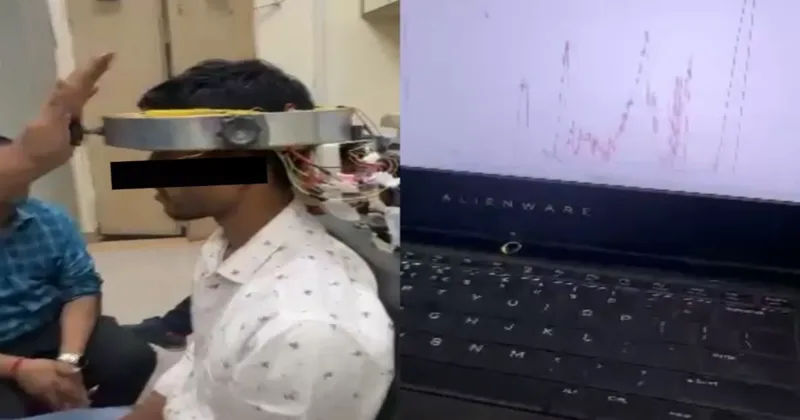
An interdisciplinary team of BHU and IIT-BHU researchers has been granted a patent for an innovative medical device. The invention termed as the biofeedback-enabled neck isometric exercise device with programming and muscle strength measurement, it is a world first device to do so. It has been developed to enable patients with neck pain and similar disorders to regain strength and mobility.
The project involves convergence of knowledge by both engineering and medicine field. The gadget was designed by collaborative effort of Shubhendu Shekhar Pandey, Assistant Professor at the Institute of Medical Sciences (IMS), BHU in the Department of Physiotherapy, Orthopaedics and Professor Neeraj Sharma of the School of Biomedical Engineering, IIT-BHU, along with their research scholar Pranshu Chandra Bhushan Singh Negi under supervision of Prof. Sharma.
Conquering a Common Issue
Neck pain is now one of the most prevalent health conditions globally. Desk jobs, sedentary lifestyle and higher amounts of screen time plays a larger role in the condition. For patients the rehabilitation exercises are the only available method to decrease the pain and restore everyday functioning. These conventional strategies commonly fail if their inadequate precision while performing it or the therapists is not experienced.
This recently patented apparatus overcomes those constraints by combining sensor technology with physiotherapy. It brings about real-time tracking and data-driven recovery, which makes rehabilitation more precise and interactive.
How the Device Works
This machine has a large number of major components that are intended to integrate. At its center is a headgear equipped with force-sensitive sensors to monitor the force exerted in various direction during exercises. This is supported by an especially shaped chair that provides proper posture, a critical aspect of rehabilitation.
Its most noteworthy aspect is the real-time bio feedback display. Patients and therapists can see data immediately through graphical outputs, which facilitates smooth adjustment of movements and monitoring of performances. This not only enhances accuracy but also keeps patients engaged by exhibiting visible improvement.
The equipment is designed to function in two modes of exercise. During the hold-relax mode the patients exert force for a certain amount of time, and in the continuous mode requires continual effort. Both modes are equally important for neck muscle strengthening and enhancing flexibility. While functioning this equipment also records and analyzes data, thus enabling therapists to measure recovery scientifically.
As per Prof Pandey this device can “revolutionise rehabilitation techniques in physiotherapy and orthopaedics.” Its advantages lie not just in clinical use. But also, in investigation of muscle recovery, researcher can also use the system to gather reliable data, so it will enhance insight into rehabilitation success.
For patients this device is much more immersive than conventional therapy. Rehabilitation sessions which are usually monotonous and repetitive in nature are made interesting through feedback and monitoring. This improves treatment compliance and accelerate results.
Collaborative approach towards Aatmanirbhar Bharat
This innovation is a proof of the strength of cooperation between BHU and IIT-BHU, demonstrating how medical sciences and engineering may be blended to provide practical healthcare solutions. This device is product of Aatmanirbhar Bharat approach toward self-reliance in medical field.
Prof. Pandey also added, “This patent will further motivate me and we are very happy to boost the image of BHU. This success will further boost the image of BHU and IIT-BHU in medical and technological research.”
These recognitions put both institutions well and truly on the international research and development map. It also consolidates India’s position in healthcare technology, proving that the nation’s educational institutions can produce innovations of universal importance.
This invention is expected to encourage more work toward the development of rehabilitation devices based on biofeedback. Although developed for disorders of the neck, the technology may eventually be developed for use with other musculoskeletal disorders. With its combination of posture correction, measurement of strength and real-time feedback, the system may see widespread use, not just in India, but globally.
For the time being, the achievement is a matter of pride for BHU, IIT-BHU, and the research team involved. It is evidence that when medical knowledge and engineering ingenuity combine, the outcome can revolutionize how patients recover and establish new standards in rehabilitation treatment.
















Comments