





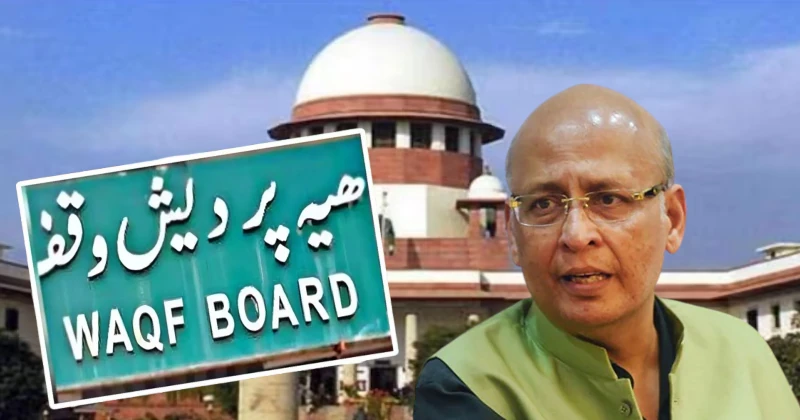
The Supreme Court of India has upheld the constitutionality of the Waqf Amendment Act, 2025, dealing a decisive blow to petitioners led by Congress leader and senior advocate Abhishek Manu Singhvi.
Despite Singhvi’s claim in court corridors that he had “won on substantial points,” the verdict makes it clear: the Modi government’s reforms survive intact, the law remains operational, and the era of unchecked waqf expansion and misuse is firmly over.
At the heart of the ruling lies a fundamental endorsement: Parliament acted within its constitutional powers. The Waqf Amendment Act, 2025 is a valid exercise of legislative authority. This removes any cloud of uncertainty over the reforms, which were crafted to bring transparency, digitisation, inclusivity, and accountability to waqf administration.
I heard Abhishek Manu Singhvi, Congress leader and senior counsel for the Muslim petitioners opposing the Waqf Amendment Act, 2025, boast that he has “won on substantial points.”
Well, I hope his clients pay his fees — because the truth is exactly the opposite of what he claims.… pic.twitter.com/8rbqquCthZ
— Amit Malviya (@amitmalviya) September 16, 2025
The apex court’s judgment reflects a balance respecting genuine religious rights while shutting the door on abuse, encroachment, and opaque practices that plagued the waqf system for decades.
Key Highlights of the Supreme Court Judgment
🔹 Verification of Faith: States must now establish a clear procedure to verify the five-year practising Islam requirement before anyone can create a waqf. This provision directly addresses misuse where properties were falsely declared waqf by individuals with tenuous religious links.
🔹 End of “Waqf by User” Misuse: The deletion of the controversial doctrine of “waqf by user” has been upheld prospectively. For decades, this provision allowed vast tracts of public or private land to be claimed as waqf simply on the basis of alleged usage, resulting in large-scale encroachments, including on government land. That avenue is now permanently shut.
🔹 Judicial Oversight in Title Disputes: The court upheld Sections 3C(1) & (2), ruling that title disputes involving waqf land must be decided by judicial or quasi-judicial authorities, not revenue officers. This strengthens due process and eliminates arbitrary executive overreach.
🔹 Protection for Monuments and Tribals:
- Section 3D: Customary religious practices in protected monuments continue under AMSAR (Ancient Monuments and Archaeological Sites and Remains Act).
- Section 3E: Tribal lands under the Fifth and Sixth Schedules are fully protected ensuring that vulnerable tribal communities are not stripped of their ancestral lands through waqf declarations.
🔹 Inclusivity in Waqf Institutions: The inclusion of non-Muslim members in oversight bodies four in the Central Waqf Council and three in each State Waqf Board has been upheld. This ensures transparency, diversity of voices, and curbs monopolisation by vested interests.
🔹 Leadership with Flexibility: While the court noted that, “as far as possible,” CEOs of waqf boards should be Muslim, it upheld the government’s discretion to appoint qualified professionals from other communities when necessary strengthening administrative flexibility.
🔹 Mandatory Registration Strengthened:
- Compulsory submission of a waqf deed for registration upheld.
- Section 36(10): Non-registered waqfs will lose legal protection after six months, tightening accountability.
🔹 Obsolete Provisions Struck Down, Reform Cemented:
- Section 104 deleted: Non-Muslims can no longer create waqfs.
- Section 107 deleted: The Limitation Act, 1963 applies to waqf disputes, ending the culture of perpetual litigation.
- Section 108 deleted: Evacuee properties are excluded from waqf purview eliminating historical confusion.
- Section 108A upheld: The Waqf Act cannot override other laws, ensuring national legal coherence.
The Supreme Court has effectively greenlighted the government’s digitisation drive for waqf assets, mandatory registration norms, and structural reforms to prevent land-grabbing. The judgment safeguards public property, tribal lands, and heritage sites, while reinforcing that waqf resources must serve community welfare, education, healthcare, and national development not vested interests.
This verdict is a watershed moment in India’s property and religious endowment law, closing loopholes that were historically exploited to amass vast real estate under waqf control, often at the expense of the state and vulnerable communities.
(The story is based on a tweet)














Comments