




“We cannot attain purity, we cannot gain our goal of truth, unless we walk in the path of virtue. The Asoka’s wheel represents to us the wheel of the Law, the wheel Dharma. Truth can be gained only by the pursuit of the path of Dharma, by the practice of virtue. Truth,–Satya, Dharma–Virtue, these ought to be the controlling principles of all those who work under this Flag. It also tells us that the Dharma is something which is
perpetually moving. If this country has suffered in the recent past, it is due to our resistance to change…. Our Dharma is Sanatana, eternal, not in the sense that it is a fixed deposit but in the sense that it is perpetually changing. Its uninterrupted continuity is its Sanatana character. So even with regard to our social conditions it is essential for us to move forward”. – Dr Sarvepalli Radhakrishnan, On July 22, 1947, Constituent Assembly Debates, Volume IV, Lok Sabha Secretariat, New Delhi, 2014, pp. 745-746
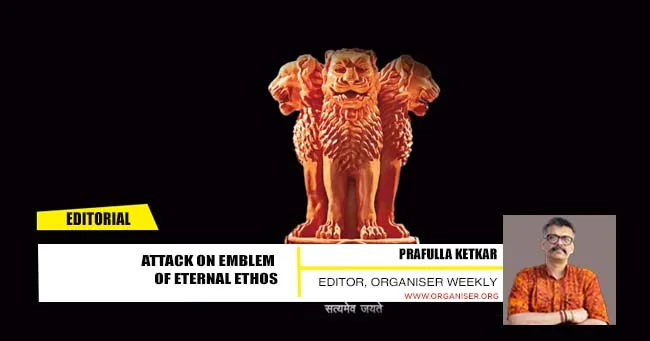
A mob vandalised the Ashoka Emblem on the foundation stone of the revered Hazratbal shrine in Srinagar, sparking a heated controversy. Islamists targeted the national symbol in the name of religious sentiments – again resurrecting the ideology of iconoclasm. The incident was justified by the leaders of Jammu and Kashmir on usual religious lines, without addressing the fundamental issues concerning our nationhood. The national emblem of Bharat was a thoughtful adaptation of the Lion Capital atop the Ashoka Pillar of Sarnath, featuring the motto Satyameva Jayate (Truth Alone Triumphs). The emblem carried the historical and spiritual significance as Bhagwan Buddha performed his first sermon at the same place. Through the State symbols and institutional mottos based on the Dharmic ethos, our Constitution makers made a proud declaration of Bharat as a ‘Republic’. Dharma here refers to righteousness, not religion. They represented the continuity of an eternal civilisation, the spirit of the freedom struggle, and the aspirations of the future. The national emblem, adapted from the Ashokan pillar at Sarnath, calls for sincere & due respect from the citizens.
The foundation stone at the sacred Hazratbal Dargah was laid by the Waqf Board of Jammu and Kashmir as a part of the redevelopment of the site. The plaque with the national emblem did not change the character of the shrine. The justification for this vandalism was given by none other than the chief minister and main opposition leader of the state, based on the belief that ‘any form of idol worship is strictly forbidden’. How was the Waqf Board logo spared then? Is showing reverence towards a Dargah in any form permissible as per Islamism? If reports are to be believed, the Jammu and Kashmir Government has also used the national emblem along with its state government logo at the same site earlier. Then, why is there such an uproar now? The site has been augmented under the ‘Pilgrimage Rejuvenation And Spiritual Augmentation’ (PRASHAD) scheme of the Ministry of Tourism, Government of Bharat, to create various facilities for pilgrims, and was initiated when Mehbooba Mufti was the Chief Minister of the state. Is accepting Government funding under such a scheme acceptable under fundamentalist Islam?
Even if there are genuine concerns, we have democratic and constitutional ways to raise them and get things corrected. Doesn’t the act of vandalism hurt the national sentiments? Attacking the national emblem on the outer side of the shrine in the name of religious sentiments is a disastrous trend that we must be wary of. The ideology of iconoclasm had led to the destruction of numerous temples by the invaders. Following the Khilafat movement, the same tendency led to opposition to Vande Mataram – the slogan that inspired both Hindus and Muslims during the freedom struggle. The Partition of the motherland on religious lines was the last blow by the children of Babar and Aurangzeb. Leading protests after the Shahbano verdict by the Supreme Court, resorting to violence every now and then in the name of religious sentiments, standing for the criminal acts by the illegal immigrants in the name of religion and opposing people like Javed Akhtar to speak in the cultural festivals as he considers himself an atheist – all manifest the same dangerous trend. Taliban destroyed the Bamiyan Buddha monument based on the same ideology.
The vandalism and defacement of the national emblem – adapted as the symbol of Dharma – is an attack on the civilisational ethos. If the Constitution and democracy are to survive, we must adhere to democratic methods of protests as Dr Ambedkar had warned. Ours is a culture of acceptance and respect for all, and intolerance towards this fundamental value of Sanatan Dharma is an attack on our nationhood. All of us, including nationalist Muslims, must dare to come forward and resist this ideology of iconoclasm in the best possible way.
















Comments