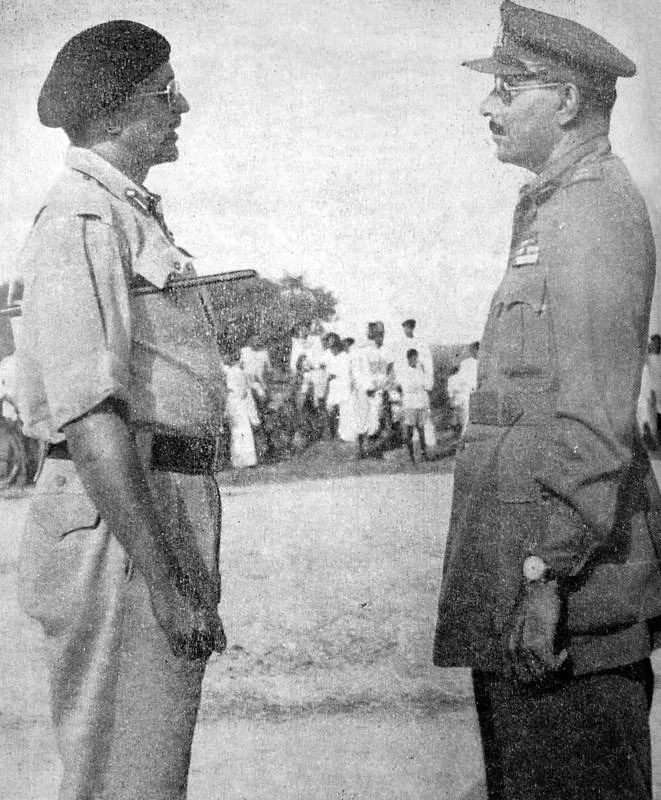
Hyderabad State Major General Syed Ahmed El Edroos (R) offers his surrender of the Hyderabad State Forces to Indian Major General Joyanto Nath Chaudhuri (L) at Secunderabad
Even as the Nizam prepared for war, the saga of letters, consultations, agreements, etc. continued unabated for 13 months. As the atrocities and attacks increased, a letter from the Union Government arrived saying that what was happening was incorrect; and the Nizam replied that it is our state, and we will run it according to our wishes’, or sometimes the Nizam’s letter said we didn’t conduct these attacks, we are not aware who did these things, Hindus may have killed each other’, or at other times the letter said `the administration is robust, Razakars who are conducting these atrocities will be apprehended and punished’. Everyone was clear about what was happening in Hyderabad state, and it was equally clear that the attack on the Nizam was imminent. Yet, the killings, loot, rapes against women, temple desecration, imprisonment and torture of countless Hindus, continued unabated.
Sardar Patel, who could no longer tolerate the Muslim appeasement policy of independent India’s first Prime Minister Nehru, ultimately ordered Police Action against the Hyderabad Nizam on 12th September 1948. Apparently, Nehru stared at the order, signed it, and walked away saying nothing.
First Day (13 September 1948)
The Indian army reached the borders of Hyderabad state on 13th September 1948. The then Governor-General, C. Rajagopalachari, described it as Police Action’, the army termed it Operation Polo’. The military operation happened under the overall command of GOC Southern Command, Lieutenant General Maharaj Singh. Major-General Joyanto Nath Chaudhuri (later Army Chief) arrived from Sholapur division. Bombay Sector Commander Major-General D.S. Dhar moved in with his army battalions. Madras Sector Commander Major-General M.V. Rudra also moved in with his battalion. Brigadier Shivadutt Singh moved in with his battalion from Central Commandment of Berar. The `all-fronts’ surround attack started at 4 am on the same morning.
Major-General J.N. Chaudhuri, who moved in from Sholapur on 13th September morning, encountered a brief battle in the town of Naldurg, the Nizam army surrendered within an hour. Major-General M.V. Rudra entered from Vijayawada and reached Suryapet after seizing Bonakal. The army battalions reached from all fronts—Ahmednagar, Aurangabad, Madhya Bharat, Mysore, etc.—with fighter planes in the skies and trucks on the ground. The Nizam police and Razakar militia everywhere threw away their arms and fled from the battlefields into jungles and hillocks. Hindus were elated, confiscated the weapons and handed them over to the Indian army.
The Nizam army fled after throwing their weapons in Talmad, Turur, Tuljapur, Manikgarh, Kanergaon, and other places that came under army control. There were no battles worth the name anywhere, not even for a few minutes. Everywhere, the Nizam army and Razakars fled from the battleground! The timid and inexperienced communal militia outfits of the Nizam army and Razakars gave up everywhere and fled; they had no idea how to face the might of the Indian army. The army came up to Jalna from Aurangabad, from Vijayawada to Suryapet; the Indian army exploded a couple of bombs at Warangal and Bidar airstrips—that was enough for the Nizam army to run away and flee the battleground.
Second Day (14 September 1948)
On the second day of the operation, on 14th September 1948, the Indian army penetrated further into Hyderabad state. Aurangabad, Rajeswaram, Osmanabad, and Nirmal were won by the army. There was no obstruction by the Nizam army to the forward march of the Indian army from Suryapet to Hyderabad. Communists began their propaganda that the Indian army was committing countless atrocities against the people, especially the Muslims. It must be noted here that communists never protested when the Nizam police and Razakars selectively targeted the hapless Hindu population, committed heinous atrocities including murders, rapes and loot, and desecrated innumerable Hindu temples. Even though the ordinary people in Hyderabad didn’t believe the communists, they made enough ruckus internationally and confused the Indian people. The army marched victoriously forward with great courage and valour. Warangal and Bidar airstrips were bombed the second day too. The Nizam army and Razakars threw their weapons and fled near the Kurnool area, when they saw the southern contingent of the Indian army.
Third Day (15 September 1948)
The same story repeated itself on the third day, 15th September 1948: the Nizam army and the Razakars couldn’t face the Indian army. Khammam town fell and the Razakars fled from the arena. They started out to halt the forward march of the Indian army coming from Zaheerabad. They wanted to dig trenches and fire at the army. But even before they reached Zaheerabad, the Indian Air Force started bombing. Immediately, the Nizam army and Razakars left their weaponry, trucks, and tanks in Zaheerabad and Vikarabad and fled crying `mar gaya re, touba touba’. The local people, remembering their atrocities, refused to even give them a morsel of rice.
Fourth Day (16 September 1948)
Zaheerabad fell on the fourth day, 16th September 1948, and the Indian army proceeded towards Hyderabad. The highway and the railway lines came under the control of the army. The Nizam army demolished the bridge on river Musi, to prevent the Indian army from entering Hyderabad. The Nizam force and Razakars immediately fled the scene into nearby jungles, and didn’t remain near the demolished bridge to fight the Indian army. However, the Madras contingent of the Indian army, with the help of local people, constructed the bridge within three hours and proceeded towards Hyderabad.
Fifth Day (17 September 1948)
On the fifth day, 17th September 1948, the Nizam police demolished a couple of more bridges and tried to plant landmines to thwart the Indian army. Those landmines didn’t even ruffle the Indian army. The army contingent under the leadership of Major-General J.N. Chaudhuri reached Patancheruvu at the outskirts of Hyderabad.
The Nizam realised his complete defeat at the hands of the Indian army. He shuddered at the thought of losing his life, the lives of his sons, his many wives, and his entire harem. His militia, the Razakar army, might be killed, Muslims who were enjoying the majority of the jobs in the administration might lose their jobs. Above all, he might lose his collection of gold, silver, ornaments, jewellery, precious stones, etc., gathered from looting the kingdom. Hindus might not keep quiet and might take revenge against the Muslim administration. He immediately went to the Indian Government’s representative, the Agent-General K.M. Munshi, and expressed his willingness to surrender. The same day, the fifth day of the war, on 17th September 1948, the Nizam, in a radio broadcast at 5 pm, declared the end of hostilities and a ceasefire, and proclaimed that `people’s welfare is my only aim’.
According to the records maintained by the Indian army, General Chaudhuri led an armoured column into Hyderabad at around 4 pm on 18th September 1948, and the Hyderabad army, led by Major-General El Edroos, surrendered.
These excerpts are taken from the book Nizams Unmasked, authored by Professor Kasireddy Venkatreddy and compiled by Ms. Pradakshina, Senior Research Associate at Centre for South Indian Studies.
