





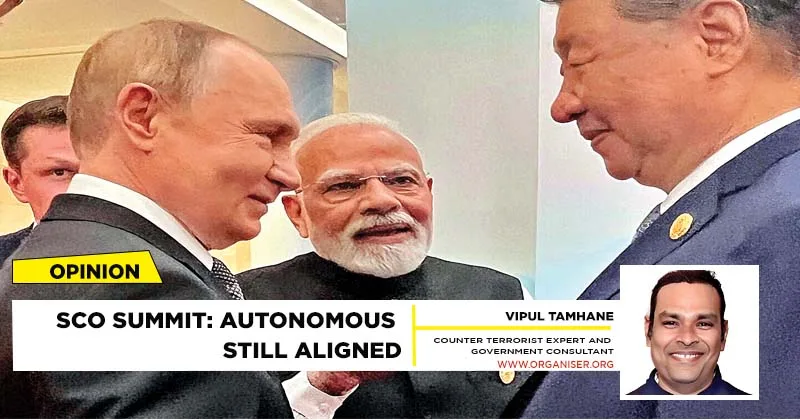
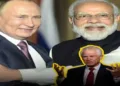
The image that came out of Tianjin conveys much about seismic shifts in global geopolitics. Prime Minister Narendra Modi, pictured alongside Chinese President Xi Jinping and Russian President Vladimir Putin, laughingly conversing at the Shanghai Cooperation Organisation (SCO) summit, has sent shockwaves through Western capitals and posed a direct challenge to assumptions about India’s strategic alignment in an increasingly fractured global order.
What the picture signifies is not simply high diplomatic nicety or merely multilateral engagement; it represents a picture of India’s deliberate decision to pursue an inherently autonomous foreign policy. An autonomous foreign policy which goes beyond the binary of alignment versus non–alignment that defined the Cold War era. In 2025, as the Trump administration’s economic nationalism reaches its peak, and punitive tariffs rain down on the US’s partners, India is forced to navigate a complex web of relationships, while positioning its national interests well in advance of ideological coherence.
Debunking False Narrative
It can be safely said that this strategic shift was only tariffs induced. The 50 per cent tariffs on imports from India by the Trump administration extend beyond economic protectionism. They misunderstand not only India’s strategic importance, but also New Delhi’s ability to act independently. The unwarranted narrative by Peter Navarro that India is somehow supporting the Russian war machine in Ukraine is certainly ignorant of not only the political implications but also of energy markets and how they function internationally and domestically.
The accusation itself is false, and economically illiterate. The oil imports by India from Russia, which increased after Russia’s invasion in 2022, make up only a small portion of the global crude trade. More importantly, the oil that they import is refined, and is then often exported back to these same European markets that applaud India for its exceptionalism. The understanding that India’s energy needs are helping to fund Russian aggression ignores the reality that oil, in energy markets, is a fungible commodity, and that Europe itself continues to trade Russian energy through direct and indirect channels.
Bullying Tactics Won’t Work
The 50 per cent tariffs have not broken India’s back; they have quickly sped up New Delhi’s search for new partnerships and alternative economic deals.
The SCO summit in Tianjin must be framed in the context of American economic aggression to facilitate ‘Diplomatic Strategic Autonomy’ around the summit. When Modi took time to conduct extended bilateral meetings with both Xi Jinping and Vladimir Putin, he was not negating India’s democratic credentials or engaging in some form of ideological authoritarianism, he was saying that India will not allow its foreign policy to be conducted in accordance with Washington’s core domestic political necessities or the financial games of Wall Street.
Special Treatment For PM Modi
The summit optics represented by Xi Jinping greeting Modi warmly. India is an equal participating member of the SCO which adds its own economic weight and strategic autonomy to the organisation.
PM Modi’s remarks at the summit highlighted a fortification of possible collaborations across security, connectivity, and economic opportunity, all characteristics which reflect Indian’s delicate disposition on how they prefer to engage in multilateral dialogues. India will support SCO initiatives to help contribute to regional stability and integration, but maintain a conscience of their own clearly articulated red lines around sovereignty and territorial integrity. CPEC that extends into, and disrupts, India’s territorial integrity.
India’s engagement on SCO underlines an even deeper, philosophical commitment to erecting a position of sovereignty, or ‘strategic resilience,’ meaning the ability to remain independent in their actions, while constructively, if selectively engaged with all major actors. India has long held a resilience as an idea or principle rooted back to India’s civilisational understanding of itself, and has always pragmatically embodied it in contemporary practices of diplomacy.
The recent meetings by External Affairs Minister S. Jaishankar with the Chinese President Xi Jinping, the Finance Minister Lan Fo’an and the Vice President Han Zheng; National Security Advisor Ajit Doval’s meeting with Chinese Foreign Minister Wang Yi, and Defense Minister Rajnath Singh’s meeting with Chinese Defence Minister Dong Jun, shows an intentional strategy to manage the China relationship while adhering to principle. These engagements, culminating with Modi’s first visit to China in seven years, indicate India’s willingness to compartmentalise differences whilst examining potential cooperation. This is not appeasement; it is sophisticated statecraft. India realises that there are no eternal benefits to hostility towards China, and the 2.8 billion people that both countries represent, as people, deserve a better alternative to hostility. The border dispute remains a serious issue, but it should not preclude engagement regarding climate change, trade, or regional security.
The myth of the Indian alignment that the Western narrative promotes as India’s strategic choices is often clouded by wishful thinking, as well as fundamental misunderstandings about the nature of Indian strategic culture. The idea that India must choose between Western democratic solidarity versus an authoritarian regime participation geography represents a ‘back and to’ worldview that India consistently rejects.
Navarro’s allegations regarding India’s funding of Russian military aggression through oil purchases constitutes a gross example of this mistaken view. India’s energy imports support the country’s development, not geopolitical goals. When world oil prices soared after the invasion of Ukraine, India’s Government acted responsibly in seeking the lowest-priced sources to fulfil its citizens’ energy needs. To imply that this translates into assistance for Russian aggression is to misunderstand energy markets and the priorities of India altogether.
Pragmatism over Ideology
This Tianjin SCO sees China opting pragmatism over ideology as an outlook reset. As the most meaningful development to arise from the SCO summit is the tangible detente in India-China relations. Modi’s reference, when describing bilateral ties, to Xi Jinping’s characterisation of the relationship as a “Dragon-Elephant Tango,” suggests that both leaders recognise the absurdity of being beset by permanent hostility between the two largest economies in Asia. This rapprochement should not be misconstrued as a strategic surrender. India’s border positions remain unchanged; New Delhi continues to develop military capabilities along the Line of Actual Control. However, it is evident that the two countries have both reached the conclusion that border tensions have elements that do not need to dominate or define the entirety of their relationship. The timing of this rapprochement is also important. Trump’s tariffs are purportedly beginning to take a toll on both Indian and Chinese exports, and now both want to see if they can squeeze closer economic cooperation to suit their own national interests. This is not about one nation preferring China over America; it is about rejecting being hostaged to American domestic politics.
In 2001, when the SCO began as a regional security organisation, it has now morphed into a quasi-vehicle for Eurasian integration which can increasingly challenge Western institutions. Full membership of India in 2017, together with Pakistan, reoriented the SCO and gave the organisation a new level of global relevance.
For India, SCO membership serves multiple purposes, i.e. it provides a forum for engaging China and Russia on equal terms, offers alternatives to Western-dominated institutions, and demonstrates India’s commitment to multipolarity. The organisation’s emphasis on sovereignty, non-interference, and mutual respect aligns with India’s core diplomatic principles while providing practical benefits in trade, energy, and security cooperation.
At present, we are at a watershed moment in India’s post-independence foreign policy trajectory, producing conditions that may lead to a transformative moment, which would include strategic shifts in relation to other states. India has demonstrated multiple ways of adapting an external orientation in response to changing global conditions while preserving strategic autonomy since the 1950s, starting with Nehru’s non-alignment to the tests of 1998 and strategic partnership with the US from the 2000s.
Some observers suggest that India is returning to the policies of non-alignment of the bygone Cold War era; but there’s a fine line there. There are profound differences between ‘traditional’ non-alignment and today’s strategic autonomy. Non-alignment was often passive, an approach that sought to avoid getting caught up in superpower competition. Strategic autonomy is engaged and active, making the best use of relationships with all major powers to maximise advantage for India.
In a multipolar world, true non-alignment has neither become possible nor palatable. Every state must deal with multiple centers of power, each with their own contributors and constraints. Every state must consider its relationships, and India’s dilemma is not whether to align or be non-aligned, but whether to cede strategic autonomy to a single power or maintain enough flexibility to engage with all.
The SCO summit demonstrates India has selected the latter option. India remains constructively engaged with China and Russia, while still maintaining relationships with the US, Japan and European powers. India is pursuing a foreign policy that prioritises India’s interests and competitors directly, instead of acting in another’s grand strategy.











Comments