






Bharat is a Rashtra filled with a vast array of dialects, attires, food habits, customs, traditions etc. The rich Samskriti of Bharat is especially seen during festivals. Each state celebrates the fervour distinctly, yet at the same time, with certain fundamental similarities. The uniqueness of Bharat resides in this diversity. Bharat stands to lose herself if this diversity fades and only uniformity remains.
Ever since the centenary year preparations have started, Param Pujaniya Sarsanghchalak Dr Mohan Bhagwat has been repeatedly explaining to us about Panch Parivartan – the five fold transformations. Pujya Sarsanghchalak Ji says that only theory will not do, the principles need to be practised; only then will the true transformation take place. The Swadeshi aspect among these five, strikes the most, as it is the easiest to practice, with minimum efforts, and express in our daily lives. Swadeshi simply means that which originates in our country. This Swa, or sense of selfhood, can be expressed through six dimensions.
Bhasha – Language
After a long time, the National Education Policy – NEP 2020 was approved on July 29, 2020. The landmark policy clearly stated the importance of learning in mother tongue for early childhood cognitive development. It also promotes learning at least one other state language along with English. Encouraging multilingualism, learning various languages has been proven to be beneficial for the development of frontal cortex of brain, thereby delaying its ageing.

According to UNESCO’s Atlas of World Endangered Languages, there are 197 languages that are dying in Bharat. This is an alarming situation. The diversity of Bharat is expressed through language. Therefore language, particularly the mother tongue, needs to be practised as much as it is received in daily life. There is no harm in learning or speaking other languages, but the important thing is the affection and pride that it instills in us. Hence, to express our views in our own language in day-to-day lives, we may practise speaking in our language at home, signing in our own language, reading literature in our mother tongue, etc. Knowing own language along with English or any other is more important.
Bhusha – Clothing
Another aspect of a shining personality is Bhusha (clothing or attire). The way one dresses creates an impression, sometimes lasting, on others. Diversity is the Pran of Bharat. Bharatiya Veshabhusha has always been vibrant, colourful, and suited to the climate of each region. Today, in the corporate, industrial and other business sectors, we see clones of people wearing the same dark and dreary blazers. These suits are worn in the western countries to save themselves from severe cold and still attempting to look stylish. But here in Bharat, in the excessive heat, it is extremely impractical to wear those suits. We saw in the group photo of 2025 Tianjin SCO summit held recently that only the Prime Minister of Bharat Narendra Modi stood out in his Bharatiya attire among all the leaders who were wearing the same dark coloured blazer.

This entry of European attire in our lives is detrimental. ‘Modernisation equals westernisation’ is a flawed concept. It is more dangerous. One can wear Videshi attire for work, for instance, Shubhranshu Shukla had to wear the space suit on his expedition at NASA. There was no choice of wearing anything else. Dress codes may be followed wherever necessary. The most important thing here is, feeling embarrassed about wearing clothes symbolising our own traditions, thinking of them as outdated or crass and considering western clothing as modernity alone as the best way to dress. This kind of thinking creates problem. Therefore, Bhava is important.
There should be a feeling of immense respect and a sense of belonging towards own traditional clothing. What one wears at home to feel comfortable is not a problem. However, we may choose to wear Bharatiya attire every now and then with immense pride, which is a start. Thus, one may consciously decide to wear traditional clothing periodically or on specific occasions throughout the year. Men can wear dhoti-kurta and women sarees during poojas and festivals. Even these are worn in several ways across Bharat. Here again, there is a lot of variety as Jammu-Kashmir, Punjab, Bengal, Assam, Meghalaya, Manipur, Arunachal, Tamil Nadu, Andhra, Karnataka, Kerala, Maharashtra, Uttar Pradesh, Madhya Pradesh, and every state of Bharat has its own distinct traditional attires.
Bhavan – Home
It is said that what makes a building a home is its people. However, there are certain elements that make a home truly Bharatiya. When we talk of house, we think of a kitchen, a garden, a terrace, rooms for all family members, etc. This is, of course, a good picture. But more importantly, how does the home make you feel? It all depends on the environment that is created by the people residing in it. There is no issue in using all sorts of modern technology to make a concrete structure for a home, but when this structure starts to look like the home of a westerner, then we need to do some introspection. A beautiful Rangoli can be drawn in front of the house in spite of it being ultra-modern, a Toran can be placed on the door, a Tulsi plant can grace the verandah or balcony, the interior decoration may incorporate pictures, or intricately carved Murtis of deities.
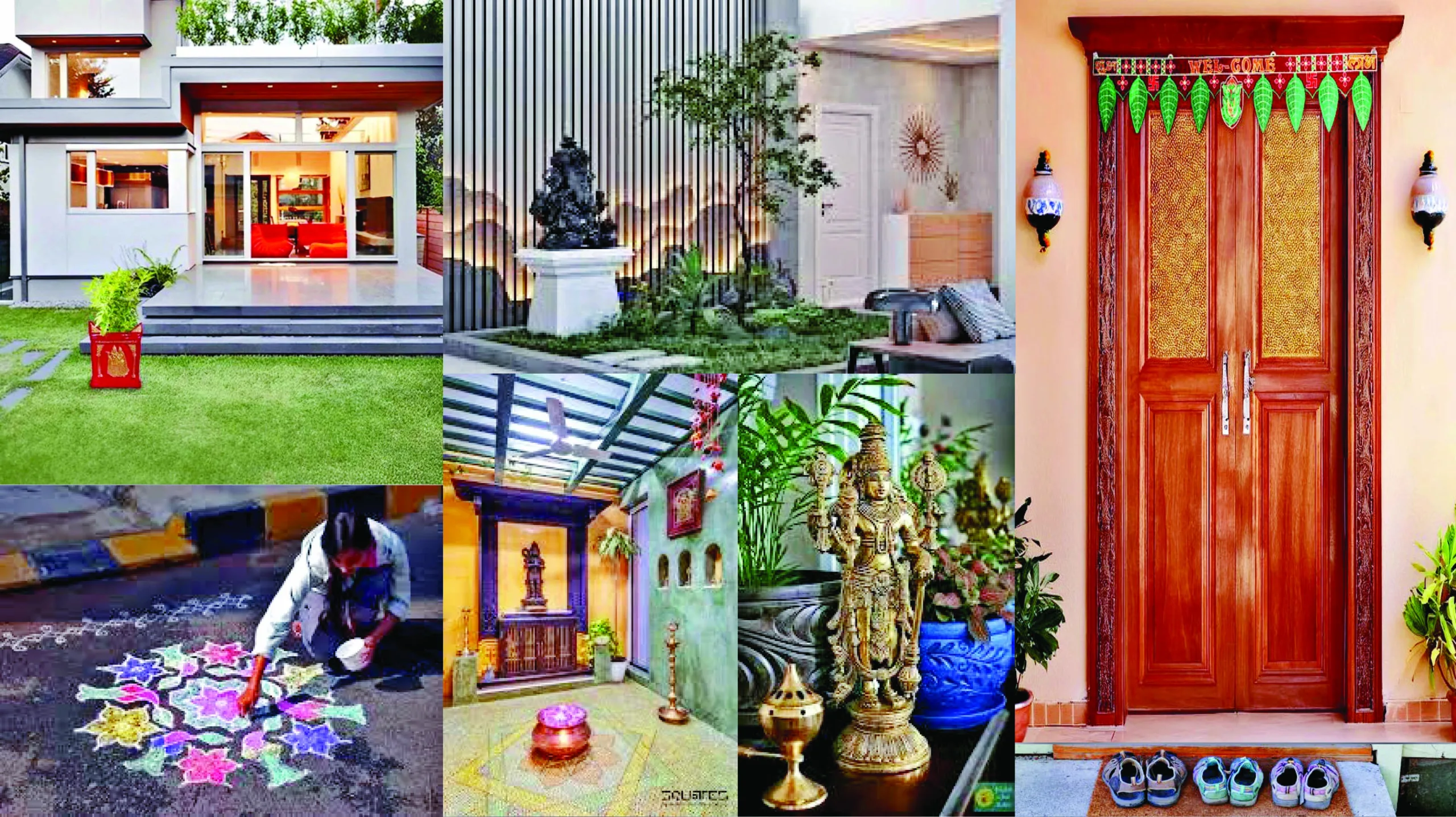
Many homes have an arrangement for chappals and footwear to be kept outside by the door. Some of them have separate chappals to be worn inside the house. When one visits a science laboratory, or a factory concerning hygiene products, or even a chip-making factory, they ask to keep the footwear outside or give a cover for shoes. This signifies that Such practices were prevalent since ancient times. This has always been our tradition, to remove footwear outside the house before entering. This is called a Bharatiya Bhavan where such practices are followed. It was forgotten in the name of modernity, but now these practices are gradually making a comeback. There are so many such miniscule things that may be incorporated and can provide Bharat Darshan in a home.
How does the home make you feel? It all depends on the environment that is created by the people residing in it
Along with this, what completes the home is the temple, whether there is a separate room for the deities or a small corner, a Bharatiya home is incomplete without a temple. Every Bharatiya home has Kula Devatas, Gram Devatas, Ishta Devatas, Yantras, sacred books, a conch, a bell, and all auspicious symbols.
Bhraman – Travel
Bhraman is an important part of life. It teaches one about the ways of the world and enhances understanding of responsible living. But travelling is not just about going to Paris, New York, Singapore, Australia for exotic vacations. Yes, one is surely welcome to do so, but do we know the vastness of Bharat? A whole lifetime is insufficient to explore all the places of this wonderland. Starting with going to nearby places on weekends, one should make bhraman a part of regular life for education, entertainment and information. Travel should not be only for enjoyment but also for enrichment. Again, Bhava is important. If one goes to Thailand, visit Brahma ji’s temple there; if you go to Paris, visit the library or museum. This is the Bharatiya Drishti of Bhraman.
Bhajan – Devotional Songs
The word ‘Bhajan’ comes from the Samskrit root ‘Bhaj’, meaning to sing or worship. Worship is a great way to release pent-up emotions. When done collectively, positive energy and vibrations are created. It is expected of a Bharatiya family to know at least some shlokas from the Ramayan, Mahabharat, and the Bhagwadgeeta along with the Atharvasheersha, Hanuman Chalisa, Ram Raksha, and other stotras. Children must be taught Pratah Smaran (morning prayers), Sandhya Vandan (evening prayers), and must practice them daily. On certain occasions, the Sunderkand may be recited collectively. We witnessed the positive psychological effects of collective prayers during the COVID period.
There is no restriction on the style of songs. Apart from devotional music, they can even be in rap or pop styles. The recent, immensely successful 3D animated movie “Mahavatar Narasimha” also showcased one such song on Bhagwan Shri Krishna. Interestingly, the life’s work of Japanese scientist Masaru Emoto is notable. He experimented with the effects of sounds and words on water. When soft, loving words were spoken to water, beautiful crystals were formed and when the water was abused and told to die, distorted crystals were formed. The same pattern occured with songs. When classical or folk music was played, beautiful crystals formed but when rock or heavy metal music was played, disfigured, ugly crystals appeared. He concluded that our bodies too are made up of about 70 per cent of water. Therefore, harsh and hurtful sounds and words affect us negatively while soft harmonies and melodious ones affect us positively. Today, we see people, especially the youth, roaming around listening to various kinds of meaningless garbage on Bluetooth devices and earphones. Therefore, paying attention to what we listen to is extremely important.
Bhojan – Food
There is a wide range of cuisines in Bharat. Like everything else, food is served and had with great reverance here. Like Bhusha (clothing), Bhojan is traditionally prepared according to the change in Ritucharya (seasons). Therefore traditionally, there was no concept of pizza, burger, coca cola, etc. This uniformity is looked down upon in Bharat. Why eat this junk when one can have nutritious freshly cooked hot meals? Once in a while having this junk is still alright, but having it frequently can take a toll on one’s health. The enrichment of Swa should be visible in food as well. To be able to cook various types of cuisines is a great flex. In today’s high tech world, every little thing is at your fingertips. In the last few years, we have seen the breakdown of the joint family system. Now we have more nuclear families where there are no grandparents to teach life skills. But today, cooking different recipes can be easily learnt social media apps.
Along with cooking, one can also learn how to drape different styles of dhotis and sarees through YouTube, instagram and other apps. This is the practice of Swadeshi with a modern blend. Safeguarding Samskritik roots does not mean rejecting change; it means carrying forward the essence of our heritage with pride and confidence. By consciously practising these simple yet profound aspects in everyday life, we can nurture a self-reliant, vibrant, and harmonious Bharat that draws strength from both its past and its present.










Comments