





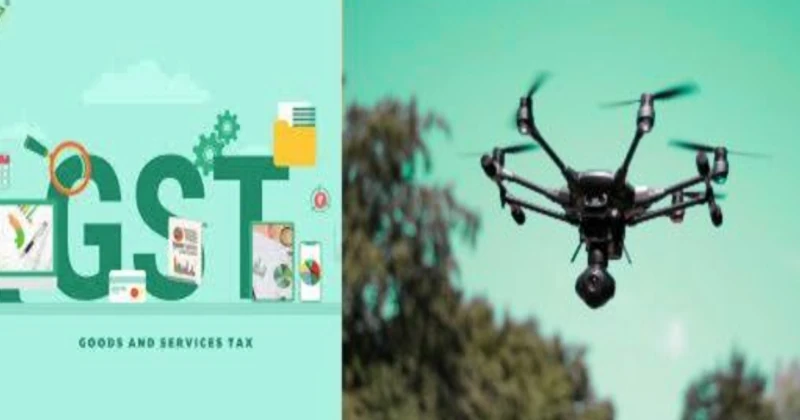
When India rolled out the Goods and Services Tax (GST) in 2017, it was termed the country largest tax reform. GST has been refined over the years to simplify compliance, drive industry and bring down citizens costs. The latest reforms, cleared in the 56th GST Council Meeting, mark a new jump. One of the most important steps is lowering the GST on drones to a standard 5 per cent. This move, when seen in the larger policy context of the government, can potentially transform the face of several sectors, ranging from agriculture to defence.
A Uniform 5 per cent GST: Breaking Barriers
Drones were subjected to two different rates: 18 per cent for camera-equipped drones and 28 per cent for consumer-use drones. This has added unnecessary complexity to manufacturers and users, with frequently disputes. In the new regime, all drones personal and commercial are classified under the same 5 per cent GST slab.
This rate cut makes drones cheaper for both individuals and companies. It also brings clarity for producers, eliminating confusion regarding categories. With a single stroke, the government has lowered prices for end-consumers and made room for quick adoption of drone technology.
Civil Aviation Minister Shri Ram Mohan Naidu welcomed this as a landmark reform and described it as the single largest step in indirect taxation after GST was introduced. By bringing down rates in all key sectors, he asserted, India is deepening its vision of “ease of living, ease of doing business and ease of compliance.” This reform for drones could be the game-changer that gets India closer to its vision of being a world leader in change-making technologies.
How Cheaper Drones Assist Indian Industries
Drones are not only technology driven devices, they are instruments of innovation and efficiency. At a lower price, now they will be affordable for farmers, industry and service providers.
- Agriculture: Farmers are able to utilize drones for monitoring crops, pesticide application and land surveying. Different drone scheme already encourages this and with GST cut, adoption will quicken. This translates into reduced costs for farmers and increased yields due to precision agriculture.
- Infrastructure and Mining: Drones assist in surveying land, construction site mapping and pipeline inspection. Low-cost drones mean they can be used more extensively by companies for safety and low-cost monitoring.
- Logistics: From rural connectivity to last-mile deliveries, drones can be the foundation of a new logistics system. Reduced GST will lead to startups and delivery platforms adopting drones into their supply chains.
- Defence and Security: Surveillance, border control and speedy response operations can be enhanced with more drones being available. India’s emphasis on indigenous production of drones will also make national security stronger.
The exemption of flight simulators and motion simulators by the government from GST adds further to the ecosystem in the form of lowering pilot training costs. This will not only make India utilise drones, but also train a generation of skilled professionals to fly them.
Establishing a Drone Ecosystem: Government Schemes
- GST cut is a well-structured policy matrix in which several schemes are aligning to encourage drones in India.
- Drone Rules, 2021: Streamlined operations, compliance and registration via the Digital Sky Platform.
- Kisan Drone Scheme (2022): Subsidised dispensation of drones, with over 240 already operational and 1,500 Drone Community Centres scheduled.
- Namo Drone Didi Scheme (2024–26): With an outlay of Rs 1,261 crore, this scheme enables women-led SHGs through 80 per cent subsidy (up to Rs 8 lakh per drone), training and income opportunities of up to Rs 1 lakh per annum per SHG.
- Sub-Mission on Agricultural Mechanisation (SMAM): Provides subsidization of up to 100 per cent to institutions and of 40–50 per cent for farmers, FPO’s.
- PLI Scheme for Drones (2021): To increase indigenous production with Rs 120 crore, being increased to Rs 1,000 crore for MSMEs and startups.
- Agriculture Infrastructure Fund (AIF): Extends collateral-free loans of up to Rs 2 crore with 3 per cent interest subvention.
- Svamitva Yojana (2021–25): Employs drones to survey almost 6.62 lakh villages for correct land records.
A new package of $234 million (Rs 1,900 crore) to enhance the production of drones, with targets to reach 40 per cent local component manufacture by FY 2027–28. All these measures of central or state government will be benefited from the GST reform. Combined, they form a policy environment where opportunity meets affordability.
Employment and Industry Impact
Reduced GST on drones will not only favor users but also generate employment. Manufacturing, assembly, software design, analysis and operations of drones will all witness an increase in demand for skilled personnel. Small and medium enterprises will be able to design, make and sell drones within the country more easily, while big corporations can expand with lower tax liabilities.
The encouragement of domestic component production under the new incentive program will further reinforce India’s industrial foundation. By FY 2027–28, the 40 per cent local production target will position Indian drones on the world stage while eliminating import reliance.
India’s identification of drones as both an economic potential and a strategic imperative is noteworthy. Globally drones are considered as essential to future technologies similar to AI, robotics or space exploration. The GST reduction puts India in a position to capture the sunrise industry.
It is also consistent with two national objectives:
- Make in India and Aatmanirbhar Bharat: Promoting local production and minimizing imports.
- Viksit Bharat 2047: Ensuring India achieves developed-nation status by its 100th independence anniversary.
Why the 5 per cent GST Slash Matters
The move to rationalise GST to 5 per cent is more than a reduction in taxes. It is a policy indication that the government wishes drones to be affordable, accessible and a part of India growth narrative. It also eliminates tax classification disputes, which had previously hampered the industry. Today companies can concentrate on innovation and growth rather than resolving complicated tax codes.
For citizens the effect will be seen in various ways: more efficient services, quicker deliveries, improved farm yields and better infrastructure for safety. For the economy, it translates into greater growth, new employment opportunities and international competitiveness.
India’s GST reform for drones is not a tax transformation but a strategic move that connects several government initiatives. By bringing the GST rate down to 5 per cent, the government has made drones affordable, promoted local manufacturing and aided national objectives of self-reliance and technological dominance.
From farmers and startups to women’s SHGs and defence forces, all industries can gain. Paired with central initiatives such as Namo Drone Didi, Kisan Drone Yojana, PLI incentives and the Svamitva Yojana, the 5 per cent GST reform makes drones not only an instrument of the future but moving partners in India’s current growth. This is how tax policy, industrial reform and below-the-surface schemes collect together to create a Viksit Bharat 2047.
















Comments