





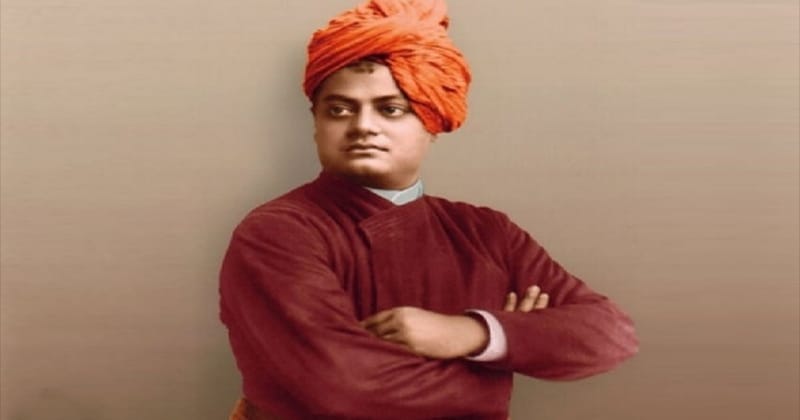
The greatest contribution of Swami Vivekananda was his concourse in bringing the Western world to understand the profundity and uniqueness of Advaita Vedanta, the most prominent school of philosophy within Sanatana Dharma. Westerners began to doubt Christianity and look for eastern wisdom in the last ten years of the nineteenth century. The Theosophical Society, which claimed to embody the highest standards of Dharma and science, arose during that period. It became so well-known that its list of members was like a who’s who of the world.
Swami Vivekananda was a spiritual Guru as well as a rationalist. At the First Parliament of World Religions in Chicago in 1893, he gave a superb discourse to a prestigious western audience, demonstrating his understanding of the Upanishadic teachings and the foundations of Bharatiya philosophy. Many in the audience thought that Bharatiya philosophy offered the ultimate solution to humanity’s quest for the ultimate truth without sacrificing scientific rationality because of how skillfully he conveyed his message, which was both spiritual and logical.
One of Swami Vivekananda’s main accomplishments was to give Hindu Dharma a true identity, a fullness, and a wholeness. Before Swamiji’s arrival, there were only a few of organizations, all of which claimed dominance over the others and were essentially independent. None of these groups shared a solid understanding of Hindu Dharma as a basis. Sister Nivedita says in her Introduction to The Complete Works of Swami Vivekananda: “It may be said that the Swami’s speech before the Parliament of Religions was about “the religious concepts of the Hindus” when he started, but by the time he finished, Hindu Dharma had been established.” For the first time, Swami Vivekananda showed that the overall principles of Hindu Dharma are universal. The unique temperament of Hindu Dharma is derived from these core principles. Swami Vivekananda created the unity and uniqueness of Hindu Dharma. After becoming the first Hindu missionary to the West to travel to America, representing Hindu Dharma in the 1893 Parliament of Religions, and teaching Hindu Dharma in the West, Swamiji became the symbol of the unification of Hindu Dharma. He encouraged Hindu brotherhood, reminded people of their shared heritage and elevated Hindu consciousness through his writings and talks. Hindus developed a feeling of shared community thanks to Swamiji. This new Shankaracharya could be seen as a unifier of Hindu doctrine, according to scholar K. M. Panicker.
Thanks to Swamiji, Hindu Dharma became active and global. He brought a missionary spirit to the Hindu community. He wished that everyone would be enlightened by the ancient spiritual teachings of Bharat, which would spread throughout the world. “Up, Bharat, and use your spirituality to conquer the world,” he said.
Address at the session, Chicago, September 11, 1893
I take pride in being a part of a Dharma that has taught tolerance and acceptance to everyone. In addition to accepting all religions as true, we also believe in universal tolerance. I’m delighted to say that I’m a member of a Dharma where the word “exclusion” is untranslatable in Sanskrit, its sacred language. Being a part of a nation that has provided refuge to refugees and persecuted people from all countries and religions makes me proud. It gives me great pride to say that we have gathered in our bosom the purest of the Israelites, who migrated to southern Bharat and sought sanctuary with us in the year or years that Roman tyranny destroyed their sacred temple. I am honored to be a part of the Dharma, which has protected and continues to support the last members of the ancient Zoroastrian country.
Swami Vivekananda presided over a meeting at which Sister Nivedita (Miss M. E. Noble) delivered a lecture on “The Influence of Indian Spiritual Thought in England” on March 11, 1898, at the Star Theatre, Calcutta. Swami Vivekananda on rising to introduce Miss Noble spoke as follows:
One thing that particularly stood up to me while I was traveling in Eastern Asia was how common Bharatiya spiritual concept is in these nations. You can only imagine how surprised I was to see some well-known Sanskrit mantras written on the walls of temples in China and Japan. Perhaps it will make you even happier to learn that they were all written in ancient Bengali characters and that they still stand as a testament to the energy of our Bengali ancestors.
Beyond these Asian nations, the influence of Bharat’s spiritual philosophy is so pervasive and obvious that, when I dug deep into Western nations, I discovered remnants of the same influence. It has now been established historically that in the past, Bharatiya spiritual beliefs spread both eastward and westward. Everyone is now aware of how much the world owes to Bharat’s spirituality and how powerful its spiritual forces have been to humanity’s past and present. The days of these are over.
Another amazing phenomena that I discover is that that magnificent race—I mean the Anglo-Saxons—has influenced the most amazing capabilities of civilization, as well as advancements for humanity and society. I might even say that we shouldn’t be gathered here today to talk about the effect of our Bharatiya spiritual concept as we are doing if it weren’t for the Anglo-Saxons’ might. Returning to our own nation, I see the same Anglo-Saxon powers operating here, despite all of their flaws, while still maintaining their distinctively positive traits, and I think that the big goal has now been accomplished. Let’s not forget that the Greeks are the source of Western civilization and that the core principle of Greek civilization is expression.
Bharat thinks—but regrettably, there are moments when we think so profoundly that we lose the ability to articulate ourselves. Thus, it gradually became apparent that our expressive power was not visible to the outside world. What is the outcome of this? This is the outcome of our efforts to conceal everything we owned. We are now regarded as a dead nation because of the lack of expression that started with individuals as a faculty of hiding and finished with it being a national habit of hiding. How can we survive without expression? Expression and growth are the cornerstones of Western civilization. I call your attention to this aspect of the Anglo-Saxon race’s effort in Bharat, which is intended to inspire our country to express itself once more and to reveal its hidden gems to the world through the communication channels that the same powerful race has created. Bharat’s future is being shaped by the Anglo-Saxons, however the range of our ancestors’ ideas were astounding.
The Bharatiya youth must stand forward to express deeply to realize Swamiji’s vision for our Dharma and nation. Every word Swamiji spoke made me proud of Hindu Dharma and the nation that provided the globe with amazing knowledge to help it progress spiritually, scientifically and with humanity and environmental considerations for long-term growth.














Comments