





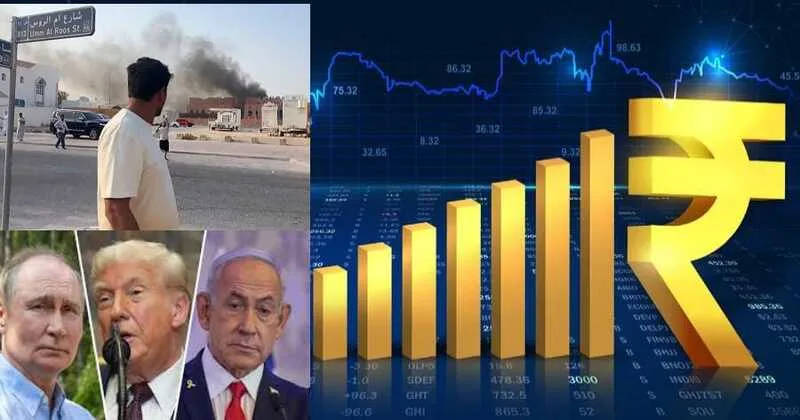
International crude oil markets surged on Monday after Israel carried out an unprecedented airstrike in Qatar, targeting senior Hamas leaders who had arrived in the Gulf nation for ceasefire talks. The strike, which marks the first time Israel has attacked a Gulf country, sent shockwaves across global energy and financial markets already reeling from geopolitical tensions.
According to reports, Hamas senior figure Khalil Azal Hayya and other top officials were in Qatar for negotiations. However, soon after their arrival, a deadly terrorist attack took place in Jerusalem, which Hamas openly welcomed. In retaliation, Israel launched a targeted strike aimed at eliminating the visiting Hamas leadership.
Israel confirmed the operation and said it had informed the United States in advance. Washington later added that Qatar had also been notified, though Qatari officials strongly denied receiving prior warning. US President Donald Trump sought to distance himself from the incident, denying direct American involvement and insisting that the responsibility lay solely with Israeli Prime Minister Benjamin Netanyahu.
Oil shock as Ukraine hits Russian energy; Trump pressures India with tariffs while showing double standards
The unprecedented attack triggered a sharp response in global oil markets. WTI crude futures rose 0.69% to $63.06 per barrel, while Brent crude climbed 0.60% to $66.79. Analysts warned that the strike could ignite fresh instability in the Gulf region, threatening global energy supplies and pressuring import-dependent economies.
Adding to the volatility, Ukraine announced that it had destroyed a Russian gas pipeline capable of transporting 82 million tons annually. Kyiv also confirmed a drone strike on Rosneft’s Ryazan refinery, one of Russia’s largest, which processes around 2.6 million barrels per day. Both developments compounded fears of energy supply disruptions and added to the bullish momentum in crude oil markets.
Economists cautioned that sustained increases in crude prices could weigh heavily on the global economy, widening trade and current account deficits for major importers. Currency markets remain vulnerable to such shocks, with depreciation risks looming over emerging economies. However, the Indian rupee managed to close at 88.12 against the dollar yesterday, gaining three paise.
Meanwhile, trade tensions between the US and Asia resurfaced after President Trump called for 100% tariffs on India over its continued purchases of Russian oil. The move, he said, was part of efforts to squeeze Russian President Vladimir Putin, which shows double standards of Washington for sparing China, the largest buyer of Russian crude.
At the same time, Trump sought to soften his stance on New Delhi, calling Prime Minister Narendra Modi a “good friend” and suggesting that a bilateral trade deal was possible. Writing on his social media platform Truth Social, Trump said talks with India were ongoing and expressed optimism about speaking directly with Modi in the coming weeks. Modi welcomed the comments, signalling that trade discussions could see renewed momentum despite tariff threats.
Global markets tread carefully amid geopolitical tensions and economic uncertainty
Equity markets reacted cautiously to the day’s developments. In India, the Sensex closed 314 points higher at 81,101 (+0.39%), while the Nifty gained 95 points to settle at 24,868 (+0.39%). Early today, the GIFT Nifty rose another 35 points, fueling investor hopes that the Nifty could soon break the 25,000 mark. Gains were led by IT, pharma and FMCG stocks, reflecting sectoral resilience amid geopolitical uncertainty.
In the United States, markets found support from growing expectations that the Federal Reserve could announce a 0.50% interest rate cut this month to stimulate growth. Futures trading was mixed ahead of key US economic data releases. The S&P 500 rose 0.2% and the Nasdaq 100 gained 0.1%, while Dow Jones futures slipped by 80 points. Investors are awaiting fresh factory activity figures today and critical August inflation data due tomorrow, which could shape the Fed’s policy direction.
Asian markets opened higher on Tuesday, mirroring overnight gains in the West. Japan’s Nikkei climbed 0.35%, while other regional indices traded positively. Gold, often a safe-haven asset in times of turmoil, showed volatility ahead of the US inflation print. The precious metal slipped slightly, trading at $3,633 per ounce in the international market, down just $2.
Analysts warn that the combination of Middle Eastern turmoil, rising US–Asia trade tensions, and disruptions in Russian energy infrastructure could heighten global market volatility in the days ahead. With crude oil prices surging and geopolitical risks escalating, concerns are mounting that West Asia could again descend into turbulence, with worldwide economic consequences.
















Comments