





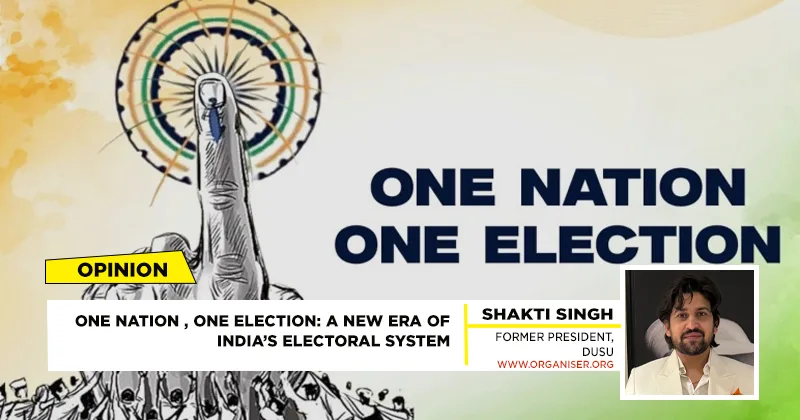
In recent years, the idea of “One Nation, One Election” (ONOE) has emerged as one of the most significant electoral reform proposals in India. Championed strongly by Hon’ble Prime Minister Narendra Modi, the concept seeks to synchronise elections to the Lok Sabha and State Legislative Assemblies so that they are conducted simultaneously across the country. This reform has sparked robust debate, both for and against, but what is undeniable is its potential to reshape India’s democratic and governance landscape. At its core, One Nation, One Election envisions holding elections for the Lok Sabha (Parliament) and all state legislative assemblies simultaneously, once every five years. Instead of multiple electoral cycles spread throughout the year, India would have a single synchronised cycle. Panchayat and
municipal body elections, which are under State purview, could either be aligned subsequently or retained on separate timelines. In practice, this would mean that when voters go to the polling booths, they would cast two votes simultaneously—one for their Member of Parliament and one for their Member of the Legislative Assembly.The Election Commission of India (ECI) would thus conduct a single large-scale electoral exercise instead of organising elections in different states every few months.
India, the world’s largest democracy, also has one of the most expensive electoral processes. Elections in the country involve mammoth logistical arrangements: millions of polling booths, electronic voting machines (EVMs), security forces, polling personnel, and infrastructure
mobilisation. The 2010 Lok Sabha elections alone cost the exchequer around Rs 60,000 crore (including both government expenditure and political party spending, according to the Centre for Media Studies). A single state assembly election often costs several thousand crores,
including deployment of paramilitary forces, printing and transport of EVMs, and administrative overheads. Repeated elections divert significant resources: for example, during each Election, over 10 lakh government officials and security personnel are redeployed from regular duties. By synchronising elections, substantial savings in public expenditure can be achieved.
Manpower that is repeatedly diverted for election duties could remain focused on developmental and administrative work.
Several democracies around the world conduct synchronised national and regional elections, ensuring efficiency and stability. South Africa, for example, holds national and provincial elections simultaneously once every five years. This system provides clarity of mandate and reduces administrative costs. Sweden conducts elections to the Riksdag (national parliament) and local governments together every four years, ensuring harmony between governance levels. Similarly, Belgium organises simultaneous elections to federal, regional, and community parliaments to promote smoother governance coordination. These models demonstrate that synchronised elections are both practical and beneficial, creating electoral coherence while reducing resource strain.
The idea of simultaneous elections is not new to India. In fact, India practised it in the early years after independence. From 1951–52 to 1967, elections to the Lok Sabha and State Assemblies were held together. This system broke down when some state assemblies were
dissolved prematurely due to political instability, leading to unsynchronised cycles. Over time, frequent imposition of President’s Rule and early dissolutions widened the gap further, and India moved into a cycle of continuous elections. Thus, the current fragmented electoral calendar is not inherent to India’s democracy but a product of political contingencies.
Beyond cost and efficiency, the larger benefits of One Nation, One Election lie in governance stability and effectiveness. Model Code of Conduct (MCC), which comes into force during
elections, restricts the announcement of new schemes and projects. With elections scattered throughout the year, governance is repeatedly stalled. Simultaneous elections would reduce such interruptions. A consolidated election would also enable political parties to concentrate on policy implementation in between electoral cycles in a focused manner. And most importantly, citizens would have a clearer choice between national and state agendas in a single electoral moment, reducing fatigue and increasing turnout.
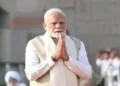
Prime Minister Narendra Modi has been the leading force behind reviving this debate. He has consistently emphasised that ONOE is not merely an administrative reform but a democratic necessity for a New India. In his speeches, PM Modi has argued that repeated
elections burden the economy, hinder governance, and impose unnecessary stress on citizens and the Election Commission alike. His leadership has ensured the idea is not just a theoretical proposal but a subject of serious discussion, with committees and think tanks examining its feasibility. This initiative reflects visionary leadership that focuses not on immediate political gains, but on long-term systemic reform.
Although there are also some legislative and technical challenges in the implementation of this reform, however, none of these challenges is insurmountable. With political consensus, phased implementation can pave the way. One Nation, One Election is not merely a logistical reform; it is a democratic reform. It promises to make India’s electoral system more efficient, cost-effective, and development-focused. The historical precedent, global examples, and governance benefits all point to its potential to strengthen India’s democratic fabric. By reducing election-related disruptions, saving resources, and enabling governments to focus squarely on policymaking, ONOE can empower both voters and institutions.
As India enters the Amrit Kaal of its democratic journey, this reform, envisioned and pushed forward by Honourable Prime Minister Sri Narendra Modi ji, could become a defining step in building a governance system that is efficient, stable, and truly responsive to the aspirations of 1.4 billion citizens.











Comments