





According to the World Health Organisation (WHO), in 2022, 1 in 8 people in the world were living with obesity. Worldwide adult obesity has more than doubled since 1990, and adolescent obesity has quadrupled. Over 390 million children and adolescents aged 5–19 years were overweight in 2022, including 160 million who were living with obesity. In 2024, 35 million children under the age of 5 were overweight.
The National Family Health Survey-5 (NFHS-5) indicates that 6.4 per cent of women and 4.0 per cent of men aged 15-49 are obese in Bharat. 3.4 per cent of children under 5 years are overweight (weight-for-height) at all-India level. Prevalence of abdominal obesity in the country was found to be 40 per cent in women 12 per cent in men. The findings show that 5 to 6 out of 10 women between the ages of 30 to 49 are abdominally obese.
The ICMR-INDIAB-17 cross sectional study done by RM Anjana et al, showed that the overall weighted prevalence of diabetes was 11·4 per cent, prediabetes 15.3 per cent, hypertension 35.5 per cent, generalised obesity 28·6 per cent, abdominal obesity 39.5 per cent, and dyslipidaemia 81.2 per cent. All metabolic NCDs except prediabetes were more frequent in urban than rural areas.
A cross-sectional study published in 2021 by Venkatrao M et al, said that the prevalence of obesity in Bharat is 40.3 per cent. Southern Bharat was highest at 46.51 per cent and east lowest at 32.96 per cent. Obesity was higher among women than men (41.88 per cent vs. 38.67 per cent), urban than rural (44.17 per cent vs. 36.08 per cent), and over 40 than under 40 (45.81 per cent vs. 34.58 per cent). More education implied a higher obesity (44.6 per cent college vs. 38 per cent uneducated), as did lowered physical activity (43.71 per cent inactive vs. 32.56 per cent vigorously active).
Health problems associated with excess weight include inflammation, heart disease, type 2 diabetes, high blood pressure, obstructive sleep apnea, Metabolic dysfunction-Associated Steatotic Liver Disease (fatty liver), Polycystic Ovary Syndrome (PCOS), high lipids, hormonal imbalance, some cancers, osteoarthritis, etc. Studies have shown that there is a difference in the gut microbiome of obese and lean people.
Although Body Mass Index (BMI) was earlier considered as a measure for obesity, in recent times, waist circumference, body fat and waist to height ratio have emerged as equally important measures. A BMI of 18.5 to 22.9 kg/m2 is considered as normal for Bharatiya population. 23 to 24.9 kg/m2 indicates overweight and 25 kg/m2 and above indicates obesity. Waist measurement which when high indicates abdominal obesity should preferably be below 90 cm in men and 80 cm in women to prevent health problems. A waist to height ratio greater than 0.5 indicates obesity.
The main reason for obesity in our country is lifestyle changes. Although there’s genetic influence and the thrifty gene in Bharatiyas plays a role in excess fat storage, major changes in our lifestyle in the last 2 to 3 decades are responsible for the burgeoning obesity problem. Poor eating habits, irregular meal timings, sedentary living, low activity levels, inadequate sleep, unmanaged stress, increased screen time, unhealthy packaged or ultra-processed foods which are imported or adopted from other countries, and many other factors contribute to obesity. Over the years, western food chains serving quick foods like burgers, fried chicken, aerated beverages, and so on have spread across the country influencing the change in our food habits. In urban areas, family meal times have reduced and other factors like unhealthy evening snacks, ready-to-eat foods, ultra-processed food intake, larger portion sizes, eating out and ordering in, have increased manifold. At times, living alone and lack of cooking skills may make a person dependent on restaurant or street foods which are not always nutritious.
Food choices, healthy or unhealthy, are influenced by personal preference, availability, cultural influence, emotions, convenience, stress, social setting, peers, and health awareness. Therefore, nutrition literacy becomes important in the ever-changing food scenario in Bharat.
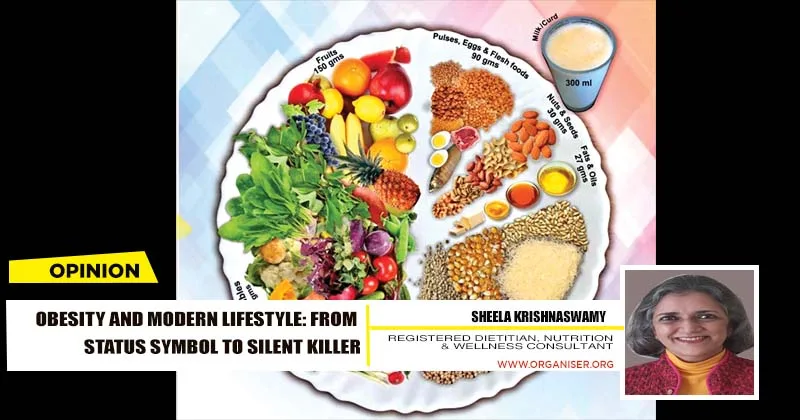
The ICMR-National Institute of Nutrition released the latest dietary guidelines for Bharatiya population last year. The ‘My Plate for the Day’ pictorial depiction shown below makes it easier to understand the food recommendations for the general public.
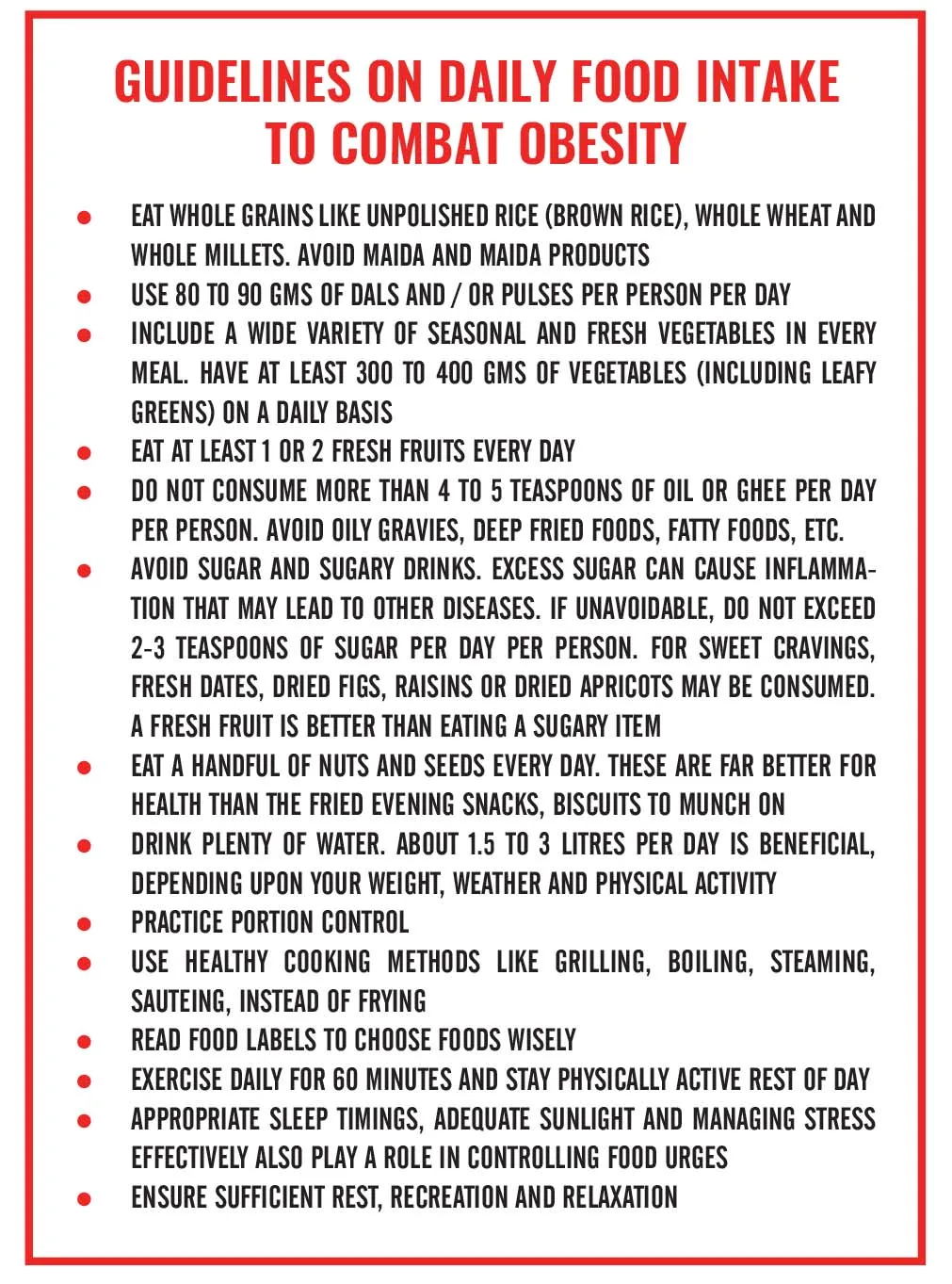
Mindful eating is as important as eating healthy. When one eats mindfully, one would eat using the five senses – seeing the food, smelling it, touching it, listening to the sounds and tasting it. The intent is to enjoy and be aware of the eating experience but it works well for weight management too. Mindful eating also makes one chew well and be more aware of satiety that helps to stop eating when one is almost full, thereby reducing total food intake. While savouring every morsel, the tendency is to select foods with health benefits.
The Government of India has launched several initiatives, including the Fit India Movement, NP-NCD, POSHAN Abhiyaan, Eat Right India, and Khelo India, to promote healthier lifestyles, better nutrition, and physical activity. These programmes aim to encourage long-term behavioral change, ensuring a healthier future for all.
Obesity is not one person’s responsibility. Multiple partners need to come together to combat obesity in our country. Healthcare professionals, especially qualified dietitians-nutritionists, are best equipped to guide individuals in their fight against obesity. To support this, there needs to be involvement from family, close friends, neighbours, co-workers and so on. Engaging local community also helps in encouraging physical activity and eating healthy. Health awareness workshops and lifestyle intervention programmes held at educational institutions, workplaces, public groups, voluntary societies, etc, may go a long way in changing behaviours en masse. Food industries need to be more open to manufacturing healthier foods by reducing fat, salt, sugar, refined ingredients and additives in the packaged foods. People’s choices are moving towards natural, additive-free, sugar-free, clean foods. Government policies need to include supporting healthier foods through incentives to grow & sell whole grains, vegetables, fruits, seeds, nuts, etc, and higher taxes for sugary, high fat, high salt, ultra-processed foods, as also more open spaces and gardens, pollution control and so much more.
Finally, it takes the entire nation to come together to make it healthier for a better tomorrow and our future generations!
















Comments