





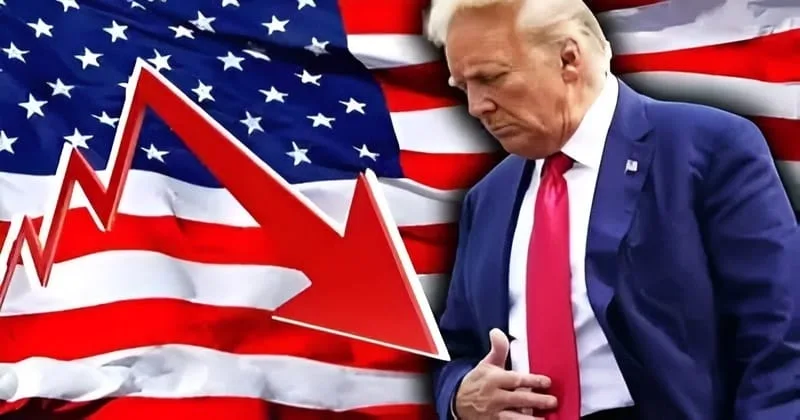
US President Donald Trump’s preoccupation with the Nobel Prize continues to shape his global strategies. Convinced that brokering peace in the Russia–Ukraine conflict could deliver him the Nobel Peace Prize, Trump made a series of diplomatic moves with that objective in mind. But when his efforts failed, his attention turned sharply toward India. He accused New Delhi of undermining American efforts by purchasing oil from Russia. In retaliation, Trump doubled tariffs on Indian goods. Now, predictions are emerging that Trump’s tariff-heavy policies could ultimately backfire on the United States itself.
One of the most striking warnings has come from Mark Sandey, a highly regarded economist and the chief economist at the rating agency Moody’s. Sandey, who famously predicted the 2008 global financial meltdown, has now raised alarms about a looming recession in the US. According to him, states that together account for nearly one-third of America’s GDP are already sliding into economic contraction, and other states are likely to follow the same path.
In a social media post, Sandey bluntly stated that these states are heading towards recession, with the crisis threatening to spill over to all Americans. He cautioned that the cost of living will rise steeply, job security will weaken, and inflation will hit levels that cannot be ignored. His warning comes at a time when many households are already grappling with higher prices in the market, a direct consequence of Trump’s tariff-led economic policies.
Sandey forecasts that the current annual inflation rate of 2.7% could surge to nearly 4% within the next year. Such a rise would erode consumer purchasing power and deepen financial strain on households. Adding to the gloom, he expressed concern about shrinking opportunities in the job market.
Weak jobs, falling demand, and housing strains push US toward recession
Supporting these warnings, the US Bureau of Labor Statistics (BLS) recently revised its employment estimates for May and June downward to 258,000 jobs. This represents the lowest three-month recruitment pace since the pandemic-triggered economic slump of 2020. Even more troubling, the average monthly job growth in 2025 has slipped to 85,000, a stark decline from the pre-pandemic average of 177,000.
The signs of a slowdown are visible across multiple sectors. Consumer spending, traditionally the backbone of the US economy, is showing its weakest growth since the 2008–09 financial crisis. As households reduce spending to cope with rising prices, company revenues are expected to fall, creating the risk of a broader financial downturn. Inflationary pressures, compounded by tariffs and supply chain disruptions, threaten to undermine the resilience of ordinary Americans who now face the dual burden of higher costs and unstable jobs.
The housing market, another crucial pillar of the US economy, is also faltering. Rising borrowing costs and weaker consumer confidence have placed both buyers and sellers in difficult positions. Adding to these stresses are government job cuts in specific areas such as Washington, D.C., which directly affect employees dependent on public-sector work.
While large economies such as California and New York are so far managing to “hold up” despite mounting pressures, Sandey has flagged growing vulnerabilities in several other states. Wyoming, Montana, Minnesota, Mississippi, Kansas, and Massachusetts, he warns, are already on the brink of recession. If the trend continues, more states could follow suit, pushing the entire nation into an economic slump.
Overall, the US economy is battling a dangerous mix of high inflation, sluggish employment growth, weakening consumer demand, and housing sector problems. Analysts argue that these combined pressures could soon converge into a full-blown recession, reminiscent of earlier economic crises
Diplomatic thaw with India as US faces deeper economic troubles
Meanwhile, India continues to monitor developments closely, especially regarding its strained relationship with Washington. Observers note that Prime Minister Narendra Modi is carefully weighing whether to move forward with his planned visit to the United States. Reports suggest that Modi and Trump may hold a telephone conversation soon to ease tensions. According to sources, Modi’s visit will only go ahead if the atmosphere improves.
The tensions escalated after Trump initially accused India of leaning towards China, a remark that drew sharp criticism in New Delhi. However, Trump later softened his stance, describing India as an important partner and hinting at reconciliation. Modi, in turn, welcomed Trump’s correction, emphasising that India and the United States share a “special relationship.”
External Affairs Minister S. Jaishankar reinforced this position by stating that ongoing communication with Washington is being maintained. Government sources added that if Trump sustains his more conciliatory approach, Modi’s US visit could indeed materialise.
Seeking to calm nerves, Trump himself publicly underlined the strength of his ties with Modi. “I have a good relationship with Modi. Modi is a great leader, a great Prime Minister. I do not agree with what he is doing now, but there is a special relationship between India and the US. We will resolve this,” he declared.
Jaishankar echoed this cautiously optimistic tone, remarking: “The Prime Minister has a good relationship with President Trump. There is communication between India and the United States. That is all I can say right now.”
Yet the larger economic story remains firmly within the United States. Trump’s fixation on personal achievements, particularly his pursuit of the Nobel Peace Prize, has led to a series of risky diplomatic and economic moves. His failure to secure a breakthrough in Ukraine not only strained his credibility but also drove him to adopt punitive measures against long-standing partners such as India. Now, as economists like Mark Sandey issue stark warnings, the possibility of Trump’s policies backfiring looms larger than ever.
If Sandey’s predictions hold true, Americans could soon be confronting the reality of surging inflation, falling job security, weaker consumer spending, and deepening economic anxiety. For many households already stretched thin, the prospect of another recession carries painful memories of past crises.
The coming months will be crucial. Whether Trump adjusts course or doubles down on his tariff-heavy strategies may decide not only the fate of the American economy but also the stability of its ties with allies such as India.











Comments