





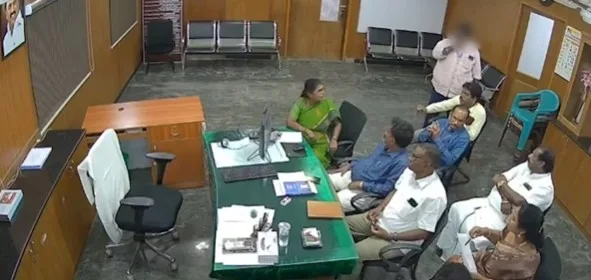
A shocking incident from Tindivanam Municipality has triggered outrage after a viral video showed a Dalit Junior Assistant falling at the feet of a woman councillor following heated exchanges. The act, widely condemned as inhuman and humiliating, is suspected to have been forced upon him.
Police swung into action after public anger and protests by activists, arresting councillor R Ramya; Ravichandran, husband of Municipality chairperson R Nirmala; Ramya’s husband Raja alias Maroorm Rajar; Nirmala’s personal assistant Kamaraj; and Selvam, husband of another councillor.
The arrests followed a complaint lodged by S Muniappan (35), a staff member from Roshnai in Villupuram district, who alleged that he was subjected to humiliation for failing to trace on time a file sought by councillor Ramya. The file reportedly related to a 2021 contract.
District SP Saravanan registered the complaint and booked the accused under relevant sections.
Tamil Nadu former BJP chief K Annamalai in a post on X said:
“This is DMK’s model of Social Justice. A public servant belonging to the Scheduled Caste community in Tindivanam was cornered continuously by DMK Councillors and was made to apologise by falling at the feet of the DMK Councillor Ramya. This is not the first time DMK has humiliated public servants. This is not an isolated incident; earlier, DMK Minister Thiru Raja Kannappan had abused a government servant with caste slurs. What the DMK parades as Social Justice is, in truth, nothing more than Social Injustice.”
This is DMK’s model of Social Justice.
A public servant belonging to the Scheduled Caste community in Tindivanam was cornered continuously by DMK Councillors and was made to apologise by falling at the feet of the DMK Councillor Ramya. This is not the first time DMK has… pic.twitter.com/XrjNvtPvAN
— K.Annamalai (@annamalai_k) September 3, 2025
It is learnt that some Municipal officers were also present when the inhuman incident took place. Ramya filed a counter-complaint against Muniappan, saying he was trying to touch her inappropriately. She alleged that he had grabbed her hand while trying to hold her chair with his left hand, and acted improperly while she attempted to push him away.
This is not first such kind incident under the Dravidian Model of social justice and equality, which the DMK has been repeatedly claiming. The party continues to accuse Brahmins, Manusmriti, Varnaashrama Dharma, and Sanatana as the root cause of social discrimination and untouchability. Yet, in some southern parts of Tamil Nadu, the social discrimination is an issue with dual-tumbler system, where Dalits finding difficulty from hairdressing services and temple entry, and even objections on procession of dead bodies on the common roads.
Some of the reported incidents are quite disturbing, but they show how the DMK government is ignoring such issues and failing to bring social harmony to society, despite its claim of being a champion of it.
In Mothakkal village, Thandrampet taluk of Tiruvannamalai district, authorities halted the funeral procession of a 56-year-old Dalit woman on 30 September 2024, preventing it from passing through a common path shared by both all Hindus including dalits. The deceased, T. Kiliyammal, who died in Chennai was brought back to her native village for cremation. When they decided to use the common tar road for her funeral, breaking from the customary mud road historically used by Dalits, local officials intervened, citing possible law and order issues.
Prior to the 2021 Assembly elections, the National Commission for Scheduled Castes directed a probe into a DMK party meeting in Coimbatore, where Rajya Sabha MP Anthiyur Selvaraj, belonging to the Arundathiyar community, was asked not to mingle with party seniors and to sit in a chair below the dais. This, critics said, was the DMK’s way of showing honour to the Dalit community.
DMK Minister PTR Palanivel Rajan’s son’s remarks against barbers invited ire. In 2020, Dayanidhi Maran also faced criticism for comments after meeting the Chief Secretary. Former RS MP R S Bharati said Dalits could become judges in the higher judiciary “because of DMK’s alms”.
R S Bharati also said earlier that it was only because of the Dravidian movement that Dalits were given alms and rose to become judges in Tamil Nadu. Referring to a judge, he reportedly said that many Dalits were inducted into the judiciary because of the indulgence of the DMK leadership during former CM Karunanidhi’s tenure. He is now facing a court case in this connection.
In another incident, a woman panchayat member was discriminated against on the basis of her caste. Gauri Maharajan, originally from Muthuvanthidal near Thirupuvanam in Sivagangai District, belongs to the Scheduled Caste community and serves as the head of the Panchayat Council. Rajkumar, a member of the backward class in the same panchayat and serving as secretary, allegedly prevented Gauri Maharajan from occupying the chair designated for the council chairman during a general meeting. Deeply hurt, she complained to the District Collector and expressed her intent to resign if no action was taken.
பட்டியலின ஊராட்சித் தலைவரை இருக்கையில் அமரவிடாமல் மிரட்டல் விடுத்ததாக புகார்! pic.twitter.com/lqDEXMhBbU
— @JuniorVikatan (@JuniorVikatan) May 14, 2024
Another occurrence in Pudukottai on May 14, 2024 involves Manimuthu, president of the Thirunalur Panchayat Council affiliated with DMK. During the renovation of the 50-year-old panchayat office building, a group including Thennalur Palaniappan, Deputy Secretary of the DMK Literary Wing in Pudukkottai District, allegedly obstructed the work. Palaniappan reportedly responded with derogatory remarks, insinuating that Manimuthu, despite being elected, lacked legitimacy to lead. Tensions escalated with verbal altercations laced with caste-based insults. Despite filing a complaint at Iluppur Police Station, no action was taken, prompting Manimuthu to approach the District Collector and SP for redress.
AIADMK’s Malarkodi Srinivasan, Chairman of the Kadichambadi Panchayat Council, filed a complaint at the Swamimalai police station demanding action against those responsible for removing her name from a plaque after the inauguration of the newly constructed Panchayat office on 10 August 2023. She said:
“After five decades in Kadichambadi, I hold the position of a marginalised woman leading the Panchayat. However, I face social barriers hindering my authority.”
In April 2024, Tirunelveli Corporation’s DMK Councillor K Chinnathai alleged caste-based discrimination in the supply of drinking water in her ward and resigned on April 23.
A survey conducted a couple of years ago by the Tamil Nadu Untouchability Eradication Front (TNUEF) found shockingly that many Dalit Panchayat presidents were not even allowed a chair in their offices. There were instances of SC and ST Panchayat presidents being barred from hoisting the national flag on Republic and Independence Days.
Governor R.N. Ravi had expressed concern over the “rise in caste atrocities in the State”. He referred to incidents including the mixing of human faeces in a Dalit hamlet’s water tank in Vengaivayal, denial of temple entry, and discrimination in local bodies. Governor Ravi said:
“P Indumathi (of Navakkaneri village panchayat, Tirupattur district), could not take the oath of office, two years after winning the rural local poll, as she belonged to the SC community… This trend in the escalation of caste atrocities should be viewed seriously. These are the people who always spread poison in society. They are the people who have kept society divided and, in the name of social justice, have still kept a large population of our country, especially SC and ST people, suppressed.”
Icchipalayam Panchayat president Rajkumar, a person belonging to SC community, was forced to sit on the floor while in Kodumudi, DMK block-level secretary Chinnaswamy sat on a chair. SHRC issued a notice to the District Collector to file a detailed report. In Mel Bhuvanagiri block, Theruku Thittai Panchayat president Rajeswari Saravana Kumar, from the SC community, was not allowed to sit on a chair at meetings or hoist the national flag. Unable to bear the ill-treatment, she lodged a complaint.
Local observers point out that while the DMK blames Brahmins at the top and continues to oppress members of the Scheduled Castes at the bottom, the incidents clearly reveal that the party has no real connection with social justice. In contrast, the BJP has elevated Dalit and tribal leaders to the highest offices Ram Nath Kovind and Droupadi Murmu as Presidents of India, L Murugan as Tamil Nadu BJP chief, and Maa Venkatesan as National Safai Karamcharis Chairman.
Senior journalist Nambi Narayanan earlier said, “There is no second opinion that DMK is a party for upper castes. There were two-tiered daises in DMK meetings, one above another like sleeper class in trains. DMK questioned Jayalalithaa who did not allow party seniors to sit next to her. She never allowed separate sitting arrangements for dalits like what Stalin did recently. Karunanidhi appointed a one-man commission under Justice Janardhanan who left within 8 months under pressure. The commission’s report never saw the light of day. Why was Stalin’s elder brother MK Azhagiri living in Madurai? Because he married a Dalit girl. DMK family never accepted his marriage and did not allow him in any family functions. Caste conflicts have existed in the DMK’s first family since Karunanidhi’s days. It is highly prevalent in the party too. The Justice Party and DMK did not do anything for dalits. It was a party of upper-caste Hindus like Mudaliars and Reddiyars.”
So nothing surprises those who follow Tamil Nadu. The Dravidian parties’ claim that this is the soil of Ramaswamy Naikar, whom they say was a reformist who fought caste discrimination, is nothing but hollow.














Comments