





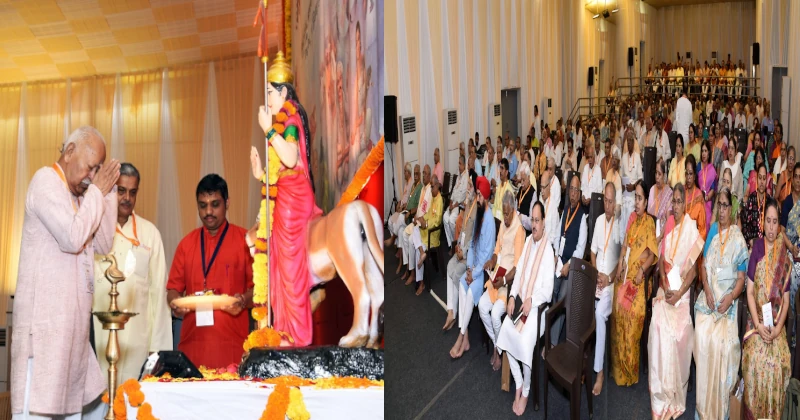
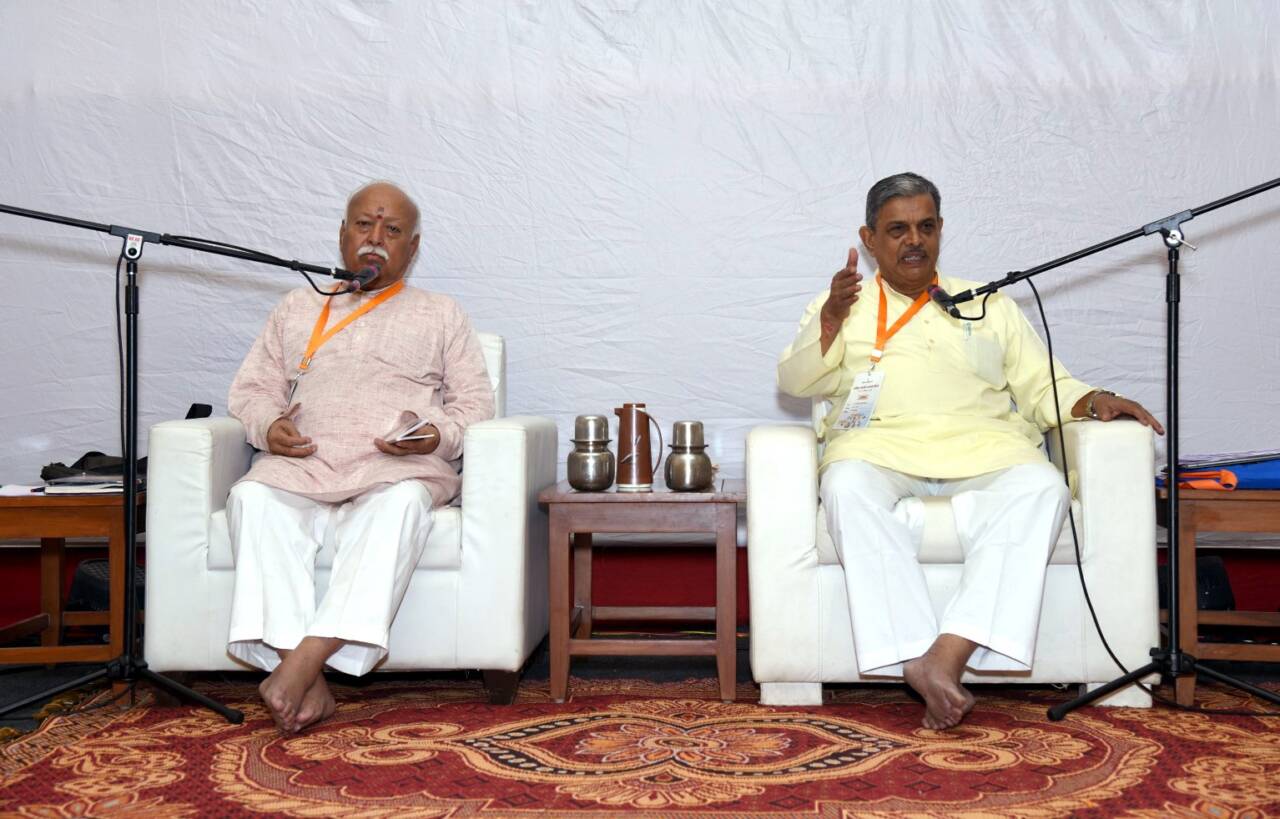
The Akhil Bharatiya Samanvay Baithak of Rashtriya Swayamsevak Sangh is being organised in Jodhpur, Rajasthan from September 5 to September 7, 2025. The three days Akhil Bharatiya Samanvay Baithak is generally organised once in a year. During this meeting, activists of Sangh inspired organisations will share the information and exchange experiences about their respective work.
How RSS came into existence?
A small organisation that began in an open ground with around 14-15 teenage boys brought together by a former revolutionary and political leader has blossomed today into a giant banyan tree with so many branches and roots that it is difficult to distinguish between the main trunk and various branches that have struck roots on their own and many that have grown independently under its benign shadow.
It reminds me of the legendary giant banyan tree in Kolkata described thus in a Times of India report – “Estimated to be more than 250 years old, the Great Banyan is occupies an area of 4.67 acres! […] We all know how banyan trees extend their aerial roots, and they spread and cover a very large area. But is it possible without the main trunk? Looks like it is. The Great Banyan lost its original trunk to disease after being struck by two massive cyclones, and so in 1925, its original trunk had to be removed in order to stop the spread of the disease. That didn’t stop the tree from growing, and grew it did! A total of 3772 aerial roots to be precise!”
From Shakha to mass organisation
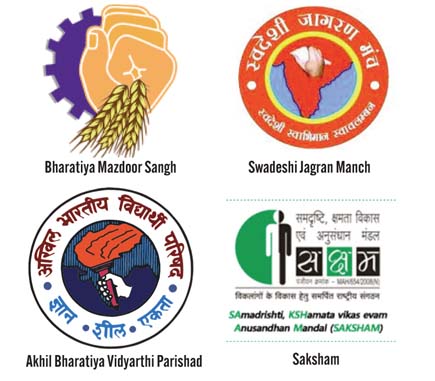
This is the closest one can get to understand the vast expanse of RSS through its various allied organisations working in almost every field of social and national life. There are 36 national level organisations inspired by RSS philosophy – beginning with Rashtra Sevika Samiti (RSS of women in 1932), Akhil Bharatiya Vidyarthi Parishad (ABVP in 1948), followed by Vanvasi Kalyan Ashram (in 1951) to Bharatiya Janata Party (1951), Bharatiya Mazdoor Sangh (1955) and Vishva Hindu Parishad (1964) – all mass based giant organisations to the youngest Saksham (2008 – working with the divyang or differently abled people) working in a niche area; people inspired by RSS philosophy are working to the best of their abilities with full dedication.
Those who have a little idea about these mass organisations know that many of them have more membership than even RSS. Scholars like Nalin Mehta tell us that BJP (with 18 crore members) has many times more members than RSS and RSS can no more influence BJP or dictate BJP the way it could earlier. Others in different social sphere are number one organisations in their respective fields. In 2008 VHP claimed to have 68 lakh members, ABVP has 45 lakh student members. BMS has a membership of nearly 1 crore with 5000 unions under its flag. There are smaller specialised organisations that have changed the direction of Indian history, like Itihas Sankalan Samiti established by renowned archaeologist Haribhau Wakankar by discovering evidences that demolished the Aryan Invasion or Migration Theory. Then there is Sewa Bharati, an apex body co-ordinating work of social service with over 150 thousand social service projects. Ekal Vidyalaya (single teacher, any time schools in remote areas) has crossed a figure of 1 lakh schools, replicated by many other organisations independently.
In such a scenario, how does the trunk that fed the original sap to these huge branches keep track of its expanse and keep nurturing them with the vital spirit of philosophy without which they may be cut off from the huge family some day even as they survive on their roots that they have struck.
Spirit of extended family
This is the question that many inquisitive people ask. It is a question that has baffled many social scientists. They have tried to find answers in their western organisational models. The answer, however, lies in the Bharatiya roots of this organisation. It is a unique organisation in terms of management and organisational structure though it looks like a typical pyramid like structure if one looks at it superficially. You can see the hierarchy from the local units of an RSS shakha at the base, you see a mandal (a local geographical group of a few shakhas, tehsil, district, state, region and finally an elected Pratinidhi Sabha and a national executive presided over by the Sarsanghchaalak. Similarly, you see such organisational structures in all its allied organisations. What is the difference between other organisations and RSS then? What helps it work harmoniously for nearly 100 years within and without, with its allied organisation?
Answer lies in a pithy observation made by the fourth Sarsanghchalak, Prof Rajendra Singh aka Rajju bhaiyya. He noted that RSS is a family organisation, not a cultural or social organisation etc. With family comes, affection, taking care of each other, mutual bonding, readiness to sacrifice for others in the family and readiness to listen to each other and respecting the elders’ views and ability of the senior members to take along other members of the extended family – samyukta parivar.
There are smaller specialised organisations that have changed the direction of Indian history, like Itihas Sankalan Samiti established by renowned archaeologist Haribhau Wakankar by discovering evidences that demolished the Aryan Invasion or Migration Theory
Consensus building is not a much valued quality in today’s organisations. Fierce competition, influencing decisions with lobbying and pushing your ideas with majority vote, to win at any cost are the major attributes in other organisations – commercial, social and political. In our nation, where we enjoy multiplicity of views and respect every view, where we love to argue endlessly, ending up with misuse of this respect for multiplicity and creating more fault lines; RSS has perfected the art of consensus building. It is easier to achieve this consensus because the relations between its members are built selflessly and like a family. The warmth of relations doesn’t allow any argument or discussion to go beyond a point of no return. It delays the decisions, but it also helps take everyone along.
Now, extend this logic to the larger ‘parivar’ of RSS inspired or allied organisations. Since, all of them are generally started by an RSS swayamsevak or aligned organisations, he or she carry with them this skill of consensus building and also relationship building. As I note elsewhere in my writings, RSS doesn’t just build IQ, it builds EQ and SQ – Emotional quotient and social quotient. Thus, none of its allied organisations split. A few members may have walked out, some returning subsequently, but none tried to break their organisations.
As RSS ecosystem grew over years, a need was felt to have some kind of co-ordination, so different organisations knew what their sister organisations were doing in their own field. Therefore, periodic ‘samanvay baithaks’ or co-ordination meetings began taking place. It helped them appreciate each other’s work and also empathise with their area of work. This understanding of each other’s work and conditions in which they worked, helped avoid any clash that might develop when they come from fields that may be considered as antagonist to each other. For example, a Laghu Udyog Bharati member may have some problem with a Bharatiya Mazdoor Sangh trade union in his factory. Or a Swadeshi Jagaran Manch or Bharatiya Mazdoor Sangh may not like some policies of BJP. And we see them criticising BJP or opposing a policy. But there are occasions when both sides meet in a ‘samanvay baithak’ and understand each other and try to work out some consensus or hold their ideas till a solution is found. Here, the role of the RSS is only that of a facilitator; it does not guide or push its views on others.
How does RSS control its urge to dictate terms to its allied organisations? It is the spirit of autonomy. It is a misunderstanding that RSS does micro-tunes its organisations. Its role is only to share its views on various issues and it is upto the other organisation whether to accept it or not. Yes, there is a strong moral pressure when the Sarsanghchaalak or Sarkaryavaah make a point. This is the reason that the top leadership thinks multiple times before it shares its views with the other organisations. Generally, the leadership responds when the other organisation reaches out for a solution or advice.
Autonomous, still connected
The spirit of autonomy is kept alive by treating organisations as equals. In early days, it was RSS that was the providing necessary human resources and even prachaaraks for a particular work. At that time too, it would urge the organisation to create its own cadre. Slowly, most of the organisations have been able to have their own workers/karyakartas and own working style depending on the field they are in. Thus, RSS may have been the provider of seed capital, but it does not hold equity beyond that. Understanding this, the RSS seniors try to give advice but not force it, respecting an organisations own compulsions and area of expertise.

I have been reading about Communist party these days for my new project. I find that this spirit of giving autonomy to the others in the organisation, creating consensus with serious efforts and nurturing the spirit of affection of a family is missing there. It is a structure that holds people in certain hierarchy for organisation purpose, nothing more. So, is it in most of the organisations.
We recall the construction of Vivekanand Rock Memorial, struggle against Emergency for restoration of democracy, Ram Mandir movement, campaign for ‘shat pratishat matadaan’ (100 per cent voting) conducted by the larger ‘Sangh Parivar’ in a coordinated manner in 2014 and its enormous impact on the society of all these activities. As time passes, the direction of RSS founder Dr KB Hedgewar that RSS should not be an organisation within the society, but an organisation of the society is coming to fruition. Even without formally attending RSS Shakha many are imbibing or following Sangh way of thinking and functioning – that is the biggest success. There are more Sanghis who have never been to Shakha than Shakha trained swayamsevaks, that is the success of coordination – the RSS Way. The evolution of RSS from an organisation to a movement is the result of this co-ordination or samanvay managed by RSS since years.
Fortunately for RSS, and unfortunately for other organisations, no one has studied or researched RSS with this view point. Their gaze on RSS has always been to find fault. For RSS, samanvay or harmonious co-ordination within and with organisations allied with it is a serious business, and that is the secret of the harmonious existence of this large Hindu Undivided Family.















Comments