





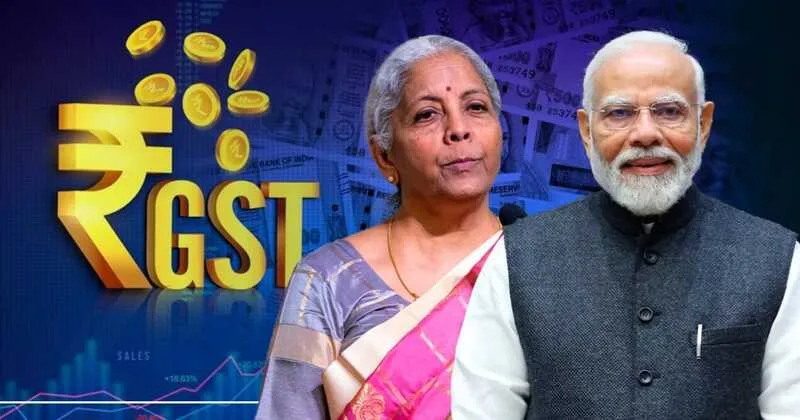
The Goods and Services Tax (GST) Council has brought major relief to ordinary citizens as well as businesses by simplifying the tax structure and reducing the slabs and rates. In a move that will directly ease the financial burden on households, GST has been completely eliminated on a range of essential items such as milk and paneer. At the same time, tax on many everyday products including butter, ghee, cashew nuts, almonds, chocolate, biscuits, cornflakes, soups, jam, condensed milk and ice cream has been reduced to 5 percent, down from the current 12 to 18 per cent.
The Council has taken a decisive step to overhaul the structure of GST by abolishing the 12 percent and 28 percent slabs altogether. Initially, there had been speculation that the 12 percent slab would simply be merged with the 5 percent rate. However, the decision to also move several items from the 18 percent bracket into the 5 percent category represents an even greater benefit for consumers. Products and services considered luxurious, which were earlier placed in the 28 percent slab, along with goods such as cigarettes and pan masala, which fall under the category of ‘sin products,’ will now be subject to a separate GST rate of 40 per cent, marking a clear distinction between essential and discouraged consumption.The revised GST rates are scheduled to take effect on September 22, coinciding with the start of the Navratri festival season. However, the newly introduced 40 percent tax on cigarettes and pan masala will not be implemented immediately. For the time being, GST on these products will remain at 28 per cent, Union Finance Minister Nirmala Sitharaman announced following the Council meeting.
Reforms Bring Relief to Families with Cheaper Goods and Insurance
The reforms promise significant relief to families by cutting the prices of goods that feature in daily life. In his Independence Day speech, Prime Minister Narendra Modi had assured citizens that GST would be lowered on commonly purchased products, and the Council’s decision confirms that promise. Beginning this festive season, households will see reduced prices on a wide range of goods, from basic food products such as milk to big-ticket items like cars. The resulting fall in the cost of living is expected not only to help families but also to boost consumption, thereby benefitting enterprises and the wider economy.
Among the products set to become cheaper are televisions, refrigerators, air conditioners, personal care items such as hair oil, shampoo and face powder, and medical equipment including thermometers. Footwear priced up to Rs 2,500 will also see a price drop. The housing and construction sector is expected to gain momentum following the reduction of GST on cement to 5 percent. This is anticipated to make housing construction more affordable and revive the sector, which has been under stress. Educational expenses too will be eased, with GST on school supplies such as books, pencils and crayons being reduced, lowering the financial burden on parents. Farmers will also benefit from the reduction in GST on agricultural equipment, previously taxed at 12 to 18 percent.
In the automobile sector, the GST Council has sought to reshape consumer preferences. The growing popularity of sports utility vehicles (SUVs) has been notable, with nearly 60 percent of new car sales in India currently accounted for by SUVs. This shift reflects changing consumer priorities, with safety and comfort gaining importance over affordability and fuel efficiency. Nevertheless, the Council is attempting to draw buyers back towards smaller cars and two-wheelers. To encourage this, the GST on small cars and two-wheelers with engine capacity up to 350cc has been reduced from 28 percent to 18 percent. On the other hand, GST on larger vehicles has been raised to 40 per cent.
SUVs, which currently attract a GST of 28 percent and an additional cess of up to 22 percent, face an effective tax rate of 45 to 50 percent. Under the new structure, this will be brought down to 40 percent, thereby lowering their tax burden. Meanwhile, electric vehicles (EVs) will continue to enjoy the existing concessional rate of 5 percent, reflecting the government’s commitment to promoting clean mobility.
The reforms have extended to the insurance sector as well, with a decision to reduce GST on health and life insurance premiums from 18 percent to zero. This measure is expected to provide major relief to households while simultaneously encouraging more people to take up insurance coverage. Presently, if an individual pays an insurance premium of Rs 100, an additional Rs 18 in GST is charged, making the total Rs 118. With GST reduced to zero, the outgo will not fall all the way to Rs 100, because insurance companies incur GST on various expenses such as commissions, estimated at around Rs 12.5. If these costs are passed on to customers, the effective premium would come down from Rs 118 to around Rs 112.5, still offering tangible savings.
During my Independence Day Speech, I had spoken about our intention to bring the Next-Generation reforms in GST.
The Union Government had prepared a detailed proposal for broad-based GST rate rationalisation and process reforms, aimed at ease of living for the common man and…
— Narendra Modi (@narendramodi) September 3, 2025
Relief Boosts Share Market Amid Global Volatility
The sweeping tax cuts are also expected to energise the stock market, particularly benefitting shares of companies in the FMCG, automobile, consumer goods, realty and insurance sectors. The immediate impact was already visible in trading yesterday, with the Nifty closing 135.45 points higher, up 0.55 percent, while the Sensex rose by 409.83 points, or 0.51 percent. At the close of trading, the Nifty stood at 24,715 and the Sensex at 80,567. Analysts expect further recovery in the coming days as investor sentiment improves in response to the GST relief.
Global market movements also played a role. In the United States, the dismissal of monopoly allegations against Google gave a significant boost to its parent company Alphabet. The court’s ruling that Google’s Chrome browser did not need to be sold off and that its cooperation with Apple could continue, coupled with the waiving of fines, triggered a surge in Alphabet’s share price and market value. As a result, the Nasdaq gained 1.03 percent and the S&P 500 index rose by 0.51 percent, although the Dow Jones slipped slightly by 0.05 percent, indicating a mixed performance.
Meanwhile, gold prices continued their record-setting run, with investors flocking to the safe-haven asset amid expectations of a cut in the base interest rate in the United States and a decline in the US dollar index. Gold exchange-traded funds (ETFs) have grown increasingly popular, reflecting the metal’s appeal as a secure investment. Internationally, gold prices reached an unprecedented level, climbing from $3,555 per ounce to $3,578.32, before settling around $3,557 in current trading.
On the geopolitical front, tensions between the United States and Russia remain high. US President Donald Trump has expressed frustration at the lack of progress in the Ukraine-Russia peace process, hinting at further sanctions on Moscow while also stating his intention to meet Ukrainian President Volodymyr Zelensky soon. Russia, meanwhile, has intensified drone attacks on Ukraine, signalling its displeasure over meetings between European leaders aimed at strengthening Ukraine’s security. President Vladimir Putin’s remark that Russian forces have advanced “too far” underscores the likelihood of continued conflict in the region.
The developments on the GST front at home, coupled with movements in global markets and geopolitical uncertainty, together set the stage for a period of shifting economic dynamics. For India, however, the immediate effect of the GST reforms promises to be a wave of consumer relief and renewed business activity, timed strategically with the onset of the festive season.















Comments