





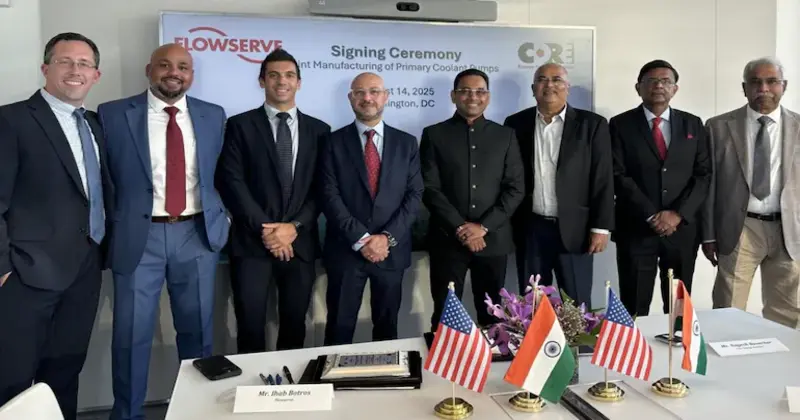
Flowserve Corporation of the United States and the CORE Energy Systems Ltd in India have signed an agreement to transfer primary coolant pump(CPC) technology to India. The deal is part of the India-US civil nuclear agreement that aims at bolstering civil nuclear partnership between New Delhi and Washington in terms of transfer of nuclear materials, equipments and technology. The agreement was inked in Washington DC in the presence of officials from the Indian Embassy and US Department of Energy. The deal is also approved by the Department of Atomic Energy(DAE) in New Delhi.
Primary coolant pumps are a critical component in the primary circuit of a nuclear power plant. It is responsible for circulating the coolant from the reactor vessel to the steam generators and back, thereby helps to remove the intense heat generated by the nuclear fuel. Coolant pumps are vital for the safe and efficient operation of the nuclear power plant as the control fuel temperature and steam production, by continuously supplying the primary coolant such as heavy or light water, carbon dioxide, molten sodium, fluoride salts etc.
“For building nuclear power plants the most critical equipment is the nuclear reactor. The second most crucial equipment is the primary coolant pump. Flowserve has been a world leader in primary coolant pumps”, said Nagesh Basarkar, Chairman and Managing Director of CORE Energy Systems Ltd. India have an ambitious target to achieve 100GW of nuclear capacity by 2047.
“This will pave the path to transfer more and more technology and build more nuclear reactors. We have opened the pipeline for many such technologies to come to India for localization. It will help big companies like Westinghouse or other big technology players, if they are looking for localization and technology transfer”, Mr. Basarkar added, while speaking about India’s readiness to absorb the transfer of critical technologies.
Challenges in technology transfer
Chairman of the CORE Energy Systems Ltd. Mr. Basarkar also highlighted the persisting geopolitical challenges in the path of technology transfer. He said, “this is the first time under the Indo-US cooperation, due to various geopolitical challenges not a single technology could be transferred easily. Because, it requires CFR 810 approval”. He also asserted that it takes almost five years to receive approval from the US to transfer this critical technology.
CFR 810 is a US regulation, which governs the transfer of nuclear technology to foreign nations. As per the act, authorization from the US Secretary of Energy is mandatory for activities like exporting nuclear-related hardware, materials and unclassified technology.
While acknowledging the current geopolitical tensions between New Delhi and Washington, Basarkar said that for firms and big industries perseverance is vital. “The first thing is (that) US company should have confidence in the Indian company and Indian company should have the capability to absorb that technology, as there are some constraints related to primary coolant pump vendors in India”, Mr. Basarkar added.
Sector-specific stability despite Trump tariff tantrums
The deal inked between India and US firms marks the fact that domain-specific stability and progress is prevailing in the India-US bilateral ties, despite the tariff tantrums of the US President Donald Trump. In a critical scenario, where US tariffs on India is at a massive 50 per cent, it is deemed that the decades long, carefully crafted Indo-US relations has been severely ruptured. However, the latest development as a part of the civil nuclear deal is a positive sign in a fragile bilateral relation.
It is indeed difficult for New Delhi to navigate the relations with the US under Trump regime. However, carefully woven strategic milestones in the domain of science, technology, defence, business can be kept stable and relevant given India’s diplomatic skills and strategic patience.















Comments