





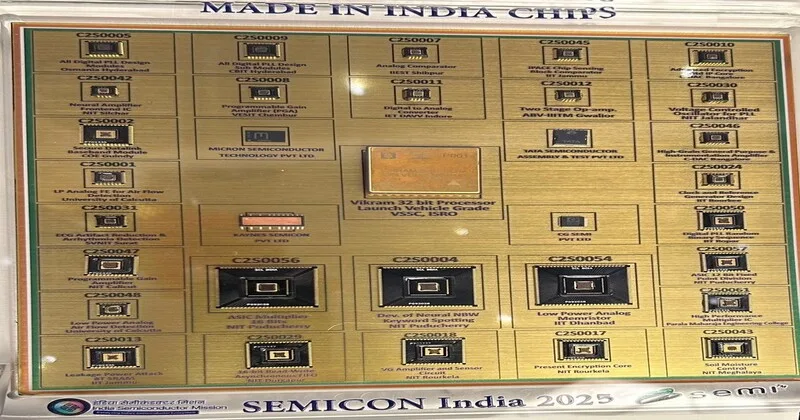
India’s launched its first batch of Made-in-India semiconductor chips. The chips are manufactured at a pilot line in India, were officially handed over to Prime Minister Narendra Modi by Union Minister for Electronics and Information Technology Ashwini Vaishnaw at SEMICON India 2025.
This achievement has come as the result of targeted effort which started in December 2021 after inauguration of the India Semiconductor Mission (ISM). Within a period of three and a half years, India has shifted from approvals of projects to the manufacturing of chips. The Minister called it as a matter of pride and attributed it to Prime Minister’s farsighted vision, great will and action for making dreams a reality. Union Minister also said that India, with its 7.8 per cent GDP growth and developing semiconductor ecosystem, is now a lighthouse of stability for the world.
In the event of SEMICON 2025 Union Minister Ashwini Vaishnaw emphasised that the pillar of India’s semiconductor mission is trust built on respect for intellectual property rights, building robust supply chains and fostering co-development models with international partners. “India has never engaged with the world as a partner, enabling mutual growth and win-win partnerships,” he said. This position of trust is one of India’s biggest strengths in the global semiconductor value chain.
About SEMICON India and ISM
SEMICON India is among the eight international SEMICON trade fairs organized yearly by SEMI. These trade fairs gather semiconductor design and manufacturing experts to promote innovation and sustainability. SEMICON India signals the start of India’s thrilling journey into the global semiconductor future.
SEMI is the worldwide industry association connecting more than 3,000 member companies and 1.5 million professionals globally along the semiconductor and electronics supply chain. The association fosters collaboration on industry-critical challenges through advocacy and workforce development to sustainability and supply chain management.
The India Semiconductor Mission (ISM) operates under the Ministry of Electronics and Information Technology (MeitY). As the nodal agency for the Semicon India Programme, ISM has to review proposals, establishing partnerships, collaborating with governments and administering fiscal incentives. Its prime mission is to make India an established, reliable global destination for semiconductor and electronics manufacturing by guaranteeing economic security and technological self-reliance
Strengthening the Ecosystem through 12 MoUs
Twelve Memorandums of Understanding (MoUs) were announced at SEMICON India 2025. These MoUs include product development, service growth and capacity-building for developing a self-sustained, future-proofed ecosystem.
· Tata Electronics & Merck collaboration to develop semiconductor manufacturing and packaging in India.
· Tata Electronics & C-DAC partnership to establish a home-grown semiconductor design and IP ecosystem.
· Kaynes Semicon with SPARSH-IQ, 3rdiTech, Focally & SenseSemi will develop India’s first indigenously automotive camera module.
· Kaynes Semicon with Infineon will manufacture India’s first MEMS Microphone and sophisticated semiconductor packages.
· L&T Semiconductor with IIT Gandhinagar & C-DAC will focus on development of a Make-in-India Secure Chip, embedded with a smart OS for next-generation electronic identity solutions such as e-passports.
· L&T Semiconductor & IISc Bangalore are setting up of a National Innovation Hub for semiconductor research and quantum leadership.
· Indiesemic (Woman co-led startup in Gujarat.) will launch of India’s first IoT (Internet of Things) Evolution Board that includes the indigenously developed VEGA processor, Bluetooth and LoRa (long-range communication) connectivity.
· NIELIT & Singapore Semiconductor Industry Association (SSIA) will promote semiconductor skills, partnership with academia-industry linkages and capacity building in semiconductor technologies.
· ISM & NAMTECH collaboration to established infrastructure to develop a future-proof talent pipeline and promote applied research and innovation as per nation requirements.
· Arizona State University & ISM: MoU regarding scientific and educational cooperation.
· C-DAC, Synopsys & IIT Madras Pravartak will provide access to Synopsys IPs under DLI scheme.
· Design Infrastructure Support and access to design infrastructure to approved companies under DLI are:
· IP Cores from ITC Korea, Secure IC, Cadence Design Systems and Analogue Bits
· EDA Tools from Sim Yog Technologies and Cadre Design Systems
· Post-Silicon Validation Services from Emerson Global, Smartsoc Solutions and Cyient Semiconductor
Deep Tech Alliance: A Billion-Dollar Push
In another major announcement, Minister Ashwini Vaishnaw released the Deep Tech Alliance of nearly $1 billion already pledged. In starting of the phase, the alliance will initially prioritize semiconductors, later spreading to clean energy, biotechnology, quantum technologies and space. The goal is to bring in much-needed venture capital funding to the emerging deep tech sectors in India.
The Semiconductor Laboratory (SCL) in Mohali is also in the process of implementing a large-scale modernization program to increase production levels, enable new product tape-outs and high-value, mid-volume manufacturing capability. Based on the success of ISM 1.0, the Government is going to launch ISM 2.0. ISM 2.0 will increase support to fabs, OSAT units, capital equipment and materials thus covering the full semiconductor value chain.
Exports will be a key area for ten sanctioned projects with Indian-made chips catering to local as well as international markets. Independent research indicates that India’s production of semiconductors is already 15–30% cost-competitive with world standards. The approvals of projects were never made in hurry. The projects went under strict analysis to identify long-term sustenance. With two fabs already in place and several others in the making, India is gaining momentum in an industry where exponential growth sets in once a strong foundation has been laid.
The presence of top-tier international semiconductor players like ASML, Lam Research, Applied Materials, Merck and Tokyo Electron presence at SEMICON India 2025 indicated international faith in India’s semiconductor progress. The presence of these players is evidence of increasing importance of India under the Prime Minister Modi regime.
Students and Startups: A Mission-Led by Talent
SEMICON also witnessed the introduction of 20 chips developed and fabricated by Indian students at SCL (Semi-Conductor Lab) to the Prime Minister Narendra Modi. 78 universities in India has now employed advanced EDA tools. Thus, building a deep pool of talent that already comprises 20% of the world’s semiconductor workforce. The talent-building and innovation are still at the core of the mission.
From 7.8% GDP growth to a growing semiconductor ecosystem with 1st ‘Made in India’ chips — Bharat stands as a lighthouse of stability. pic.twitter.com/bIUz5cCZUH
— Ashwini Vaishnaw (@AshwiniVaishnaw) September 2, 2025
India’s startup and design ecosystem is also increasing steadily. Over 28 startups have progressed from project to product, with recent MoUs encompassing full IoT chipsets and camera systems. Institutions such as IIT Madras have already launched native microcontrollers and processors. Under the Design Linked Incentive (DLI) scheme, a valuable portfolio of intellectual properties has been developed and 25 priority products have been listed for development.
Toward a $1 Trillion Industry
With the worldwide semiconductor market expected to touch $1 trillion by 2030, India is setting itself up as a leader of the future. Relying on its advantages in talent, trust and technology, India is firmly on the path to accomplishing the Prime Minister vision of transforming India into a hub for semiconductors globally.
Within a time span of four years India has progressed from planning to make its own chips, through high confidence, university-led talent and startup entrepreneurship. It is the synergy of policy vision, global partnership and domestic will that has put India firmly on the trajectory of emerging as a leader of the semiconductor revolution. This is more than a technological breakthrough, it is a strategic landmark that puts India in the global digital economy for decades ahead.
















Comments