





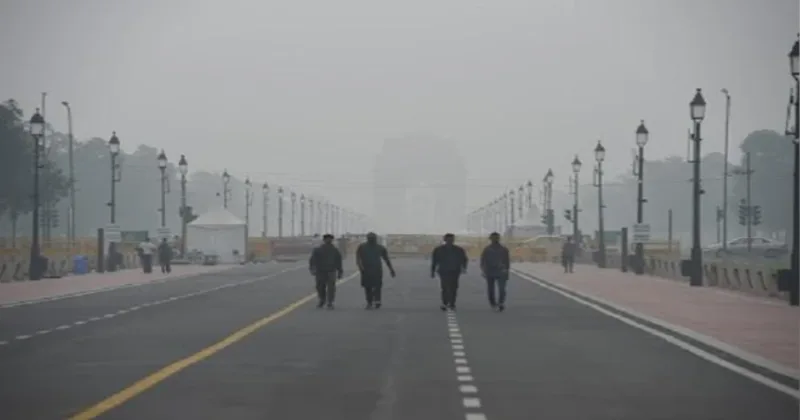
Delhi-NCR has battled long with deadly smog and frightful levels of pollution, is now starting to see a turnaround. Government data recently reported there is consistent improvement in the city’s air quality in 2025. This year New Delhi recorded its highest performing year on average AQI (Air Quality Index) since 2018, except for the extraordinary year 2020 when Covid-19 lockdowns had suspended all human activity.
Between January and August 2025 Delhi’s average AQI was recorded at 172, a significant improvement has been noticed as compared to 187 in 2024, 174 in 2023, 194 in 2022 and 192 in 2021. Even compared to 203 in 2018 and 199 in 2019, the progress is evident. This shift is not a one-off event but reflects a year of targeted policy action, coordination between agencies and improved public awareness.
One of the most apparent markers of improvement is the increase in “Good-Satisfactory” air quality days. Delhi had 23 such days in August 2025, as opposed to 19 in 2018, 22 in 2019, 11 in 2021 and just 8 in 2023. While 2020 remains exceptional with 31 such days because of enforced lockdowns, the 2025 figures show an ongoing policy-driven trend and not a temporary reprieve from pollution.
August 2025 average AQI was also 89, better than 116 in 2023, 93 in 2022 and 107 in 2021. Even when compared with pre-pandemic years like 2018 (111) and 2019 (86), the trend is unmistakably downward in terms of pollution. The duration between January–August 2025 did not record a single “Severe” AQI day (AQI > 400), as compared this with 6 such days in 2018, 7 in 2019, 6 in 2021 and 3 in 2024.
Declining PM2.5 and PM10 Levels
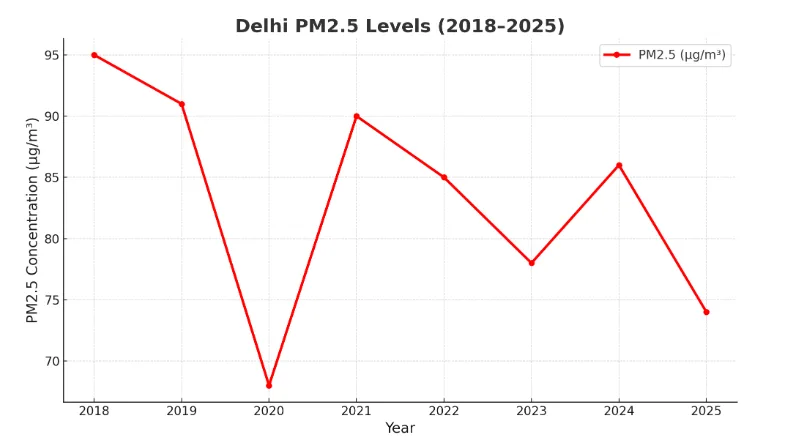
Particulate matter (PM2.5 and PM10) has long been New Delhi biggest concern, having its direct impact on human lungs and cardiovascular health. In 2025 Delhi recorded the lowest PM2.5 levels since 2018. The city’s PM2.5 running average stood at 74 µg/m3, down from 86 in 2024, 85 in 2022 and 95 in 2018.
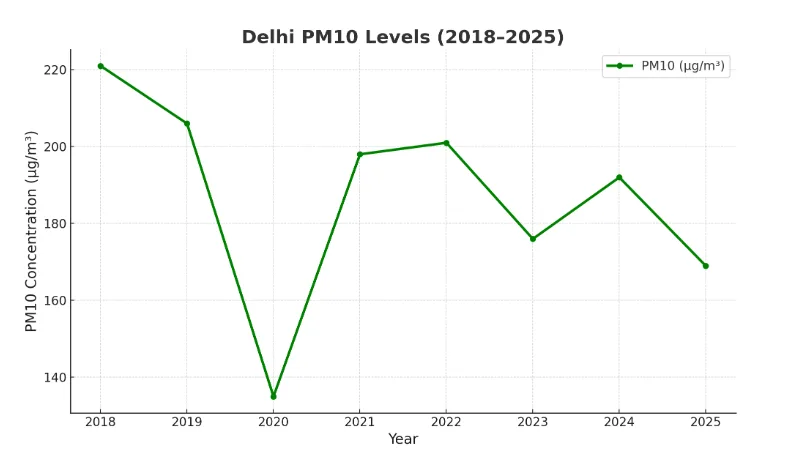
PM10 levels averaged 169 µg/m3 in 2025, as compared to 192 in 2024, 201 in 2022 and 221 in 2018. These reductions mark a significant achievement considering Delhi’s long battle with dust, vehicular emissions and industrial pollutants.
This statistical change indicates a purer AQI trend in 2025 than in the seven-year average under AAP government. August 2025 was also highlighted by government statistics as being among the top-performing months in recent times, with an AQI of only 89. But experts also note that the comparison is not simply a matter of direct comparison, air quality is influenced not just by state policies but also by Union-level compliance, local authority and seasonal meteorological factors. However, the BJP administration has attributed the seen improvement to its new initiatives such as tighter vehicle access regulations, EV promotion, industrial fuel prohibitions, dust controls from construction and trial cloud-seeding injections while opposition leaders still fighting over credit.
The Commission for Air Quality Management (CAQM) has been at the forefront of such initiatives. With close coordination with the state governments, municipal authorities and technical organizations, CAQM has introduced various interventions to manage industrial emissions, control construction dust and enforce more stringent systems of waste management. As per the officials, such integrations will only gain momentum in the future in order to prevent the setbacks in the achievements made over the years
Initiatives of BJP Government Under CM Rekha Gupta
Though meteorological conditions have also contributed, most of the progress is the result of concerted government efforts. BJP regime in Delhi with CM Rekha Gupta also being proactive for air quality management, various measures have been initiated to limit pollution and intensify monitoring. Some of the most important steps taken are:
Air Quality Monitoring Stations
Delhi presently has one of the most extensive AQI monitoring networks across the country. The BJP-led government in New Delhi under CM Rekha Gupta initiated an increase in real-time monitoring stations, making pollution data public and transparent. This enabled policymakers to take measures to correct this soon.
Introduction of Cleaner Public Transport
The government promoted a shift towards CNG and electric buses in Delhi’s public transport fleet. This significantly cut down vehicular emissions, which contribute up to 40% of Delhi’s winter pollution. Incentives were also extended to private citizens to adopt electric vehicles.
Ban on Dirty Fuels and Industrial Controls
Utilization of contaminated fuels like coal for industries in clusters near Delhi was phased out. Cleaner fuels like PNG (piped natural gas) were adopted. Tough checks and balances made industries shift to greener ways.
Construction Site Regulations
Massive construction, a key contributor to PM10, is now governed by regulations for dust suppression on site, tarpaulin covering of waste as a requirement and the use of anti-smog guns at large project sites. Construction and demolition activities will face stricter oversight, with bans during high-pollution periods.
Green Initiatives and Urban Forestry
There are several plantation drives initiated in Delhi-NCR to enhance the green cover. These not only remove the pollutants but also assist in mitigating the urban heat island effect. PM Narendra Modi planted sapling at Bhagwan Mahavir Vanasthali Park on Thursday as part of a broader mission to build a “clean and green Delhi”.
Management Partnerships
Though stubble burning continues to be a challenge in adjacent states, the BJP regime actively assisted the use of bio-decomposers and mechanized stubble management systems. Farmers were incentivized not to burn crop residue, curbing winter smog episodes in Delhi.
Citizen Engagement and Awareness
Improve air quality was also linked to behavioural change initiatives. From making people aware of waste incineration, CM Rekha Gupta office has invested in community-based solutions.
Why This Improvement Matters
Purer air directly enhances the public health. Air pollution is responsible for 1.7 million premature deaths in India every year as per the Lancet Commission on Pollution and Health reports. Delhi is frequently listed among the world’s most polluted cities, curtailing PM2.5 and PM10 means curbing the load of asthma, heart disease and lung cancer.
Improved AQI boosts Delhi’s economic productivity. Healthier workers, reduced hospital admissions and cleaner urban environments attract investment and tourism. Internationally, Delhi’s progress enhances India’s credibility in meeting climate and clean air commitments.
Though encouraging are the numbers for 2025, problems persist. Seasonal peaks, most notably in winter caused by stubble burning and light wind speeds, can negate months of achievement. Experts emphasize the necessity for sustained vigilance, sustainable long-term policymaking and inter-state cooperation with Punjab, Haryana and Uttar Pradesh to build cleaner future for capital city.
Also 2.10 crore saplings have been planted across the Capital by various agencies. 30 wetlands and water bodies are being developed along the Yamuna floodplains, where seven lakh saplings have already been planted as part of ecological restoration efforts.
The story of Delhi’s improving air quality is a rare case of good environmental news. Through a combination of government initiatives, technological enforcement and citizen cooperation, Delhi is beginning to breathe a little easier. The BJP government under CM Rekha Gupta has ensured that the narrative around Delhi’s air is no longer only about despair, but also about measurable progress.
















Comments