





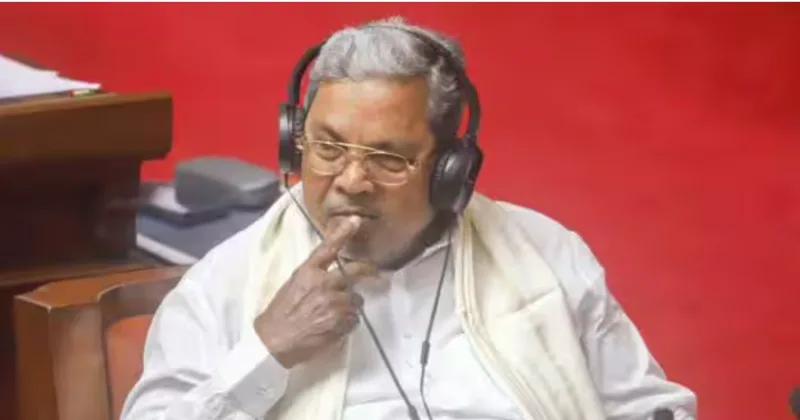
Bengaluru: The Congress government in Karnataka has come under severe criticism after the Comptroller and Auditor General (CAG) of India exposed large-scale lapses in the Excise Department, leading to a revenue loss of at least Rs 11.50 crore over nearly two decades.
The CAG report, presented in the Karnataka Legislative Assembly session this August, revealed that between 2003-04 and 2022-23, the Karnataka State Beverages Corporation Limited (KSBCL) imported foreign liquor without the mandatory CL 11A license. Despite clear rules under the Karnataka Excise Act, 1965, and repeated objections raised, the Excise Department allegedly turned a blind eye, resulting in heavy financial loss to the state exchequer.
According to the Karnataka Excise Act, “foreign liquor” refers to all liquor manufactured outside India. The rules categorically state that such liquor can only be imported with a valid CL 11A license, for which an annual license fee of Rs 50 lakh must be paid. However, the CAG found that KSBCL continued to import liquor without ever securing the license.
While the corporation claimed it was not “directly importing” liquor from abroad but only distributing liquor obtained from authorised agencies outside the state, the CAG categorically rejected this reasoning. The report pointed out that obtaining liquor from other states or bodies amounted to “import” into Karnataka and hence required specific licensing.
The audit also highlighted that the Excise Commissioner and Finance Department failed to enforce compliance, allowing KSBCL to bypass the law for years. This resulted in a cumulative loss of Rs 11.50 crore between 2003-04 and 2022-23, money that could have otherwise strengthened the state treasury.
The revelations have embarrassed the Congress government, especially as Chief Minister Siddaramaiah and Excise Minister RB Thimmapur were reportedly involved in reviewing the CAG’s objections. The report disclosed that the Excise Commissioner and Principal Secretary, Finance, had held discussions with both leaders, after which an official reply was framed and sent to the CAG.
The reply, however, failed to convince the auditors. The CAG flatly rejected the government’s stance that the payment of a “privilege fee” by KSBCL compensated for the absence of a CL 11A license. “The CL 11 license does not permit import of liquor from outside the state. Treating privilege fees as a substitute for license fees is untenable,” the report stated.
Critics have slammed the Siddaramaiah-led Congress government for shielding the corporation and failing to uphold transparency in one of the state’s highest revenue-generating sectors. Opposition leaders allege that the government’s complicity has weakened excise governance, creating an atmosphere conducive for misuse of authority.
The CAG report did not stop at liquor imports. It also exposed serious irregularities in Karnataka’s booming microbrewery sector. Out of all microbreweries audited, at least 25 were found violating norms by serving beer far beyond the freshness limit. Instead of serving fresh brews, customers were being offered beer aged between 15 days and 2 months, violating excise guidelines.
Additionally, the audit found that malt liquor was not being blended in the prescribed ratios in whiskey and brandy production. These lapses not only compromise quality but also raise concerns over consumer rights and the integrity of the excise system.
What has angered many observers is the government’s reluctance to accept responsibility. Despite the CAG’s repeated reminders, the Congress leadership defended KSBCL’s practices rather than ensuring compliance. Experts argue that the issue is not merely about ₹11.50 crore in lost revenue, but about the state’s inability to enforce its own laws.
Former bureaucrats say that by refusing to acknowledge violations, the government has undermined the accountability of the Excise Department. “This is not a technical error it is a deliberate dilution of rules. When such violations are regularized politically, it corrodes the very foundation of governance,” said a retired IAS officer familiar with excise administration.











Comments