





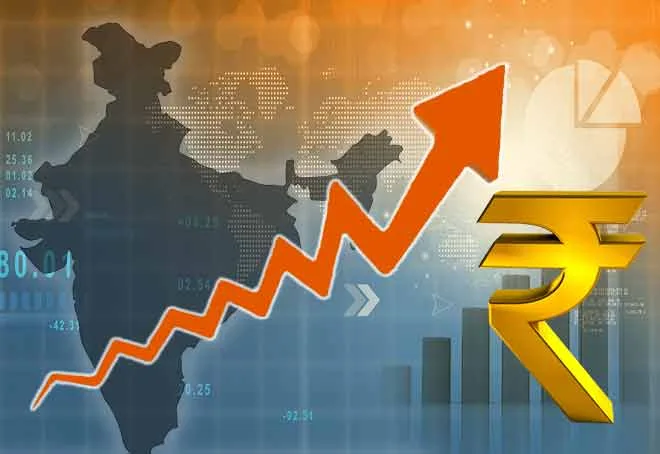
India’s manufacturing sector surged to a 17-and-a-half-year high in August, with the HSBC India Manufacturing Purchasing Managers’ Index (PMI) climbing to 59.3, up from 59.1 in July. The data, released on September 1, is being seen as a resounding endorsement of the Modi government’s steady economic stewardship and its long-term commitment to self-reliance through the ‘Make in India’ and Swadeshi Bharat initiatives.
The PMI reading, one of the most closely watched indicators of factory health, showed the fastest improvement in operating conditions since 2007, highlighting not just resilience but also the transformation of India into a manufacturing powerhouse amid global disruptions.
The strong performance comes at a time when global uncertainties, from Trump’s renewed tariff regime to slowing Chinese exports, are reshaping supply chains worldwide. India’s ability to emerge as a reliable hub for production is no accident; it reflects years of structural reforms under Prime Minister Narendra Modi, including:
Production-Linked Incentive (PLI) schemes that attracted global manufacturers in electronics, semiconductors, and renewable energy.
A consistent push for ease of doing business, cutting red tape, and boosting investor confidence.
The Atmanirbhar Bharat (Self-Reliant India) mission, which fortified domestic industries while maintaining competitiveness abroad.
Economists note that the government’s balancing act, welcoming global investments while strengthening indigenous industries has positioned India as a natural choice for companies seeking alternatives to China.
According to the HSBC report, the uptick in the PMI was primarily driven by faster growth in production volumes, with August registering the quickest expansion in nearly five years. The survey highlighted that:
1. New domestic orders surged on the back of robust consumer demand.
2. Advertising and marketing campaigns by firms further boosted sales.
3. The intermediate goods segment recorded the sharpest growth, followed by capital goods and consumer goods.
“Strong demand alignment with supply chains has created the perfect ecosystem for production to flourish,” the report noted, reflecting how policies like logistics upgrades, GST streamlining, and industrial corridor development are showing results on the ground.
On the external front, the data revealed that international orders rose at a slower pace, the weakest in five months. However, demand from Asia, Europe, the Middle East, and the US remained historically strong, underlining India’s increasing role in global trade despite tariff wars and protectionist sentiments.
This is where the Modi government’s diplomacy has played a crucial role. By forging trade partnerships and promoting initiatives such as “One District, One Product” (ODOP), India has strengthened its global export basket, mitigating risks from Western tariff pressures.
The PMI survey also shed light on pricing dynamics:
1. Input costs rose due to higher prices of steel, minerals, bearings, leather, and small electronic parts.
2. Despite this, inflation remained moderate, lower than long-run averages.
3. Firms responded by raising selling prices, supported by strong demand conditions.
This controlled inflation scenario stands in sharp contrast to many advanced economies still grappling with post-pandemic shocks, an outcome of prudent fiscal and monetary coordination in India.
Interestingly, the PMI surge coincides with renewed calls for swadeshi, a return to indigenous consumption and production. Prime Minister Modi, in his public addresses and through initiatives like ‘Vocal for Local’, has emphasised the need to empower domestic manufacturers.
The August data reflects precisely this vision: a growing ecosystem where Indian consumers trust Indian products, and global buyers increasingly view India as a dependable partner.
While economists caution that global demand volatility and tariff wars could pose risks, India’s strong domestic consumption base is expected to keep momentum alive.
For now, the numbers are clear: under Prime Minister Narendra Modi’s leadership, India is not just weathering global economic storms, it is charting a new course as a manufacturing and economic powerhouse, proving that Atmanirbhar Bharat is more than a slogan; it is a lived economic reality.















Comments