





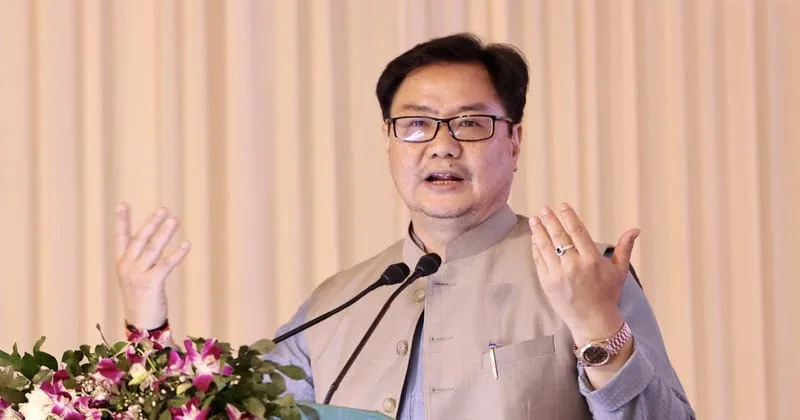
Union Parliamentary Affairs and Minority Affairs Minister Kiren Rijiju on August 31, reaffirmed that tribal communities in India will be exempt from the proposed Uniform Civil Code (UCC), ensuring that their traditional customs and ways of life remain untouched. He was addressing an event organised by the Vanvasi Kalyan Ashram in the national capital.
Rijiju’s remarks came amid heated debates and social media discussions over the UCC, with the minister clarifying that “false narratives” were being spread about the government’s intentions.
Explaining the government’s stance, Rijiju said: “Our government and party (BJP) think about bringing a Uniform Civil Code in the country as per the Constitution. When criminal law is equal for all, why should civil law not also be equal? But we have clearly said that tribals will be exempted. Let Adivasis be given freedom to live in their own way.”
He categorically stated that the UCC would not be implemented in regions covered under the Fifth and Sixth Schedules of the Constitution, nor in tribal-dominated areas of the northeast.
Rijiju noted that certain groups and individuals were “misleading people” about the scope of the UCC. While he did not name anyone specifically, he underlined that the government’s commitment to protect tribal identity and customs remains firm.
Currently, the Law Commission of India is examining the proposal for a nationwide UCC. The code seeks to replace India’s pluralistic system of personal laws, based on religion, with a single framework governing marriage, divorce, inheritance, adoption, and maintenance for all citizens.
Earlier this year, Uttarakhand became the first state to implement the UCC, approving a comprehensive law drafted by a five-member committee headed by retired Justice Ranjana Prakash Desai. The draft, consisting of 392 sections across seven schedules, was submitted in February 2024 and swiftly passed by the state cabinet and governor.
The Uttarakhand UCC includes bans on halala, iddat, and instant talaq under Muslim personal law, making it one of the most far-reaching reforms in recent decades.
While the Centre has reiterated its constitutional backing for the UCC, it has also stressed that the law will be implemented gradually, with sensitivity to India’s cultural fabric. Several states are studying Uttarakhand’s model as a possible blueprint, but exemptions for Scheduled Tribes are expected to remain a permanent feature.













Comments