





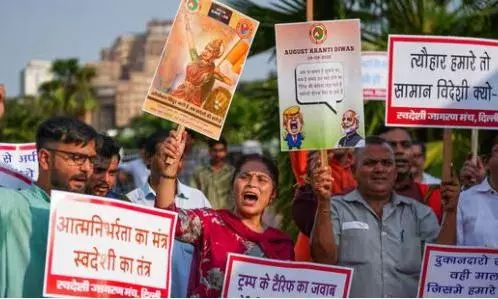
Calls to boycott American goods are intensifying across India after U.S. President Donald Trump slapped a 50 percent duty on Indian exports, including an additional 25 percent penalty linked to Russian oil trade. Trump justified the move by accusing India of profiting from discounted Russian crude sales while “ignoring the human cost of the Ukraine conflict.”
The decision, which came into effect on August 27, 2025, has sparked not only diplomatic tensions but also consumer outrage in one of the world’s largest markets. Household American brands, Pepsi, Coca-Cola, McDonald’s, KFC, and Subway, are now facing boycott campaigns across India.
Yoga guru Baba Ramdev launched a sharp attack on U.S. multinationals, urging Indians to completely shun American products.
“Not a single Indian should be seen at the counters of Pepsi, Coca-Cola, Subway, KFC, or McDonald’s. There should be such a massive boycott that it sends shockwaves through the U.S. economy,” Ramdev declared.
The stakes are considerable. Westlife Foodworld Ltd, which operates McDonald’s in western and southern India, reported revenues of Rs 2,390 crore in FY24, while PepsiCo India earned Rs 8,200 crore in the same period. With India ranking among PepsiCo’s top 15 global markets, a widespread boycott could significantly dent U.S. corporate earnings.
Prime Minister Narendra Modi reiterated his call for “vocal for local” consumption, describing Trump’s move as part of the “politics of economic selfishness” in global trade.
“When we decide to buy anything, there should be only one measure: it must be made by the people of India, using the skill and sweat of Indians,” PM Modi said.
His remarks echo the historic Swadeshi Movement of 1905, which saw Indians boycott foreign goods during colonial rule.
Political leaders have also joined the chorus. AAP MP Ashok Kumar Mittal, in a letter to Trump, wrote: “If 146 crore Indians were to channel the spirit of the Swadeshi Movement today and strategically restrict U.S. businesses, the impact would be far more severe for the United States than for India.”
On the streets, the Bangia Hindu Mahamancha staged demonstrations, burning American products and urging citizens to replace them with Indian-made alternatives.
Interestingly, boycott calls are not confined to India. Protests against U.S. products have also surfaced in France, the UK, and Canada, but analysts warn that India, with its 1.5 billion consumers poses the biggest threat to U.S. companies if the sentiment sustains.
India has officially rejected the U.S. action as “unfair, unjustified, and unreasonable”, vowing to protect its economic interests. Despite Trump labelling India’s economy “dead,” the country has continued to post strong growth figures, 7.8 percent in Q1 2025, exceeding global estimates.










Comments