





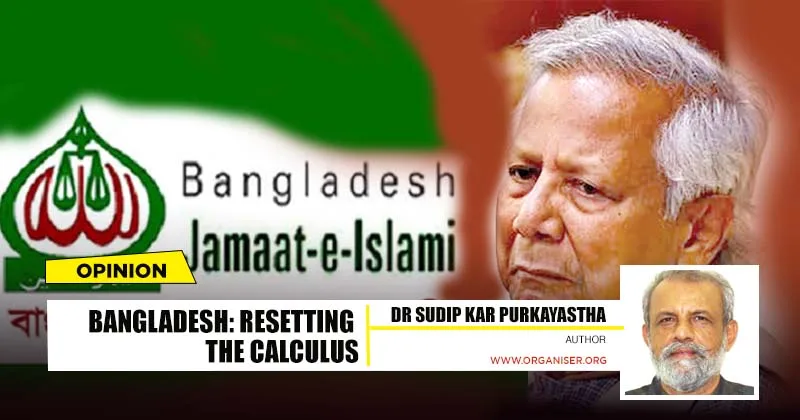
Post-August 2024, Bangladesh has raised several questions to many of us. The most critical of them is whether the widely prevalent notion of Bangladesh being a secular, modern, progressive country as opposed to Pakistan, a country that represents feudalistic pattern of society, medieval obsession about religion and Bharat-hatred as the purpose of life, was an illusion?
Fillip to Fundamentalism
Questions are arising in the wake of occurrence of a series of events like violent upheaval of people, especially students, simultaneous emergence of a constellation of religious fundamentalist organisations like Jamat-e-Islami, Jamiat Ulem-e-Islam, Hizb-ul-Tahrir, Hefazet-e-Islam, Ansar Al Islam, Huji-B, JMB and Islamic Democratic Party to prominence, reports of jailbreak and arms looting by religious fanatics and hardened criminals, unprecedented atrocities on religious minorities, the indulgence or passive endorsement of many of these events by the caretaker government and the presence of ISI and other Pakistani officials in the country after five decades, the planned destruction of evidence of liberation struggle of 1971 and brutal suppression of rival political parties, the latest being the banning of Awami League on May 10, 2025, the largest party which was at the vanguard of Bangladesh liberation struggle.
Yunus-Govt’s Pro-Pak Leanings
The present situation in Bangladesh reminds one about the strident anti-Bharatiya attitude of East Pakistan in 1947. Significantly, a couple of months after his take over as chief advisor Muhammad Yunus had cryptically urged the country to press the ‘reset’ button. It raised a storm and his press wing quickly clarified it did not mean erasing the country’s history. Notwithstanding, it was widely interpreted as an invocation to delete the freedom struggle against Pakistan in 1971. While the storm refused to die down, the decision of Yunus-led Government to cancel the celebration of March 7 as National Day strengthened the suspicion that the caretaker Government was under the spell of pro-Pakistan fundamentalist organisations like JeI and HuT. Incidentally on March 7, 1971 Sheikh Mujib had declared independence of Bangladesh that has long been held as sacrosanct.
Examining Anti-Bharat Events
- In October 2024, the chief advisor made the controversial reset button comment.
- In December 2024, Mahfuj Alam, special assistant and a key aide of the chief advisor, made a Facebook post showing parts of West Bengal, Assam and Tripura as part of Bangladesh. He deleted it following criticism and protest but after making his point to his countrymen.
- Around the end of March 2025, the chief advisor in the course of a four-day visit to China made a provocative statement about the seven North Eastern States of Bharat leading to criticism and protest.
- On April 29, Major General (Retd) Fazlur Rahman, a trusted aide of the chief advisor and head of National Independent Investigation
Committee made a highly provocative Facebook post suggesting Bangladesh should invade and occupy seven North Eastern States of Bharat if it attacked Pakistan in retaliation to terror attack in Pahalgam. Not only that, he called for cooperation from China in that venture. Though Bangladesh Ministry of Foreign Affairs distanced the caretaker Government from this statement, the chief advisor himself reignited the issue on May 14, 2025 when in a meeting with the Dy Speaker of Nepalese Parliament, he stressed on an integrated economic plan for Bangladesh, Nepal, Bhutan and the seven sisters (seven North Eastern States of Bharat).
The matter gained additional weight considering the caretaker Government’s decision to re-build a former Air Force base at Lalmanirhat, situated close to the Siliguri corridor (Chicken neck) with Chinese help. Though the caretaker Government claims this would be a civilian airport, its very close proximity to the narrow corridor forming the only land link between the seven North Eastern States with the rest of Bharat, raised questions about Bangladesh’s intentions. Once constructed, it can become a potential Chinese post and pose a perpetual threat to the security of the North East.
Bharat probably has been caught unaware by these unfriendly, nay, hostile developments. It is common sense that this 180 degree kind of shift in attitude by a country from 1971 cannot happen unless it has significant support of the mainstream population. All of these cannot be overnight development. India probably remained or better to say, chose to remain blissfully ignorant about the real attitudinal geography of that country. It is better late than never. It is time to re-examine all past hypotheses that India had made vis-a-vis this neighbour.
It needs to be appreciated that such arrogance by Bangladesh can stem out of a quiet confidence. What can that confidence be based on? A possible answer is a successful demographic invasion of Bharat that it has already accomplished which it can depend on as its fifth column in the event of a conflagration between two countries. In a democratic country where vote hunger of political parties cripple their moral and ethical values, such a demography of infiltrators inherently inspired by religious hatred, can achieve for their country of origin such a thing that large stockpiles of weapons and equipment cannot.
Influx of Illegal Bangladeshis
To elaborate, since 1971, there has been large-scale infiltration of Bangladeshi Muslims into Bharat. It has been huge, relentless, across the whole of India through the border states, and able to build up a formidable support system for themselves in many political parties, some key institutions, and media of India. A considerable part of this demography today takes part in the local, state and federal elections and hence can exert influence on the political decisions of the country, indirectly.
Unless the magnitude of this infiltrator population is understood, the kind of risk it poses to Bharat cannot be gauged. There are some data points which can throw helpful insights. We shall consider two interesting data points, examine their validity from relevant census data.
Our first data point may seem somewhat unconventional to some readers, but it has relevance and merit. In 1951, the total population of East Pakistan was 4.19 crore while that of West Pakistan 3.37 crore. In 1970, the total population of Bangladesh (then East Pakistan) was estimated as 6.9 crore while that of West Pakistan 6.0 crore. Thus, it may be seen that East Pakistan turned Bangladesh had consistently higher population than West Pakistan (now Pakistan). Intriguingly, in 2021, while the (West) Pakistan population has been estimated at about 24 crore, while Bangladesh population is held to be around 17 crore. Prima facie, it indicates a clever suppression.
The Left media and ideologues laboured hard to explain this anomaly by projecting Bangladesh as a secular, progressive, modern, state ahead of other countries in South Asia in terms of health, education, economy, and most importantly growth rate of population. But the recent surfacing of a vibrant network of Islamic fundamentalist parties and terror outfits in the centre stage of politics, the spates of Fatwas by Mullahs and to their adherence by increasing numbers in the mainstream population proves that the Left narrative was a hoax. As a matter of fact, that narrative has been leveraged by vested interests in pushing a large chunk of the missing crores to India without arousing suspicion.
The other data point is an official estimate. It talked about 2 crore Bangladeshi immigrants living illegally in Bharat, and this data was put before the upper house of Parliament by Minister of State Kiren Rijiju in November 2016. It seems to be a conservative estimate for understandable reasons. The more realistic figure may lie between two and seven crore, or it may be higher today considering that nearly a decade has passed since 2016.
One common observation on the data is that the percentage of Muslim population to the total population of concerned States was, by and large, stable over the first two decades following independence of India but they began to rise perceptibly after 1971. This stable trend applied in greater measure to two border States of Assam and West Bengal, which had higher Muslim populations historically. Considering that these two States witnessed the arrival of the largest number of Hindu refugees from Bangladesh during the same period, which ought to have raised the percentage of Hindu population, an astounding rise in the percentage of Muslim population to the total population, on the contrary, give clearly evidence of huge inorganic growth caused by large scale infiltration from Bangladesh. It is likely that the infiltration spread from these border States to the rest of India in course of time depending on the availability of economic opportunities and political importance of the destination States and support system. The significant rise in Delhi, Maharashtra, UP and Bihar are to be viewed in this light.
New Sect of Doctrines
To start with, given its greatly enhanced stature as an economic, political and military power, its dramatic success through Operation Sindoor, and its new set of doctrines to deal with terror and aggressive neighbouring country of Pakistan, Bharat needs to banish its meek and docile attitude vis-a-vis another wily neighbour Bangladesh. India’s recent experience of dealing with Pakistan may be of help in adopting a bold yet common sense driven policy matrix.
The Modi Government has made it clear to Pakistan that ‘water’ and ‘blood’ cannot flow together. Similarly, Bharat now needs to make Bangladesh understand that it has, over five long decades, committed atrocities by driving into India both its religious minorities as refugees and religious majority as infiltrators. India has been taking it lying down all along. It is time to say, ‘enough is enough’. The new policy mix should begin with this assertion and can probably involve three levels of implementation.
At the first stage, both the flow of refugees and the infiltrators from Bangladesh must stop forthwith. Both countries should discuss Bangladesh’s action plan to take back the illegal infiltrators who are already thriving inside India. Meanwhile, India must identify all illegal infiltrators on its soil and separate them from electoral processes at every level from Panchayat to Parliament. For this purpose, a parallel mega scale biometric identification system which may be called symbolically as NIRADHAR (an antonym of AADHAR) may be introduced with urgency.
At the second stage, given the incorrigible inhuman biases against religious minorities by large sections of Bangladeshi people and media, which has been very vivid over last nine months, and the irrepressible tendencies of every ruling regime to make the religious minorities victims of hostage strategy, the only solution to give them life of security and dignity is to accept all of them, who are willing to migrate, into India. It needs to be remembered that their total numbers at present are much dwindled and way below the numbers of Bangladeshi infiltrators thriving in India. Both processes of acceptance and deportation, if carried out, will be of huge advantage to India.
At the third and final stage, India should ask for land compensation for all refugees whom it has accepted from (former East Pakistan) and Bangladesh right since 1947. For example, if hypothetically, their numbers constituted one third of the total population, India’s claim of one third of Bangladesh’s total land is morally and ethically justified. This can be serve as the basis and be further worked out through discussion and negotiation. To some, such a demand may sound utopian, but it needs to be remembered that similar demand was proposed in the early fifties by a visionary leader Syama Prasad Mookerjee who had rightly realised that no civilised approach would work with regimes who are blinded by religious bigotry.
Given the unilateral generosity extended by Bharat, Bangladesh has been accustomed to exploit it with a sense of entitlement. That has done harm to both countries. Though the policy mix may raise a big hue and cry in Bangladesh, it would be beneficial to both countries as well as to the world at large in the long run. Bangladesh, with its very high population density and threatened with the loss of considerable coastal area due to global warming, has been exporting its demography through its 4,096 kms long borders with India to keep itself light. Once it is made to take back a few crore of its migrant population, it will return to its senses and take urgent measures to curb the fecundity of its populace to the relief of itself, and world at large by lessening the threat to global environment.
To conclude, the political situation in Bangladesh is very fluid at present. Its political, economic and social future depends not only on its domestic factors but also on how other large and powerful countries like Bharat deal with it. As far as Bharat is concerned, its policy calculus must include the permanent resolution of the infiltrators-refugees issues, no matter which party or coalition of parties finally come to rule Bangladesh going forward. That will hold the key to a lasting healthy and mutually beneficial relationship between the two countries.














Comments