





The Indian Government Department of Space (DoS), supporting the Indian National Space Promotion and Authorisation Centre (IN-SPACe) to increase the nation’s space economy by asking the state governments to set up space manufacturing clusters. The clusters are supposed to become innovation hubs, industrial cooperation and skill development centres that can turn India into a world leader in space technology and manufacturing.
Common Technical Facilities at the State Level
IN-SPACe has declared it will establish common technical facilities inside such space clusters. These centres will accommodate capital-intensive infrastructure necessary for the realisation of space systems, allowing companies, startups and universities to access tools that are otherwise too expensive to create individually.
To facilitate this programme, the Government of India has set aside Rs 500 crore, of which a maximum of Rs 100 crore can be provided per state for setting up such centres. States must send detailed project proposals to IN-SPACe to get acceptance and utilise the funds.
The scope for the proposal is broad, states can submit proposals for
• Spacecraft and launch vehicle systems in upstream activities.
• Ground stations or communications hubs in midstream activities.
• In Downstream applications, user terminals and space-based services can be opted for.
Also, states can partner with IN-SPACe to establish centres of excellence and enhance space technology studies in their universities.
Education in Space Technologies to Build Future Talent
IN-SPACe has also focused on education and students’ engagement in space activities. To enhance university-level involvement, it has introduced a B.Tech Minor Degree in Space Technology, sanctioned by the All India Council for Technical Education (AICTE). Eight state-funded colleges have already implemented this course at different levels, giving students direct experience in the rapidly developing space industry.
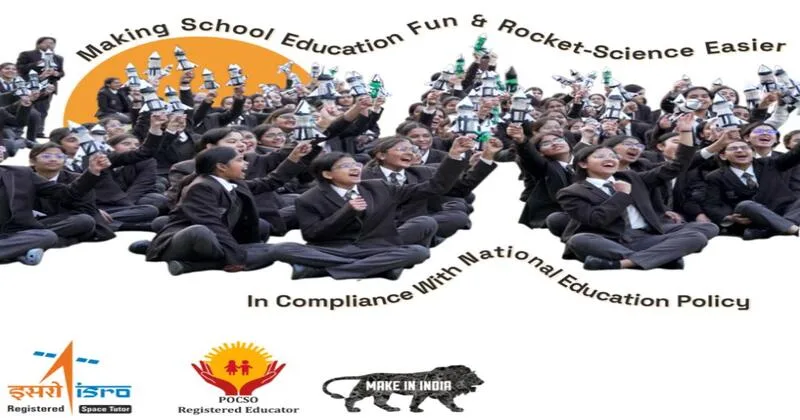
Outside classrooms, the IN-SPACe and the Astronautical Society of India (ASI) and ISRO have launched CANSAT and Model Rocketry India Student Competitions since 2023. These competitions give practical exposure to designing, constructing and launching small satellites and rockets.
The 2024–25 competition has witnessed enthusiastic participation, and 138 student teams have submitted their applications from all Indian states. From these, 80 student teams from state and central-level universities have been shortlisted to participate in the finals, which will be organised in Kushinagar, Uttar Pradesh, from October 28 to 30, 2025. Competition like this encourages innovation and creates a consistent flow of fresh young talent primed to serve India’s space aspirations. In the 18th International Olympiad on Astronomy and Astrophysics, Mumbai, Aug 11–21, 2025, India bagged 4 gold medals and 1 silver medal.
Guidelines for State Proposals
States have to fulfil specific requirements to create a space manufacturing cluster. The proposals would be evaluated and considered by a Selection Committee led by the Secretary, Department of Space and comprising members from IN-SPACe and the Office of Member (Finance)
The requirements are that the states need to identify a minimum of 40 acres of dedicated land, with good road, rail, or air connectivity and proximity to major cities. States must provide civic and civil infrastructure at the site, including facilities for housing the technical centres. States should identify Non-Governmental Entities (NGEs) willing to establish manufacturing units in the cluster. IN-SPACe may be consulted for this process. States must commit to maintaining the facilities after transfer, with a technically trained workforce in place for operations.
IN-SPACe will first take care of design, procurement, installation and equipment commissioning at the facilities. The ownership will lie with IN-SPACe initially and subsequently with the state governments at a mutually agreed schedule. Post-transfer, states will have the complete responsibility and cost for operation and maintenance (O&M) of the facilities. The respective state governments will finalise the O&M mode.
Expected Outcomes for India
The government has a successful vision of this program:
Boost to Space Economy: The manufacturing clusters would be an integrated single-source solution for space system development and production. They would significantly enhance India’s space economy by ensuring quality, cost-effectiveness and timely delivery.
Global Competitiveness: Mass production of cost-competitive space-grade components will make India a strategic worldwide supplier. It will boost exports and raise India’s contribution to the global space economy, which is projected to explode exponentially in the next few decades.
Generation of Employment: It will create significant employment opportunities for skilled professionals, such as engineers and technicians, as skilled labour. With unskilled labour, it will directly benefit local economies in all participating states.
Support to Industry: IN-SPACe has also established a Technical Centre where Indian space firms can avail design software, assembly facilities and test infrastructure like climatic chambers, thermovac chambers and vibration test facilities.
Broader Impact on India’s Future
The government’s project extends beyond industry and infrastructure. It is a move towards a role model for India’s space program with active participation by states. It will also support the traditional role of ISRO and national organisations. This decentralisation will help avoid concentrating the benefit of space to a particular institute only and have it disseminated across the nation.
These clusters can be utilised for long-term growth for India, which wants to raise its contribution to the global space economy from 2% to a higher percentage in the future. They will also facilitate collaboration among academia, startups, industry and government agencies, creating a healthy innovation ecosystem.
India’s space programme has always been something to take pride in, from the Mars Orbiter Mission (MoM) to the success of Chandrayaan and Aditya missions. But to remain ahead in the space race, the nation must establish robust manufacturing capabilities, develop a skilled talent pool and attract private investment. This programme will help establish manufacturing clusters with facilities of international standards. Promotes education and student competitions, guaranteeing the development of talent. It also includes state governments and private players in the loop, making India’s space ecosystem broader.
India’s initiative to establish space manufacturing clusters through IN-SPACe is not just an industrial program it is a nation-building narrative. By engaging Indian states directly, the program makes sure that progress is shared. The strategy also holds a new chapter of collaboration in which the government, academia and industry collaborate hand in hand to advance the frontiers of science and technology.
For youths, it holds the prospect of jobs. For states, it means a way of generating employment and investment. For businesses, it means access to global markets. It reinforces India’s position in the global space economy. With vision and commitment, these initiatives will make India not just self-reliant in the space system but even a respected leader of space innovation in the world.















Comments