





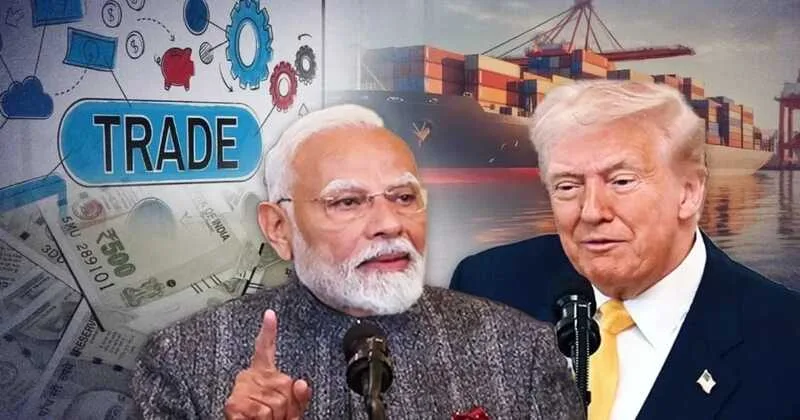
India has reiterated its commitment to protect national interests in the face of the United States’ decision to impose a steep 50% tariff on Indian products. The additional duty, announced earlier this month by US President Donald Trump, will come into effect from August 27 as per the draft notice issued by the US Department of Homeland Security. This decision comes against the backdrop of the continuing Russia-Ukraine conflict and the failure of a peace process reportedly brokered by Trump.
The tariff hike, which doubles the existing rate from 25 per cent to 50 per cent, comes as a punitive response to India’s independent energy policy and continued trade with Russia. By refusing any flexibility on import duties, the Trump administration has resorted to aggressive economic pressure, escalating trade tensions and targeting India despite its legitimate need to secure energy for 1.4 billion people.
India Prioritises Energy Security
India has made its position clear on Russian oil imports. Indian Ambassador to Russia Vinay Kumar categorically stated that Indian companies would buy oil from wherever it is available at the lowest price to ensure energy security for the country’s 1.4 billion people. He called the earlier 25 per cent duty imposed on India for buying Russian oil “unjustified” and added that New Delhi would take all necessary measures to protect its interests after Trump announced the additional tariff. The ambassador underlined India’s fundamental goal that guaranteeing uninterrupted energy supplies to meet domestic demand. “Our priority is the energy security of our citizens,” he emphasised.
PM Modi: No Surrender to Economic Pressure
Prime Minister Narendra Modi strongly reacted to the US move, asserting that India would not yield to external pressure. Speaking at a public event in Ahmedabad, Modi declared, “No matter how much pressure is put on us, we will continue to increase our strength to overcome it. The self-reliant India is getting a lot of energy from Gujarat today as a result of two decades of hard work.”
Calling out global trends of “economic selfishness,” Modi assured citizens that their interests would remain paramount. “I assure the country that the interests of the citizens will be given priority. From the land of Gandhiji, I promise your interests are paramount for Modi. My government will never allow any harm to small entrepreneurs, cattle breeders or farmers,” he said.
Modi added that policies rooted in self-reliance would be India’s answer to protectionist barriers. “The world is busy playing politics outside its own economic interests. We will not give in to such pressure. The answer to additional tariffs is self-reliance. Atmanirbhar Bharat is India’s way,” he affirmed.
Atmanirbhar Bharat: The Strategic Response
The Prime Minister drew a direct link between the US tariffs and India’s drive for self-reliance. Recalling his Independence Day address, Modi reiterated that farmers, cattle breeders and fishermen would remain the top priority for his government. “True national pride lies in self-reliance,” he said, pointing to the Atmanirbhar Bharat mission as the long-term solution to external economic shocks.
Highlighting India’s technological and industrial capability, Modi urged the youth to innovate and create indigenous platforms. “Why should we rely on foreign platforms? We can trust our own capabilities after we defeated the enemy with our own weapons,” he said, calling for homegrown social media and digital platforms as part of a larger strategy to reduce dependency on foreign technologies.
Trade Talks in Limbo, But India Holds Ground
The tariff escalation by the US has cast a shadow over bilateral trade discussions that were scheduled in New Delhi. The move also puts the much-anticipated Bilateral Trade Agreement (BTA) on hold. However, India has made it clear that it will stand firm and will not compromise on national priorities despite these hurdles.
The US action follows Trump’s warning that countries maintaining trade relations with Russia would face higher tariffs. He also indicated plans to target nations imposing digital services taxes (DST) by restricting access to US semiconductors. While these measures are aimed at exerting economic pressure, India has signaled that it will continue to uphold strategic autonomy in trade and energy policy.
Trump’s tariff warning is not limited to India. Expressing anger at China’s restrictions on rare earth exports, Trump threatened to impose tariffs of “200 per cent or more” if the United States does not get access to critical magnets. His statement underlined Washington’s hardline approach in safeguarding its own industrial and strategic interests, even if it comes at the cost of global trade harmony.
PMO Convenes High-Level Meeting, Relief Measures Under Consideration
The Prime Minister’s Office (PMO) will convene a high-level meeting in response to the decision to impose heavy import tariffs on Indian products. The meeting, scheduled for today, will be chaired by the Prime Minister’s Principal Secretary and will focus on measures to provide relief to exporters. The Ministry of Commerce and Industry is currently consulting exporters and export promotion councils to assess the impact of the existing 25 per cent duty. Export companies have informed the government that the prevailing tariff has already eroded profit margins and reduced competitiveness.
The government is reportedly planning targeted support schemes for industries most affected by the tariff hike. One of the proposals under consideration is an emergency credit line guarantee scheme that would provide working capital without collateral, coupled with risk protection for exporters. The meeting is expected to finalize the broad outline of India’s response and explore measures to cushion the blow to export-driven sectors.
Limited Impact on Economic Growth Expected: Experts
While the tariff hike poses challenges, experts believe its overall impact on India’s economic growth will be limited, thanks to strong domestic demand. The additional duties imposed by the US are expected to affect textiles, gems and jewellery the most, while sectors such as pharmaceuticals, smartphones, and steel are likely to remain resilient due to existing tax incentives and robust domestic consumption. According to S&P Global Ratings, India’s large domestic market will help offset the adverse effects of the tariff hike. However, the agency also warns of potential difficulties for exports of manufacturing equipment, chemicals, vehicles, and food products.
The US remains India’s largest market for textile exports, and India is the third-largest exporter to the US after China and Vietnam, accounting for roughly 9 per cent of imports. Over the past five years, India has strengthened its presence in the US market as China’s share declined from 38 per cent to 25 per cent, while India’s share rose from 6% to 9%. Experts suggest that domestic consumption-driven sectors, including financial services, telecommunications, airlines, hospitality, cement, and manufacturing equipment, are well-positioned to absorb the impact of this tariff escalation.
For India, the immediate focus remains on shielding domestic sectors from the impact of the 50 per cent tariff and ensuring the welfare of farmers, small entrepreneurs and dairy producers. Modi’s message from Ahmedabad leaves no ambiguity that India will not bow to external pressure and will pursue a path of resilience, self-reliance and economic sovereignty.












Comments