





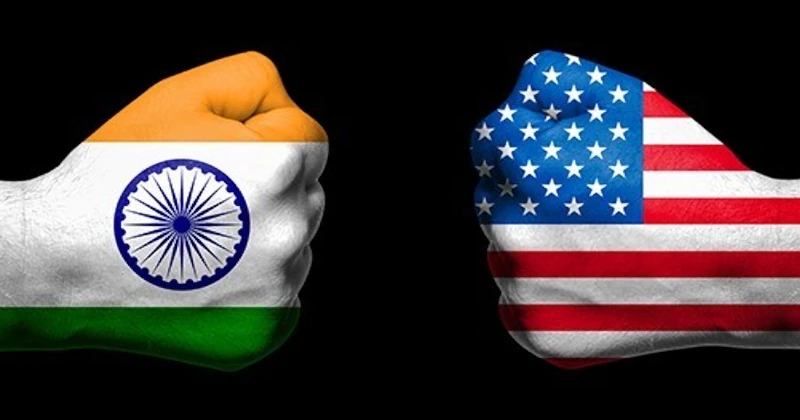
In August 2025, the United States sharply escalated trade tensions with India by imposing a two-tiered tariff system, a 25 per cent ‘reciprocal’ tariff aimed at balancing trade disparities, and an additional 25 per cent ‘penalty’ tariff directly linked to India’s continuing defence and energy engagements with Russia. This sudden hike, bringing the effective tariff burden to 50 per cent, has sent ripples across global markets and sparked intense debate on the intersection of economics, politics, and strategy.
At the surface, tariffs are often justified on economic grounds, protecting domestic industries, correcting trade imbalances, or strengthening fiscal leverage. Yet, in this case, the move is more than just economic retaliation. It reflects Washington’s attempt to reshape global alignments in the wake of shifting US–Russia dynamics. By targeting India, the US is signalling its discontent with New Delhi’s strategic autonomy, particularly in defence procurement from Russia and oil trade resilience amidst Western sanctions.
Viewed through a scientific lens of systems analysis, the tariffs represent more than a trade measure; they are a stress test of interdependent networks spanning global supply chains, diplomatic relations, and energy security. The outcome will not only redefine US–India ties, but also influence the emerging New World Order of multipolar geopolitics.
Economic Motives: Trade Deficits and Market Imbalances
The first layer behind Washington’s tariff decision lies in the realm of trade economics. The United States has consistently highlighted its widening trade deficit with India, which reached $45.7 billion in 2024, marking a 5.4 per cent increase from 2023. For American policymakers, such figures are not just numbers, but indicators of what they frame as ‘structural unfairness’. From their perspective, India’s export-heavy model, combined with persistent barriers to American goods, creates a lopsided dynamic. Tariffs thus become a tool to narrow this gap, or at least signal disapproval of policies that feed it.
Another long-standing American grievance concerns India’s protectionist trade architecture. While New Delhi often highlights its openness to foreign investment, Washington argues that the picture on the ground is more restrictive. With tariffs averaging 17–39 per cent, especially in sensitive areas like agriculture and dairy, India is seen as maintaining an asymmetric advantage. The United States has repeatedly raised the point that its farm goods, dairy products, and medical devices face steep tariffs and regulatory hurdles in India, reducing genuine market access. This frustration is not new; as far back as 2018, former President Donald Trump had referred to India’s tariffs as “among the most strenuous and obnoxious” globally. Such rhetoric has shaped bipartisan consensus in Washington that India’s protectionism warrants a hard pushback.
Yet, there is also the charge of hypocrisy in reciprocity. Critics note that while Washington justifies tariffs by citing Indian purchases of Russian oil, defence systems, and fertilisers, it quietly continues to import Russian uranium, palladium, and fertiliser for its industries. This creates an impression that reciprocity is selectively applied. For Indian policymakers and analysts, this double standard undermines the moral authority of US actions, exposing them as less about principles of free trade and more about geopolitical leverage. Thus, the economic justification for the tariffs cannot be seen in isolation; it merges with strategic calculations, where economics is a proxy for diplomacy and power politics.
Strategic Triggers: Geopolitics as a Tariff Tool
The second major factor behind the US tariff escalation on India lies in the strategic domain, where geopolitics serves as both a pretext and a tool. Foremost among these triggers is India’s deepening engagement with Russia in the energy and defence sectors. Nearly 40 per cent of India’s crude oil imports now come from Russia, alongside continued procurement of sophisticated military hardware, including S-400 missile systems and nuclear submarine collaborations. Despite sweeping Western sanctions on Moscow following its confrontation with the West, New Delhi has maintained this relationship under the rationale of energy security and strategic autonomy. The Trump administration framed this as non-compliance with U.S.-led sanctions, directly linking higher tariffs to India’s Moscow connection. By doing so, Washington aimed to punish and pressure India for sustaining a partnership that weakens Western leverage over Russia.
Another layer to the tariff strategy emerges from India’s prominent role in BRICS. With the bloc increasingly vocal about financial multipolarity and promoting alternatives to the US dollar in trade settlements, policymakers in Washington saw a looming threat to dollar hegemony. India’s participation in currency swap frameworks and proposals for BRICS-backed financial instruments were perceived not as symbolic gestures but as tangible moves toward de-dollarisation. The tariffs, therefore, doubled as an economic warning designed to deter India from lending its weight to these initiatives.
Ultimately, this approach reflects the transactional essence of the Trump-era ‘America First’ policy. US foreign relations have grown increasingly conditional, emphasising short-term leverage and tangible concessions over shared values or long-term alliances. Tariffs have thus become not only economic instruments but also diplomatic bargaining chips, underscoring Washington’s pivot to a strategy-driven, interest-centric global order.
Post US–Russia Dialogue: Evolving World Order
The tariff escalation unfolded against the backdrop of a fragile global order, marked by the ongoing Russia–Ukraine war, energy instability, and supply-chain disruptions. India’s recent high-profile engagement with Moscow, including Prime Minister Modi’s dialogue with President Putin, reinforced New Delhi’s pursuit of strategic autonomy, a doctrine emphasising independent decision-making rather than alignment with Western bloc politics. This move, while consistent with India’s long-standing foreign policy traditions, has been perceived in Washington as a challenge to the West’s united front against Russia. Analysts argue that the tariffs are not merely about trade disputes, but a direct signal of American unease with India’s balancing act between global powers. By penalising India, the US sought to push New Delhi closer to its orbit, yet the move may paradoxically accelerate India’s role in shaping a multipolar world order. Such tensions highlight how bilateral frictions, rooted in deeper strategic divergences, can ripple across the global stage, impacting energy security, defence supply chains, and the future of global governance.
Within the United States, the tariff escalation has sparked significant debate, exposing fissures in Washington’s foreign policy consensus. While the Trump administration framed the tariffs as a necessary step to defend ‘America First’ economic and security priorities, domestic critics, particularly among Democrats, argued that coercive tariffs undermine long-term partnerships with key allies like India. Instead, they advocated focusing resources on supporting Ukraine militarily and diplomatically to counter Russia, rather than alienating New Delhi. Policy analysts in think tanks such as Brookings and CSIS noted that punitive tariffs risk eroding US credibility as a reliable partner in Asia, where India is seen as a crucial counterweight to China. Moreover, sections of the US business community expressed concern that tariffs of nearly 50 per cent could damage bilateral supply chains in pharmaceuticals, IT services, and textiles, ultimately harming American consumers and industries. Thus, the debate reflects a broader divergence within US politics, whether to prioritise punitive measures against states engaging with Russia, or to sustain strategic economic partnerships that serve long-term geopolitical goals.
Economic Ripples: Quantifying the Impact
The imposition of tariffs on Indian goods has begun to ripple across multiple sectors, with varying degrees of impact. The automobile and auto parts industry, which exports nearly $2.6 billion worth of goods annually, is witnessing estimated losses in the range of $130 million to $780 million. Electronics, one of India’s fastest-growing export categories valued at around $10 billion, faces an even sharper blow, with potential revenue losses projected between $500 million and $3 billion. Similarly, the $9 billion gems and jewellery sector, which had been a consistent foreign exchange earner, is seeing its gains erode rapidly. Notably, certain key sectors like pharmaceuticals and semiconductors have been exempted from the tariff regime, offering partial relief and highlighting their strategic importance in global supply chains.
On the macroeconomic front, the continuation of tariffs poses the risk of a 0.2 to 0.5 per cent contraction in India’s GDP for FY26, contingent on the duration and severity of restrictions. The immediate aftermath has already manifested in rupee depreciation and equity market sell-offs, eroding investor confidence. Foreign portfolio investors pulled out nearly $2 billion in July 2025 alone, underlining the vulnerability of India’s financial markets to global trade shocks.
The broader export ecosystem is expected to lose between $5 and $7 billion annually, translating into a 40 basis point drag on GDP. Critical labour-intensive industries such as textiles, machinery, and gems are particularly exposed, placing close to 300,000 jobs at risk. This looming threat underscores the urgent need for policy recalibration, diversification of markets, and strengthening of domestic resilience.
Political Reframing: Indian Responses
India’s political response to the tariff shock has been framed around resilience, diversification, and the assertion of strategic autonomy. Prime Minister Narendra Modi quickly seized the moment to reinforce the Atmanirbhar Bharat vision, underlining the need to reduce import dependence in sensitive areas such as semiconductors, critical minerals, and electronics manufacturing. To cushion businesses from immediate disruptions, the government announced targeted reforms, including adjustments in the Goods and Services Tax (GST) regime and the establishment of special task forces to monitor and strengthen supply chain resilience. These moves are designed not only to mitigate short-term risks but also to accelerate India’s long-term goal of becoming a global manufacturing hub.
On the external front, India is doubling down on its trade diversification strategy. While negotiations for the Bilateral Trade Agreement (BTA) with the United States remain stalled, New Delhi is actively pushing ahead with parallel agreements. Key initiatives include the Comprehensive Economic Trade Agreement (CETA) with the UK, the Free Trade Agreement (FTA) with the European Union, and the Trade and Economic Partnership Agreement (TEPA) with EFTA nations. Such deals are intended to widen India’s export base and reduce vulnerability to unilateral shocks.
At the diplomatic level, Indian officials have strongly criticised the tariffs as ‘unfair and unjustified’, pointing to Western double standards, particularly on issues like energy imports from Russia. At the same time, India has carefully emphasised its principle of strategic autonomy, ensuring that defence and security ties with the US continue uninterrupted despite the ongoing trade friction.
Scientific Lens: Modelling the Tariff Shock
The tariff shock India faces can be better understood when examined through scientific and analytical frameworks that go beyond immediate economic numbers. Game theory provides one such lens, framing the US tariffs as bargaining chips in a larger strategic contest. By imposing punitive duties, Washington seeks to extract concessions, test India’s resolve, and potentially redirect trade alignments in its favour. From India’s perspective, the payoffs of different choices must be carefully weighed. Accepting pressure may yield temporary relief, but risks long-term dependence, while doubling down on strategic autonomy may entail short-term pain yet strengthen India’s credibility and bargaining power in the multipolar order. This dynamic illustrates a classic prisoner’s dilemma in international trade politics, where both sides risk losses if cooperation is delayed.
Econometric modelling deepens the analysis by quantifying potential scenarios. Simulations suggest that if tariffs of around 50 per cent are sustained, India’s GDP growth could slow by 0.5 to 0.8 per cent annually, depending on spillover effects across industries. The rupee would likely depreciate further as investor sentiment weakens, triggering capital flight. Over time, global supply chains might also adjust, with some industries, particularly electronics and textiles, relocating manufacturing to tariff-neutral countries in Southeast Asia or Africa. This structural shift could erode India’s hard-earned competitiveness if corrective measures are not swiftly adopted.
A third analytical tool, network analysis, highlights the interconnectedness of trade with broader strategic sectors. India’s economic, defence, and energy partnerships are part of an overlapping web of global linkages. Tariff disruptions expose vulnerabilities in this network, especially where economic dependence intersects with strategic interests. Yet they also reveal opportunities for realignment. Deeper cooperation with Europe, ASEAN, and Africa could offset US pressures, while stronger regional energy and defence partnerships might create a more resilient multipolar network. Thus, a scientific perspective not only diagnoses the risks but also identifies potential pathways for adaptation and renewal.
The US tariffs imposed on India, which have risen to 50 per cent, are far more than trade barriers. Economically, they threaten key export sectors, currency stability, and GDP growth. Geopolitically, they signal a transactional shift in US diplomacy and reveal discomfort with India’s multipolar positioning. As India navigates this, it reaffirms self-reliance, diversifies trade, and engages pragmatically in global institutions, all while adapting to a reshuffling global order. In that sense, this tariff war may not just be about goods; it is about shaping the future architecture of world power.














Comments