





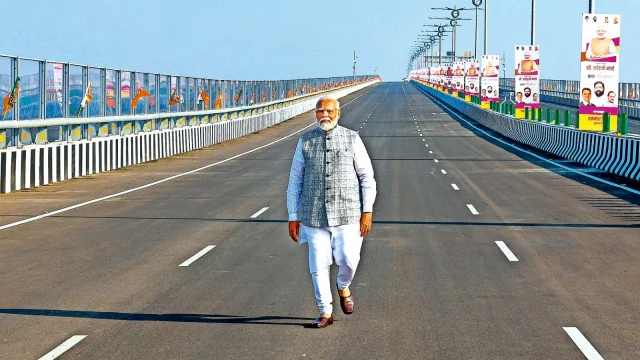
The road and highway sector has emerged as a cornerstone of India’s infrastructure revolution, reflecting the vision of Prime Minister Narendra Modi to transform connectivity, spur trade, and improve everyday life. In 2014, India’s national highway network stood at 91,287 km. By 2024, this figure had expanded to 146,000 km, marking a 60 percent growth and making India’s network the second largest in the world after the United States.
This historic leap has helped India surpass China in total road network size, a feat that shows the government’s determination to build a stronger and more connected India.
The transformation has been fuelled by massive investments of over Rs 3 lakh crore annually in road infrastructure. The Prime Minister has often emphasised that roads are not just pathways but lifelines of development, enabling economic growth, social unity, and cultural integration.
Projects like Setu Bharatam, which replaced thousands of unsafe bridges across the country, showcase the government’s commitment to safety and modernisation. Each rupee spent on roads has delivered a return of 3.2 percent to GDP, demonstrating the unmatched economic multiplier of this sector.
Under the ambitious Bharatmala Pariyojana, India targeted 34,800 km of highways, of which over 26,000 km have been awarded and nearly 20,000 km completed by early 2025.
Flagship projects include:
1. Delhi–Mumbai Expressway drastically cutting travel time and improves freight efficiency.
2. Purvanchal, Bundelkhand, and Ganga Expressways in Uttar Pradesh, opening up eastern and central regions for growth.
3. Dwarka Expressway and Urban Extension Road-II in Delhi-NCR, built at a cost of Rs 11,000 crore, easing traffic congestion and improving regional connectivity.
The upcoming Capital Region Ring Road, a six-lane controlled-access highway, promises to further smoothen traffic flow around the national capital.
These expressways have unlocked immense opportunities by connecting backwards regions with major trade hubs, ensuring inclusive growth.
The Pradhan Mantri Gram Sadak Yojana (PMGSY) has transformed rural connectivity, building 3.5 lakh km of village roads and creating 650 crore man-days of employment in the last five years. This has ensured that farmers can reach markets, students can access schools, and healthcare is within easier reach for rural households.
Religious and border infrastructure have also seen dramatic upgrades:
1. All-weather Char Dham roads in Uttarakhand and a new route to Kailash Mansarovar via Pithoragarh.
2. Enhanced connectivity to Ayodhya, Varanasi, Prayagraj, and Chitrakoot, enriching spiritual tourism.
3. The Aunta-Simaria bridge in Bihar (Rs 1,870 crore), with its 1.86-km six-lane span over the Ganga, inaugurated by the Prime Minister, has cut long detours for freight and pilgrims alike.
Every region of India has benefited:
1. Northeast: Nearly 10,000 km of highways added since 2014 with an outlay of Rs 1.07 lakh crore, strengthening ties with neighbours under the Act East Policy. Another 5,000 km is under construction.
2. India’s South: Bengaluru’s NICE Road corridor expansion, Hyderabad’s Outer Ring Road, and Chennai’s Peripheral Ring Road have decongested urban traffic.
3. East: The Dankuni Expressway and Eastern Metropolitan Bypass in Kolkata ease movement, while the Raipur–Visakhapatnam corridor strengthens industrial links.
4. West: The Mumbai Trans Harbour Link, India’s longest sea bridge, ties Mumbai with Navi Mumbai. The Samruddhi Mahamarg, connecting Mumbai to Nagpur, has become a trade backbone for Maharashtra.
These projects showcase how highways are engines of regional balance, ensuring no part of India is left behind.
The pace of development has only accelerated in Prime Minister Modi’s third term. Within the first 100 days, infrastructure commitments exceeded Rs 11 lakh crore, with roads as a major beneficiary. The highway construction rate now averages 33 km per day, compared to just 8–11 km a decade ago.
The PM Gati Shakti Master Plan has further streamlined project execution, reducing logistics costs from 14 percent to an expected 8 percent of GDP by 2030. The 2025-26 Union Budget allocated over Rs 11 lakh crore for capital outlay, with a large share directed at highway development.
Private sector participation has been reinvigorated through the Hybrid Annuity Model, ensuring faster and more efficient project completion.
India’s roads today are more than just stretches of concrete; they are lifelines of growth, unity, and prosperity. They link remote villages to bustling cities, holy shrines to pilgrims, and industries to global markets. With three times the return on every rupee invested, highways have become the backbone of India’s journey towards becoming a developed nation by 2047.
The Modi government’s relentless focus on roads and highways has not only changed India’s landscape but has also redefined its future, one expressway, one bridge, and one village road at a time.














Comments