





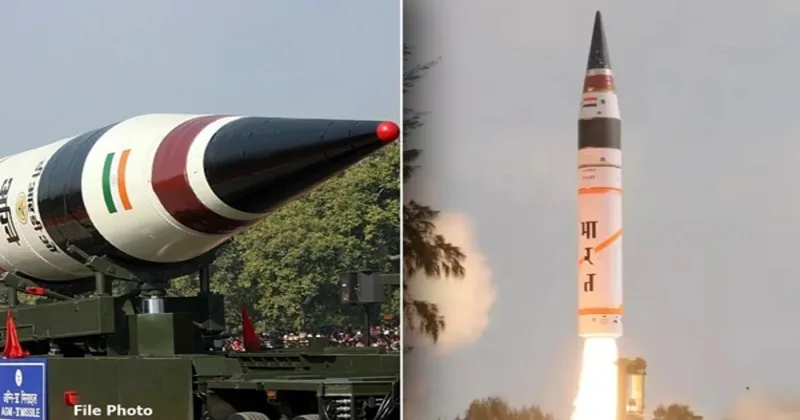
India successfully test-fired its nuclear-capable intermediate-range ballistic missile (IRBM) Agni-5 on Wednesday from the Integrated Test Range (ITR) in Chandipur, Odisha, the Defence Ministry announced. The trial, conducted under the Strategic Forces Command, confirmed all technical and operational capabilities of the missile. Officials described the launch as part of routine user trials.
Developed by the Defence Research and Development Organisation (DRDO), Agni-5 is among India’s most advanced long-range missiles, boasting a range exceeding 5,000 km. It features cutting-edge navigation, guidance, propulsion, and warhead technologies, significantly bolstering India’s nuclear deterrence posture. Classified as a ground-based intercontinental ballistic missile (ICBM), Agni-5 is equipped with Multiple Independently Targetable Reentry Vehicle (MIRV) capability, allowing it to engage multiple targets simultaneously. The missile can carry and deploy up to three nuclear warheads in a single launch.
The first successful MIRV test was conducted from Kalpakkam, Tamil Nadu, on March 11, 2024, demonstrating its capability to launch multiple warheads with precision. DRDO is currently working on advanced versions of Agni-5 to incorporate bunker-buster technology, further enhancing its ability to neutralize hardened and well-protected targets.
While the current variant has a range of about 5,000 km, an upgraded version under development is expected to extend this range to approximately 7,500 km. The Agni-5 project was initiated primarily to strengthen India’s strategic deterrence against China. Earlier, Agni-3, with a range of 3,500 to 5,000 km, was the country’s most powerful missile. However, its range limitations meant it could not cover key Chinese cities located along the eastern seaboard. This strategic gap underscored the need for a missile with greater reach.
The Agni-5 addresses this challenge, enabling India to target Beijing and other major industrial hubs across China. Beyond Asia, its range also covers the entire African continent and large parts of Europe, marking a significant boost in India’s strategic reach. The missile was developed by modifying the two-stage design of Agni-3, adding a third stage for extended range and improved performance.
India’s latest test has triggered concerns in Pakistan. Islamabad-based Strategic Vision Institute (SVI) has reportedly warned Prime Minister Shahbaz Sharif and Army Chief Asim Munir that India’s expanding missile program poses a serious threat to regional stability. According to the SVI, India has accelerated missile development since 2016, raising apprehensions that future systems with ranges exceeding 8,000 km could even place the United States and Russia within India’s strike capability.
The successful trial underscores India’s growing technological capabilities and its resolve to maintain a credible minimum deterrent in an evolving regional and global security environment.
















Comments