





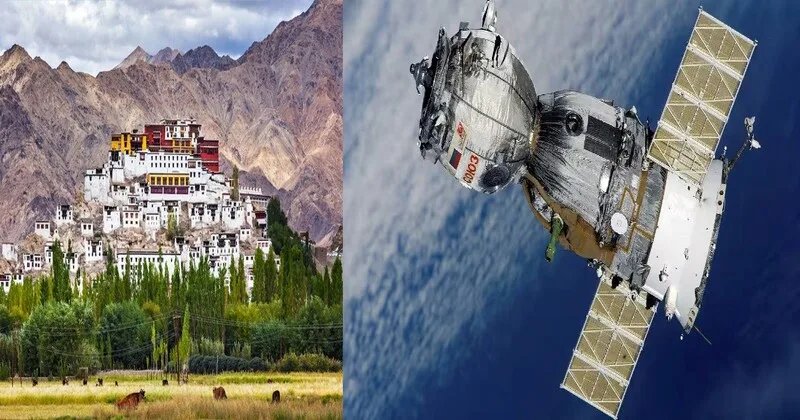
Whenever space technology is discussed in India two names came to our minds, ISRO and Sriharikota, the agency and the launching pad for rockets. This time something else is happening in space sector of India. A revolution is underway in Ladakh, a state whose geography and strategic location position itself at the central point of India’s future-generation space-based remote sensing and communications. The Indian Space Research Organisation (ISRO) through a constellation of satellites and ground efforts is creating the foundation for a path-breaking role for Ladakh in the nation’s scientific and development journey.
The New Fleet of Satellites
By 2027–28, ISRO aims to commission Resourcesat-3, 3A, 3S, 3SA, HRSAT, the G20 satellite and TRISHNA (Thermal Infrared Imaging Satellite for High-resolution Natural resource Assessment). These satellites are made to enhance India’s remote sensing capability with accurate data for agriculture, water resources, forestry, urban planning and climate change monitoring. In Ladakh, where delicate ecosystems are existing with expanding human needs, the use of raw data becomes indispensable.
Currently operational assets of ISRO are Cartosat-2 series of satellites offer high-resolution imagery for mapping, infrastructure planning, natural resource monitoring and disaster management. Cartosat-3, which is sub-metre resolution, enables 3D mapping, coastal studies and defence purposes. Resourcesat-2 and 2A provide essential data for agriculture, land use, forestry, water resources, and drought monitoring. RISAT-1A, with radar imaging, operates in all weather and night conditions, supporting crop monitoring, flood mapping, soil studies and strategic activates. INSAT-3DR and 3DS are geostationary weather forecasting, cyclone monitoring, atmospheric data-gathering satellites and search- rescue operations. Oceansat-3 tracks ocean colour, wind waves, assisting fisheries, climate science and monsoon forecasts.
Indo-French mission SARAL measures sea surface height and oceanic currents circulation, assisting climate research and tsunami warning. Indo-US joint NISAR mission is already supplying vital information across Ladakh.
These satellites together enhance India capabilities in agriculture, urban development, environmental monitoring, defence and disaster management. Providing valuable insights for regions like Ladakh where ecological and strategic needs of India meet.
Why Ladakh?
Ladakh a Union Territory of India is the intersection of environment, security and strategic geography. The reasons why ISRO’s is more focused towards this place because of multiple reasons:
§ Fragile Ecology: Ladakh’s cold desert and high-altitude terrain is highly climate-sensitive. Remote sensing is crucial to monitor glacial recession, water supply and land degradation.
§ Strategic Frontiers: Landlocked between China and Pakistan, Ladakh holds strategic importance for national security. Space-based observation and communication directly boost defence readiness.
§ Scant Resources: Agriculture and horticulture are based on effective management of land and water. Satellites offer planning tools to farmers as well as planners.
§ Renewable Potential: Ladakh is rich in solar and wind energy possibilities. Space applications assist in the identification of suitable areas and optimal utilization of resources.
§ Astronomical Advantage: Its clear skies and high altitude make Ladakh as a perfect place for tracking space objects.
Technically, Ladakh reflects both India’s environmental vulnerabilities and its strategic desires.
Projects Operating in Ladakh
To meet the above-mentioned requirements, ISRO has introduced few dedicated projects:
• LAMA (Ladakh Specific Modelling and Space Applications): An integrated programme on natural resource research, environment and climate change effects. It integrates scientific research into an active geoportal that assists local governments for sustainable resource management.
• Geo-Ladakh Spatial Data Infrastructure (SDI): A specialized platform for agriculture, horticulture, bio-resources expansion, artificial glacier creation, water conservation, renewable energy harvesting, and flood hazard assessment. This digital infrastructure ensures that satellite data becomes actionable policy for Leh and Kargil.
• AMRUT 1.0 & 2.0: ISRO has developed high-resolution geospatial databases for Leh and Kargil under the Atal Mission for Rejuvenation and Urban Transformation, it comprises GIS-based master plans and waterbody information systems. For the towns that fall under high-altitude arid regions will get assistance for urban planning.
• Land Use and Land Cover (LULC) Change Analysis: Comparing data of 2020–21 and 2025–26 projections, ISRO provides data on how Ladakh’s landscape is transforming under human settlements and natural forces.
• Mountain Ecosystem Studies: Covering the north-west Himalaya region including Ladakh, the ecosystem studies examine natural hazards, geodynamics and resource monitoring.
• Disaster Management Support Programme (DMSP): Satellite inputs assist the authorities in managing earthquakes, floods, avalanches and landslides a typical risk in the area.
ISRO’s NETRA (Network for Space Object Tracking and Analysis) program introduces a fresh scientific dimension to Ladakh. An optical telescope is being set up at Hanle, which is one of the world’s highest and best astronomical locations. Its purpose is to monitor satellites and space junk in geostationary orbit (36,000 km). With the issue of increasing orbital congestion, the availability of NETRA in Ladakh guarantees India’s ability to defend its space assets.
Apart from remote sensing, ISRO’s communication satellites provide 12 dedicated channels across Ladakh. These are available for telecom operators to increase connectivity. In an area where geography hamper ground networks, satellite-supported broadband is only a lifeline for governance, education, telemedicine and commerce. Foreign satellite operators and low-earth-orbit constellations permitted to operate in India over Ladakh region.
Ladakh a place known by its isolation for centuries. With the efforts of ISRO, it is turning into an epicentre of applied science, environmentally conscious management and foresight in technology. From assisting farmers in Nubra Valley to assisting disaster managers in Kargil these satellites are revolutionizing the defence and strategic interests of government.
India’s space program was usually about its lunar landers and interplanetary missions. But now its focus over regions such as Ladakh is supporting strategic and ecologically sensitive benefits. The intersection of science and applications, emphasizes why Ladakh is significant not merely for ISRO, but for the nation’s future security and resilience.
















Comments