





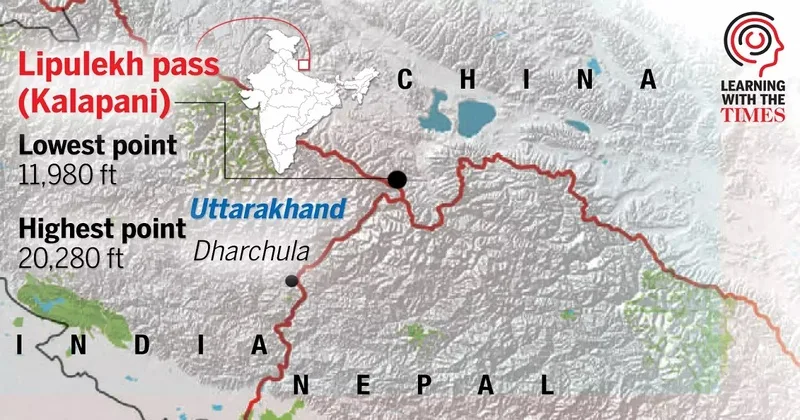
On August 20th, in a sharp and firm response to Kathmandu, New Delhi has rejected the territorial claims of Nepal over the Lipulekh pass in the Uttarakhand state. MEA has asserted that such claims by Nepal are ‘neither justified’ nor ‘based on historical facts and evidence’. The statement by MEA comes as a reaction to the recent assertions made by the Foreign Ministry of Nepal regarding Kathmandu’s authority over border territories especially the Lipulekh Pass.
Nepal’s latest territorial assertion comes in the wake of mutual agreement reached between India and China to resume the border trade via the Lipulekh Pass in Uttarakhand that is a trijunction zone between India, Nepal and China. The decision between New Delhi and Beijing was taken during the visit of Chinese Foreign Minister Wang Yi to India on August 18th and 19th. India and China are on the path of resetting the bilateral relations that had hit an all-time low post the 2020 Galwan clash. Resuming the border trade via the Lipulekh pass was one among the latest decisions in a series of normalization efforts initiated between India and China such as resumption of the Kailash Mansarovar Yatra, issuance of the tourist visas to Chinese citizens etc.
“We have noted the comments of Ministry of Foreign Affairs of Nepal related to the resumption of border trade between India and China through the Lipulekh Pass. Our position in this regard has been consistent and clear. Border trade between India and China through the Lipulekh Pass had commenced in 1954 and has been going on for decades. This trade had been disrupted in recent years due to covid and other developments and both sides have now agreed to resume it”, reiterated the official spokesperson of the Ministry of External Affairs, while quoting the historical nature of the trade between India and China via the Lipulekh pass. The cross-border trade will also continue persistently, as Lipulekh is historically and evidently an integral part of India.
India rejects the unilateral action of Nepal and calls for dialogue
MEA has strongly debunked any unilateral actions by Nepal regarding the border issues and has called for dialogue and diplomacy to resolve the territorial disagreements. “As regards territorial claims, our position remains that such claims are neither justified nor based on historical facts and evidence. Any unilateral artificial enlargement of territorial claims is untenable”, asserted the MEA spokesperson.
However, New Delhi has acknowledged the vitality and scope of ‘constructive interaction’ with Nepal to resolve all the bottlenecks with respect to border issues. India has welcomed the path of ‘dialogue and diplomacy’ to resolve the ‘agreed outstanding boundary issues’. Infact, India has always championed the route of dialogue and diplomacy to solve any geopolitical gridlocks with the partner countries across the globe.
Meanwhile, as a reaction to the resumption of India-China border trade, Nepal Foreign Ministry had said, “It is also known that the government of Nepal has been urging the Government of India not to carry out any activities such as road construction/expansion, border trade in the Nepali territory. It is also known that even the friendly country China has been informed that the said area is Nepali territory”.
Border dispute between India and Nepal
Nepal has repeatedly made the territorial contestations over Kalapani, Lipulekh and Limpiyadhura regions that fall under the aegis of the Himalayan state of Uttarakhand in India, which is also a trijunction between India-China-Nepal. The Government of Nepal led by KP Sharma Oli has released a political map of the country that depicts the region in the east of the Mahakali River as the ‘integral part of Nepal’, which includes the above said regions of Uttarakhand. The new map of Nepal has also been officially inducted into the Nepal constitution as well.
India has also outrightly rejected these territorial claims and cartographic assertions as ‘artificial and unilateral enlargements’ that are not based on historical facts and evidence. On many occasions, Kathmandu has expressed its disagreements over India’s activities in the border areas. It opposed when India inaugurated a motor able link road connecting India and China via the Lipulekh pass, which helps to reduce the travel time for Kailash Mansarovar Yatra. Nepal was also in averse of the 2015 India-China trade agreement via the Lipulekh pass. However, India has always advocated for a mutually agreed path based on historical facts and evidence to resolve the territorial bottlenecks with Nepal and has always kept the doors for dialogue open.












Comments