





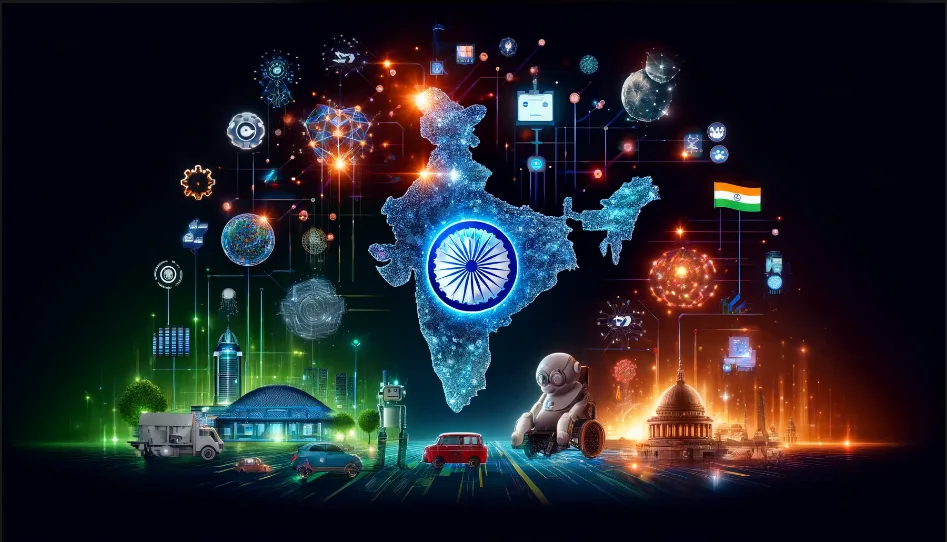
The 21st century is not only the “digital age” but it is an age of intelligence. Artificial Intelligence (AI) has moved from being a specialised research field to a reason-shaping global economies, national security, healthcare, education and daily life. In this century, the pace of AI updation and skill enhancement will determine whether nations rise to leadership or remain dependent on others.
For Bharat the scenario is even more critical, where more than 3 5crores of young and aspiring population exists, it possesses a demographic power which can become the world’s most powerful AI-ready workforce. For this population skill upgradation is must on time to time, so this very strength may become an opportunity which was not possible in previous years. Skill development in AI is no longer a school phenomenon, it has become a necessity for a nation. If Bharat does not build domestic capabilities in AI technologies and data ecosystems, it will risk its sovereignty by having dependence on foreign platforms. Thus, compromising both economic opportunities and digital sovereignty.
This is where Bharat’s AI approach, based on the Hon’ble Prime Minister’s visions, needs to democratize technology adoption for all. It seeks to address Bharat specific challenges and generate economic and employment opportunities for Bhartiya’s. The vision is not just to embrace AI but to lead in AI creation so that its source of economy toa reach the grassroots.
AI Ecosystem in Bharat Today
Bharat’s technology industry is already adopting a strong foundation for AI growth. With the annual revenue expected to exceed $280 billion this year, employing more than 6 million individuals and over 1,800 Global Capability Centres (with 500+ dedicated to AI), the foundation is robust. The start-up ecosystem is active with 1.8 lakh start-ups and impressively 89% of new start-ups were based on AI. This information was submitted by Union Minister of Electronics and IT Shri Ashwini Vishnaw.
In Global rankings of Stanford AI Index rank, Bharat is one of the leading nations in AI capabilities, skills and policies. Bharat is the second-largest contributor to GitHub AI projects, demonstrating the energy and innovation of our developer ecosystem. Focusing on this strength, the IndiaAI Mission initiated in 2024 aims to make AI accessible to everyone and create a strong inclusive AI ecosystem that supports national development objectives.
AIKosh: Bharat’s Data Backbone for an AI Future
One of the pillars of the IndiaAI Mission is working on datasets for AI. The AIKosh is Bharat AI Datasets Platform, which is a one-stop data hub bringing together government and non-government sources.
It provides carefully selected datasets in prominent areas like health, agriculture, and education with robust measures for data confidentiality. They are sourced from government ministries, universities and Bhartiya startups so as to make them locally applicable. What this implies is that developers can concentrate on developing innovative AI products without wasting resources on replicating foundational modules.
AIKosh provides more than 1,200 Bhartiya centric datasets and 217 AI models on its platform. This dataset provides farmer query data from Kisan Call Centres, geological data from state governments and clinical, imaging, and pathology data for AI-based diagnosis of brain lesions. Small AI models like text-to-speech (TTS) in Bhartiya languages like Bengali, Gujarati, Kannada, and Malayalam are also included.
AIKosh also offers a sandbox feature enabling Bharat startups and academia to try out their tools test in a controlled environment. This platform has already drawn over 265,000 visitors, 6,000 registered users and 13,000+ downloads of resources.
Bharat Data Exchange: Sharable Government Data
The Bharat Data Exchange (Bharat Data Platform) is an extension of the Open Government Data (OGD) program. It is the data repository for AIKosh, allowing access to shareable, government-owned data in human-readable as well as machine-readable form.
Digital India Bhashini: Empowering and Enriching Languages
Language is at the centre of AI inclusivity in Bharat. The Digital India Bhashini program under the National Language Translation Mission (NLTM) focuses on AI-led language solutions.
Through the BhashaDaan platform, citizens provide voice, text and translations of 22 Bhartiya languages. In collaboration with more than 70 research institutions and sectoral experts, vast quantities of annotated datasets are harvested for technologies such as speech recognition, machine translation, and other language tools.
Data is gathered from different parts and populations of Bharat to understand Bharat’s complete linguistic diversity and society, such as day-to-day dialects and conversation variations, so that AI models could be accurately trained and portray our real diversity and do not become biased.
National Mission on Interdisciplinary Cyber-Physical Systems (NM-ICPS)
The NM-ICPS has set up 25 Technology Innovation Hubs (TIHs) in the best educational institutions, which specialize in AI, ML, IoT, robotics, cybersecurity and quantum technologies.
• IIIT Hyderabad TIH: Created 105+ Bharat-specific datasets (clinical, mobility, autonomous driving), it has also digitized more than 2,000+ pathology images and developed the India Driving Dataset (IDD) which is downloadable in 30+ countries.
• BharatGen consortium (IIT Bombay, IIT Madras, IIT Kanpur, etc.) constructed a huge Bharat-focused corpus with trillions of tokens, thousands of multilingual speech hours and millions of local documents. The main aim is to source diverse datasets and develops Bharat specific AI models.
• ARTPARK at IISc Bengaluru: Developed the Vaani dataset (16,000 hours of audio in 54 languages, 80 districts) and (Medical Imaging and Information Datasets) MIDAS medical imaging datasets for public health.
Indian Council of Medical Research (ICMR) and AI in Healthcare
Healthcare is among the largest AI opportunity space in Bharat. ICMR Health Research Data Repository provides centralised, secure access to high-quality clinical datasets. It is in line with international standards (WHO, ISO, HL7) and national health guidelines (NDHM/ABDM).
Datasets are the National NCD Monitoring Survey, the ICMR-INDIAB study (2008–2020) involving 113,043 subjects, TB treatment trials, diabetes registry, antimicrobial resistance network and IN-CXR chest radiographs.
Funding and R&D for AI Excellence
Programmes such as IMPRINT and Uchhatar Avishkar Yojana (UAY) have provided Rs 1,000 crore for AI curriculum development, collaborative R&D and industry-academia tie-ups.
The Anusandhan National Research Foundation (ANRF) has introduced the “AI-for-Science” initiative to fuel discovery in physics, chemistry and biology with machine learning tailored for Bhartiya researchers. In addition to this, the India AI Open Stack is an underlying AI architecture infused with science and engineering models designed for Bhartiya scientists.
AI is not technology-centric, it’s people-centric. To enable Bharat to be a leader in AI, our people need to continually enhance skills in dimensions such as data analytics, machine learning, language technologies and ethical development of AI.
The existing pace of AI adoption will amount to nothing if the talent pool is not ready to implement, manage and innovate on these platforms. Bharat’s second-largest contributor status globally to GitHub AI projects is an indicator of capability, but maintaining this position needs structured training, ongoing learning and public-private partnerships.
The Bharat’s AI pursuits is already on display developing high-quality, local and unbiased datasets that power innovations in healthcare, agriculture, governance and education. By making AI platforms and tools locally relevant, Bharat not only protects digital sovereignty but also keeps economic gains in the country.
In the 21st century, updating of AI and skill development are as important as road construction, railway construction or power plant construction. For Bharat, the vision is clear to leverage the energy of its people along with the strength of AI to create a future in which technology serves society, guards culture and enhances national security.













Comments