





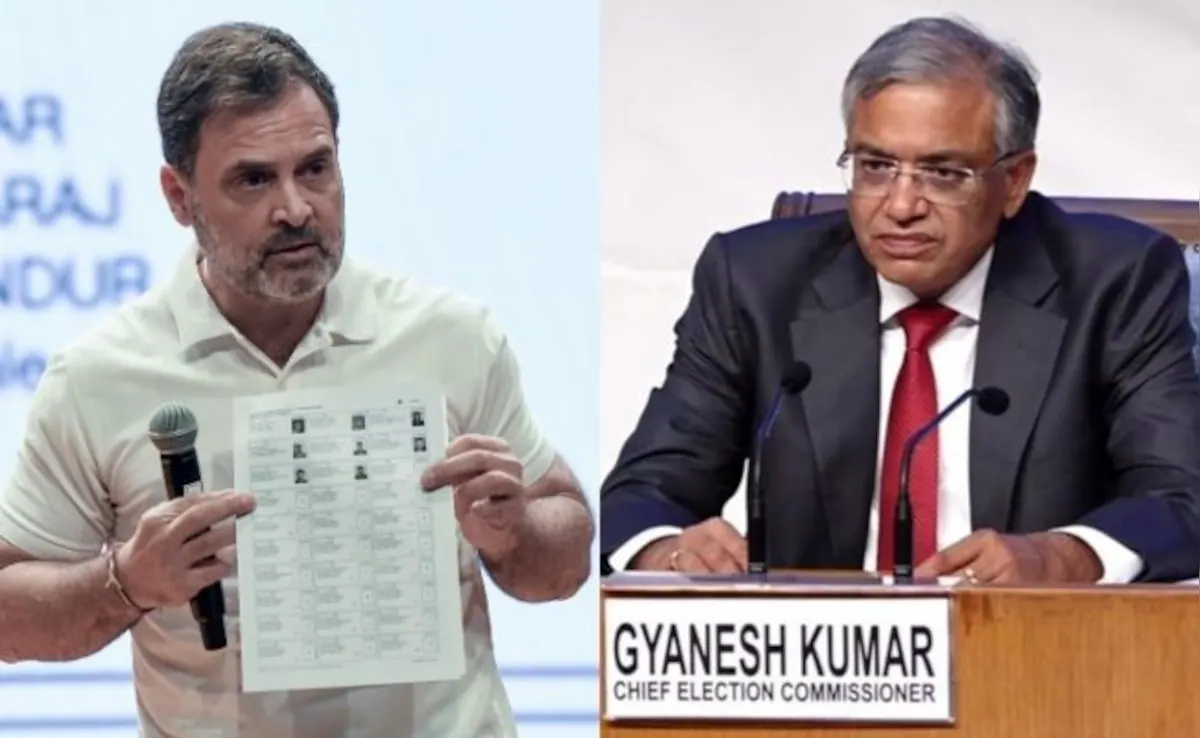
New Delhi: Days after the Election Commission of India [ECI] strongly refuted Leader of Opposition Rahul Gandhi’s charge regarding ‘house number zero’ given to voters, reports in media indicate that the provision to provide the unique address to electors was first started in Delhi, aiming inclusion of homeless voters in the election process.
According to reports, inclusion of such voters with house number zero was first started by the poll body in year 2013, largely as an initiative to include people residing in shelter homes and those without a house.
A number of such people residing in various shelter homes in the capital city, carrying voter ID cards with the zero house number have reportedly voted in various elections ranging from State Assembly elections 2013 to Lok Sabha polls 2024 to recently concluded Assembly polls in Delhi.
House number 0 as address on Voter list= vote chori?
No, it’s actually a way to ensure even the homeless get their right to vote.
Started in Delhi in 2013.
Here are a few examples pic.twitter.com/DU58vTOvXl— Padmaja Joshi (@PadmajaJoshi) August 19, 2025
Moreover, there are people who have house number zero addresses linked with bank accounts. According to officials, a homeless person has to fill Form no 6 and provide proof that he or she is a resident of the shelter home along with their date of birth after which the Booth Level Officer [BLO] visits the locality to verify the address.
ECI’s reply to ‘House No Zero’ charge
Replying to the charge related to house number zero, CEC Gyanesh Kumar on August 17 stated “Many people do not have a home, but their name is also in the voter list, and what is their address given. The address is given at the place where that person comes to sleep at night. Sometimes on the side of the road, sometimes under the bridge. And then if it is said that he is a fake voter, it is a big joke with our poor voters, sisters, brothers and elders.”
The CEC highlighted that there are crores of people with zero number in front of their houses in which they live and the ECI stands with them. “You know that in this country, crores of people have zero number in front of their house addresses. Why? Because the Panchayat, Municipality has not given the number to the house in which they live. There are unauthorized colonies in the cities, where they do not have a number, so what address should they fill in their form? So the instructions of the Election Commission say that if there is any such voter in this country, the Election Commission stands with him and will give him a notional number,” said Kumar.
#WATCH | Delhi: On zero house numbers, Chief Election Commissioner Gyanesh Kumar says, “Many people do not have a home, but their name is also in the voter list, and what is their address given. The address is given at the place where that person comes to sleep at night.… pic.twitter.com/lZCAwl1NJf
— ANI (@ANI) August 17, 2025
He further emphasised that citizenship and completion of 18 years of the age are key to determine that whether the person is an eligible voter or not.
“Just because when he fills it in the computer, he sees zero, it does not mean that he is not a voter. In the conditions of becoming a voter, your address is not as important as your citizenship and your completion of eighteen years of age and as much as you live in the vicinity of that booth,” added Kumar.
Significantly LoP Rahul Gandhi in a presser on August 7 had alleged the ECI for manipulation of electoral list. The Congress MP is also undertaking a yatra opposing the Special Intensive Revision [SIR] being conducted by the ECI ahead of the State Assembly polls in Bihar.
The ECI on the other hand on August 17 countered the allegations labelled by the LoP, urging him to either submit an affidavit regarding the allegations or apologise to the country. The poll body has maintained that the voter revision exercise in Bihar is being conducted to overhaul the electoral list, ensuring inclusion of every eligible voter.
The Election Commission’s simple method:
- A homeless individual could fill Form 6 and provide proof of stay in a shelter home.
- A Booth Level Officer (BLO) would then verify the address and identity.
- A voter ID card was issued with House No. 0 as the address, linked either to the shelter or to the locality of residence.
This breakthrough meant that a class of people who were invisible in governance the poorest of the poor could finally exercise their constitutional right to vote. Delhi led the way, and the model gradually spread. It was not a loophole but a landmark step in inclusive democracy.
The Lives behind ‘0’: Real citizens, real struggles
The media, spoke to citizens carrying House No. 0 on their voter IDs. Their stories expose the cruel indifference behind Congress’s accusations:
Apurba Chatterjee (67), a migrant from West Bengal, now lives in a shelter at Shankar Gali, Sita Ram Bazaar. His voter ID reads “House No. 0.” He has proudly cast his vote in the 2024 Lok Sabha elections and the 2025 Delhi Assembly elections.
A Russian translator in his 40s, who lost his Vasant Kunj home after personal tragedy, has been voting since 2013 from Bangla Sahib’s Rain Basera shelter again under House No. 0.
Shanti Devi (60) from Bihar, who keeps her voter ID tied in a cloth bag, votes regularly despite shifting between shelters. Without House No. 0, she would have been erased from the rolls years ago.
Darshana (born 1959), abandoned by her family, earns Rs 5 per person with her weighing machine at Connaught Place. With no Aadhaar, her only valid proof of identity is her voter ID marked with House No. 0.
During the Special Intensive Revision of Bihar’s electoral rolls, Rahul Gandhi and Congress raised alarms over the appearance of House No. 0 in the records. The insinuation was clear: these were fake entries engineered to swing elections.
















Comments