IWT: BJP President JP Nadda fires fresh salvo at Nehru
August 6, 2026
  • Read Ecopy
  • Circulation
  • Advertise
  • Careers
  • About Us
  • Contact Us
Android AppiPhone AppArattai
Organiser
  • ‌
  • Bharat
    • Assam
    • Bihar
    • Chhattisgarh
    • Jharkhand
    • Maharashtra
    • View All States
  • World
    • Asia
    • Europe
    • North America
    • South America
    • Africa
    • Australia
  • Editorial
  • International
  • Opinion
  • RSS @ 100
  • More
    • Op Sindoor
    • Analysis
    • Sports
    • Defence
    • Politics
    • Business
    • Economy
    • Culture
    • Special Report
    • Sci & Tech
    • Entertainment
    • G20
    • Azadi Ka Amrit Mahotsav
    • Vocal4Local
    • Web Stories
    • Education
    • Employment
    • Books
    • Interviews
    • Travel
    • Law
    • Health
    • Obituary
  • Subscribe
    • Subscribe Print Edition
    • Subscribe Ecopy
    • Read Ecopy
  • ‌
  • Bharat
    • Assam
    • Bihar
    • Chhattisgarh
    • Jharkhand
    • Maharashtra
    • View All States
  • World
    • Asia
    • Europe
    • North America
    • South America
    • Africa
    • Australia
  • Editorial
  • International
  • Opinion
  • RSS @ 100
  • More
    • Op Sindoor
    • Analysis
    • Sports
    • Defence
    • Politics
    • Business
    • Economy
    • Culture
    • Special Report
    • Sci & Tech
    • Entertainment
    • G20
    • Azadi Ka Amrit Mahotsav
    • Vocal4Local
    • Web Stories
    • Education
    • Employment
    • Books
    • Interviews
    • Travel
    • Law
    • Health
    • Obituary
  • Subscribe
    • Subscribe Print Edition
    • Subscribe Ecopy
    • Read Ecopy
Organiser
  • Home
  • Bharat
  • World
  • Operation Sindoor
  • Editorial
  • Analysis
  • Opinion
  • Culture
  • Defence
  • International Edition
  • RSS @ 100
  • Magazine
  • Read Ecopy
Home Bharat

Indus Water Treaty: BJP President JP Nadda fires fresh Salvo at Nehru; Accused him of being too generous to Pakistan

On August 18, BJP President JP Nadda touched the subject of parliamentary debate on Indus Waters Treaty that had taken place on November 30, 1960. During this debate, several MPs, which included several Congress members, from Punjab and Rajasthan, besides Atal Behari Vajpayee of the Jan Sangh, found fault with then Prime Minister Jawaharlal Nehru. Most members accused Nehru being too generous to Pakistan even to the extent on harming India’s interests

Sant Kumar SharmaSant Kumar Sharma
Aug 19, 2025, 09:30 am IST
inBharat, World, Asia, Jammu and Kashmir
Follow on Google News
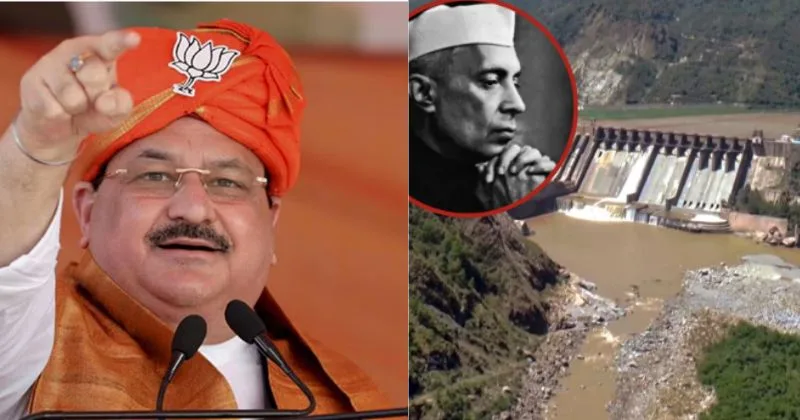
JP Nadda revives 1960 debate: Nehru accused of being too generous to Pakistan in Indus Waters Treaty

JP Nadda revives 1960 debate: Nehru accused of being too generous to Pakistan in Indus Waters Treaty

Facebook
Twitter
WhatsAppTelegramEmail

The BJP President and Union Health Minister JP Nadda started the new week on August 18 by going after then Prime Minister Jawaharlal Nehru on the signing of Indus Waters Treaty (IWT) in September 1960. He said that this lopsided Treaty was criticised by many MPs during a parliamentary debate in November, two months after its signing. Nadda said that most parliamentarians who took Nehru to task for being too generous towards Pakistan and thus bartering away India’s interests were Congress members.

Indeed, a limited debate had taken place on the Treaty in Parliament on November 30, 1960, and many MPs spoke on the issue. Other than Union Irrigation Minister Hafiz Mohammad Ibrahim, nobody spoke in favour of the Treaty. As expected, Nehru had defended his government’s action by saying that “we purchased a settlement, if you like; we purchased peace to that extent and it is good for both countries”. However, this assertion of buying peace was not borne out by the subsequent events that unfolded over years, decades and during the last 65 years since the Treaty has been signed.

In his speech, late Atal Behari Vajpayee, who was then Lok Sabha MP from Balrampur in UP, said: “After the signing of this Treaty, Pakistan President has said that joint inspection means joint control and joint control means joint possession. He says,`By accepting the procedure for joint inspection of the river courses, India has, by implication, conceded the principle of joint control extending to the upper reaches of Chenab and Jhelum, and joint control comprehends joint possession.

Also Read: ‘Dog shelters will not solve the issue’: Dr Mohan Bhagwat on Supreme Court stray dog order

Vajpayee cautioned that this interpretation of the Treaty, as explained by President Ayub Khan, will have very dangerous portents for India. He said that under no international law, it is incumbent upon India to provide that much of water to Pakistan. Besides, Pakistan does not have the capacity to utilise that much water as has been allocated to it. If the government were more careful, and negotiated better, Pakistan sure could have been asked to agree to far lesser water of the Indus basin rivers.

“The Treaty on river waters is not in Indian interests and we have tried to give too much to Pakistan with the false hope of earning its friendship. Despite this very high price paid by us, we cannot be sure that Pakistan will behave in a friendly manner.

Congress MPs from Punjab and Rajasthan, Iqbal Singh and H.C. Mathur termed the Treaty as something that was distinctly disadvantageous to India. In their statements, these Congress MPs asserted that both their home states “had been badly let down”.  Ashok Guha, another Congress MP, lamented that interests of India had been sacrificed to placate Pakistan, and this generosity was sure to bring no good results.

Harishchandra Mathur, who represented Pali Lok Sabha segment, said: “ … the facts of the case before us give us an inevitable feeling that this Treaty is all to the disadvantage of this country. The progress and development programmes will be retarded and it is all to the advantage of Pakistan. Rajasthan has been badly let down in this Treaty.

He added: “It is not only by being overgenerous that you can create a friendly feeling. You must be a strong and firm government. You must create a feeling on that side that all reasonable demands would be considered but nothing beyond reasonable demands would be considered.

At another point during his speech, Mathur said: “What goodwill has come out of the friendship we have generated? Immediately after the Treaty was signed, we find the President of Pakistan talking about the physical possession of the upper reaches of these rivers (read the Western Rivers). It is most disappointing if we have generated this sort of goodwill.

Another MP, Ashok Mehta said: “Every concession becomes a thin end of the wedge. … the Kashmir dispute, instead of getting settled, instead of the solution of the canal waters problem leading us, helping us towards easing the tensions in the area, have aggravated the situation.

Mehta was very harsh during his speech towards the government action and said: “It is a kind of Second Partition which we are experiencing. It is a kind of reopening of all the wounds that we had hoped had started healing. This is being done again with the signature of our Honourable Prime Minister. This had happened in 1947 with regard to Partition without understanding, realising and making sure that it will not lead to carnage all sides.

Another parliamentarian, AC Guha, citing figures regarding irrigable land in India, said: “… in the Indus basin, on the basis of land which India possesses, India should have got at least 40 per cent of the waters of the Indus basin. But under the Treaty, only 20 per cent of the Indus basin water will flow into India and 80 per cent into Pakistan. This is a serious mistake in the agreement. There is a relevant question to ask, namely, whether Pakistan will need that 80 per cent water or whether Pakistan will have the capacity to utilise that 80 per cent water.

Brajraj Singh also criticised the Treaty and said: “ … I want that not only with Pakistan, India should have good relations with all countries across the world. However, when we talk of goodwill and friendship, we must remember that these cannot be and must not be achieved by selling one’s honour. I feel that in signing of this Treaty, honour and prestige of the country have been lowered. After all these sacrifices, I want to ask one question here, after keeping millions of Indians hungry, is there any guarantee that Pakistan will behave in a friendly manner? No, I believe that our hopes will change into a sense of betrayal and despondency when Pakistan behaves in an inimical manner.

A parliamentarian from Odisha, Surendra Mohanty, who represented Dhenkanal Lok Sabha segment, said: “Time being short, let me tell him (read Nehru) that it (Treaty) has acted against the interests of our country. The Rajasthan Canal System will starve for water. I am told that from 1961, some water will be available for Kharif crops but Rabi crops water can be had only after 1973. You are also going to starve the plains of Himachal Pradesh which needed water. This is the Treaty of surrender which we could have well resisted and I am sorry that the Prime Minister put his signature on it.

Topics: J P NaddaAtal Bihari VajpayeeIndus Waters TreatyParliament debatePresident Ayub Khan
Share
Tweet
SendShareSend
✮ Subscribe Organiser YouTube Channel. ✮
✮ Join Organiser's WhatsApp channel for Nationalist views beyond the news. ✮
Previous News

“Nation first” for six decades: Odisha CM praises Rashtradeep at jubilee event

Next News

Strategic leap by Bharat in technology; Rs 1.60 lakh crore semiconductor mission announcement:

Related News

Permanent Representative of India to the United Nations Parvathaneni Harish speaks at United Nations Security Council session

India rejects Pakistan at UN: Links Indus Waters Treaty to cross-border terrorism, reaffirms J&K stand

NEET Paper Leak Row: PM Modi announces fast-track courts; “Nothing is more important than our youth’s future”

Chenab Riverbank

J&K: Salal, Baglihar reservoirs to be de-silted in coming days, advisory issued for people living on banks

A representative image

From ABHA to AI: How Ayushman Bharat digital mission is building one of the world’s largest digital health ecosystems

Xi builds, Sharif stays silent. The Indus tells the real story

Selective Outrage? China’s Indus Dam exposes Pakistan’s double standards on water security

‘Ancient Pakistan’ to ‘Children of the Indus’: Why Pakistan is rebranding its identity

Load More

Latest News

Meta faces intense MeitY scrutiny following admissions over paid content amplification (AI-generated Image)

Meta admits it was paid to boost ‘certain types of content’— Exposing the lie of the “neutral platform”

NEET UG Exam

NEET-UG could shift to JEE-style two-stage format; Centre says no final decision yet

A wanted gangster carrying a Rs 1 lakh bounty, Mohammed Furqan, was killed in a police encounter in Uttar Pradesh's Shamli district

UP: Rs 1 lakh-reward gangster Mohammed Furqan, linked to Kairana Migration, killed in Shamli police encounter

A newly discovered hidden backdoor in Chinese-made routers has intensified global concerns over cybersecurity and supply-chain security

Think Before Buying: Hidden backdoor found in 20+ Chinese Router models, warns cybersecurity firm VulnCheck

Russian President Vladimir Putin and Prime Minister Narendra Modi(File Photo)

India-Russia to celebrate 80 years of diplomatic & strategic partnership; Sets $100 bilateral trade target by 2030

NIA Arrests Most Wanted Accused Umar Farooq in Praveen Nettaru Murder Case

Praveen Nettaru Murder Case: NIA arrests key accused Umar Farooq after four-year hunt

Bombay High Court convicts Tarun Tejpal in 2013 sexual assault case

Bombay High Court convicts former Tehelka editor Tarun Tejpal in 2013 rape case, overturns 2021 acquittal

Karnataka: BJP alleges cabinet expansion driven by ‘Payment Quota’, slams Congress over Nagendra’s re-induction

Prime Minister Narendra Modi & Meta CEO Mark Zuckerberg

Meta’s PM Modi video removal sparks concerns over accountability to Indian laws & digital sovereignty: Cyber Experts

Uttar Pradesh Cabinet has approved amendments to the Madrasa Education Act, ending the recognition of Kamil and Fazil degrees

Uttar Pradesh: Yogi government ends recognition of Kamil and Fazil degrees in line with Supreme Court ruling

Load More
  • Privacy
  • Terms
  • Cookie Policy
  • Refund and Cancellation
  • Delivery and Shipping

© Bharat Prakashan (Delhi) Limited.
Tech-enabled by Ananthapuri Technologies

  • Home
  • Search Organiser
  • Bharat
    • Assam
    • Bihar
    • Chhattisgarh
    • Jharkhand
    • Maharashtra
    • View All States
  • World
    • Asia
    • Africa
    • North America
    • South America
    • Europe
    • Australia
  • Editorial
  • Operation Sindoor
  • Opinion
  • Analysis
  • Defence
  • Culture
  • Sports
  • Business
  • RSS @ 100
  • Entertainment
  • More ..
    • Sci & Tech
    • Vocal4Local
    • Special Report
    • Education
    • Employment
    • Books
    • Interviews
    • Travel
    • Health
    • Politics
    • Law
    • Economy
    • Obituary
  • Subscribe Magazine
  • Read Ecopy
  • Advertise
  • Circulation
  • Careers
  • About Us
  • Contact Us
  • Policies & Terms
    • Privacy Policy
    • Cookie Policy
    • Refund and Cancellation
    • Terms of Use

© Bharat Prakashan (Delhi) Limited.
Tech-enabled by Ananthapuri Technologies