





President Trump in his second term has weaponised tariff both against friends and foes, from European Union (EU) to China. He has done multiple flip flops over a period of time and he has recently signed orders for tariff against large number of countries. President Trump has been totally unjust and unreasonable to impose a massive fifty per cent tariff against India. Since he has quoted India’s import of oil and military hardware from Russia, he seems to have weaponised the tariff structure in literal sense.
It is not difficult to assume that President Trump wanted India to accept his offer of American F-35 fifth generation fighter jets unconditionally. He also wanted India to wean away from Russia as far as its defence imports are concerned. Essentially, the American plan appears to be to make India another Pakistan, which toes the US line willingly. For an unconventional president like Trump, it is difficult to accept that a country like India can follow an independent foreign policy.
I have believed that every adversity presents an opportunity to new Bharat to overcome the setbacks and prosper even more. Since President Trump has unleashed his version of Tariff terror, such an act should be counted as another form of economic terrorism. As India has outlined its ‘New Normal’ against terrorism in the ongoing Operation Sindoor, a similar approach is now needed to deal with unfair Trump tariff against India. Three examples would prove that India has the potential to be self-reliant and a world leader.
First pertains to India becoming a nuclear power. India established its nuclear programme in the late 1950s to utilise nuclear power for peaceful purposes. India was assisted both by the US and the USSR. There was some assistance given by Canada too. But as far as enrichment of uranium is concerned, India developed indigenous technology under Homi Bhabha and India was able to carry out first nuclear test in Pokhran in the year 1974. After more than two decades of sanctions, India finally conducted nuclear tests in the year 1998 under then PM Atal Behari Vajpayee. Since then, India is a nuclear power nation and in August 1999, India declared a ‘No First Use’ policy. Even then, US had imposed sanctions against India but India continued its growth journey.
Second example is about India’s space programme. From humble beginnings in the 1960s, the focus shifted to developing sounding rockets and India launched its first satellite Aryabhatta in the year 1975. From the year 2000 onwards, ISRO has launched multiple space missions towards space exploration. Recently, Group Captain Shubhanshu Shukla spent 16 days in space showcasing India’s growing capabilities in space. Today India boasts of indigenous and cost-efficient launch of weather, earth and navigation satellites. India is counted as a major global player in space. With purely homegrown efforts, India’s space programme now has ambitious plans to have an Indian space station by the year 2035.
Third example of indigenous development pertains to India’s missile programme. Right from 1980s, India commenced Integrated Guided Missile Development Programme (IGDMP) which was aimed to develop strategic and tactical guided missiles including Agni, Prithvi, Akash, Trishul and Nag series. India has been successful in developing short range, medium range and long-range ballistic missiles. Under Dr. APJ Abdul Kalam, India’s missile programme reached the milestone of producing Inter Continental Ballistic Missiles (ICBM) and only seven countries in the world have such capability. BrahMos, a supersonic cruise missile developed by India in collaboration with Russia is considered one of the best in the world.
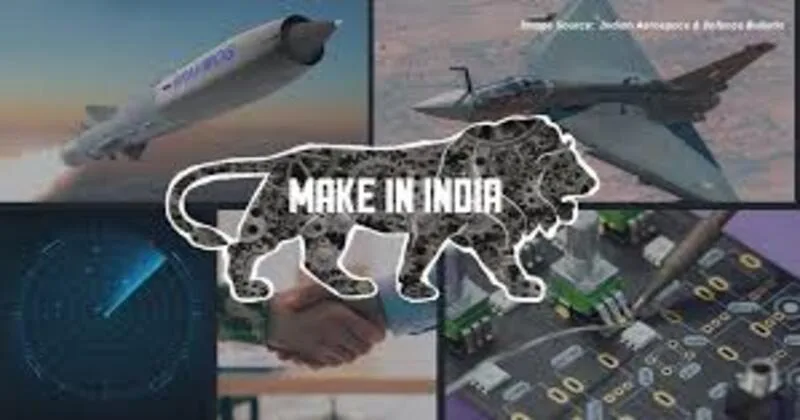
It is therefore surprising that India did not become self-reliant in the production of arms, ammunition, aircraft, ships, submarines etc. since independence. In fact, India did not pay much attention to in-house defence production even after the outstanding victory over Pakistan in the 1971 war. There was a time when India imported 80% of its military hardware from erstwhile USSR and later Russia. Possibly, it was to do with massive kickbacks in defence acquisition. But Modi government realised that our massive foreign reserve is going into arms import. Thus came a series of defence reforms in India from Modi 1.0 government onwards. Slowly and steadily, indigenous defence production rose. But two decisions of the Modi government made significant difference. One was corporatisation of Defence Public Sector Units (DPSU) in the year 2021 and the second was opening of defence sector to the private industry.
It is heartening to note that India’s defence production is more than 1,50,000 lakh crores in the FY 2024-25, up 18 per cent compared to the last year. Our defence exports have also reached a figure of Rs. 30,000 crores in the last fiscal. These developments are encouraging but we have to reach a stage where are defence imports are less than 20 per cent of the capital budget. For that, both the public and private sector have to work extra hard. There is immense competition in the world market for the military hardware and India has to develop niche technology like the BrahMos to be a global brand.
Let’s take the example of China’s rise as a manufacturer of world-class defence equipment. When Soviet Union disintegrated in the year 1991, several nations of the erstwhile USSR faced economic crisis. Many of these countries of Soviet bloc had good defence manufacturing facility. China was able to harness the talent of many Soviet era scientists to development their defence industry in quick time. India unfortunately missed this golden opportunity and it remained stuck in importing defence equipment, now largely from Russia. India thus lost the opportunity to harness the talent of many defence scientists from the erstwhile USSR who would have preferred India as their destination.
Thus, this tariff tyranny presents another golden opportunity for India to become totally self-reliant in the defence sector. Towards this, we have to attract best talent, both within the country and that available abroad. Our IITs must offer B. Tech and M. Tech in defence engineering. We are still not attracting the best talent in aeronautical and maritime engineering. All this should quickly change. The central and state governments as also the private industry has to come forward to encourage quality defence production. I have no doubt that India has the capability to become mass manufacturer of small arms, artillery guns, tanks, APCs etc. These defence items are imported by most of the nations and thus India can export much more in the years to come.
India needs time bound goals to become a global player in the defence industry. In the next five years, we should plan to be the major player in our neighbourhood and the immediate region. In the next 10 years, we should aim to be a global player in most of the military hardware. By the year 2047, India should aim to be amongst the top three in defence production. And yes, we should also aim to export some military hardware to America in the next five years. That would be a befitting answer to Trump’s tariff tyranny.











Comments