




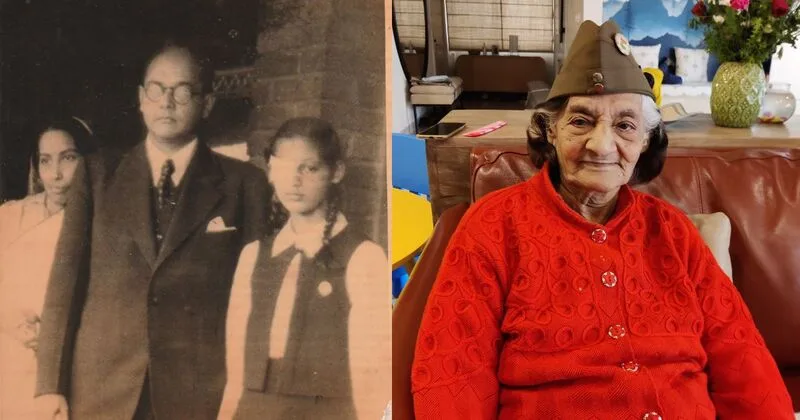
Just two days before Bharat celebrated its 79th Independence Day, the nation lost one of its bravest daughters and a living link to the Azad Hind legacy. Lieutenant Bharati ‘Asha’ Sahay Choudhry, the valiant freedom fighter of the Rani of Jhansi Regiment of the Indian National Army (INA), passed away on 13th August 2025 at the age of 97. Born in Kobe, Japan, in 1928, she carried within her the indomitable fire of Netaji Subhas Chandra Bose’s dream of Azad Hind. Her passing is not merely the end of a personal journey, but a powerful reminder that the sacrifices of such women warriors have too often been marginalised in mainstream histories dominated by the Congress narrative. To remember Asha Sahay is to remember that Bharat’s freedom was won through sweat, sacrifice, and steel — not only in the debating halls of Delhi but also on distant battlefields from Burma to Tokyo.
India’s freedom struggle was never confined to its geographical boundaries. It was a global movement nurtured by revolutionary zeal across continents, carried by revolutionaries who defied colonial power in lands far away from their motherland. Japan, in particular, played a historic role in becoming the second home of revolutionaries like Rash Behari Bose, who sought refuge there after evading British pursuit in 1915, and later Netaji Subhas Chandra Bose, who reorganised and led the INA with Japanese support in 1943. Together, they transformed the land of the Rising Sun into a staging ground for Bharat’s liberation. Yet, while the Congress was content with petitions, compromises, and gradualist politics, it was leaders like Netaji — and dedicated warriors like Lt Asha Sahay — who believed that freedom must be seized by force, not begged for at the feet of colonial masters. Within this shared Indo-Japanese legacy, Asha Sahay represents the youthful flame that carried Netaji’s fire forward.
Born on February 2, 1928, Asha was the daughter of Anand Mohan Sahay and Sati Sen Sahay, stalwarts of the independence movement in East Asia. Her father was a founding secretary of the Indian Independence League, a minister in the Azad Hind Government, and a close adviser to Netaji Subhas Chandra Bose. It was in this atmosphere of patriotic fervour that Asha grew up, in a Japan devastated by wartime bombings but also alive with revolutionary spirit. At just 15, inspired by Netaji’s clarion call of “Give me blood, and I shall give you freedom,” she approached him to enlist in the INA. Netaji, struck by her passion but conscious of her tender age, gently turned her away. But Asha was not one to give up. Two years later, now stronger and even more determined, she stood before Netaji once more, demanding her right to serve her motherland. This time, her resolve could not be denied. She was inducted into the Rani of Jhansi Regiment, the women’s wing of the INA, which was created to strike terror into the heart of the British Raj by proving that even Bharat’s daughters were willing to march into battle.
Asha underwent rigorous military training — drills, weapons handling, discipline, and endurance — that transformed her from a skinny teenager into Lieutenant Asha Sahay, a soldier in every sense of the word. The INA was not merely a military experiment; it was the embodiment of a civilisational will to reclaim sovereignty. For Asha, the bombings of Japan during the Second World War were not a cause for fear but a crucible that hardened her spirit. She became a living example of Indian womanhood’s courage, embodying the spirit of Rani Lakshmibai herself. At a time when colonial narratives dismissed Indian women as docile and dependent, the Rani of Jhansi Regiment, with warriors like Asha, shattered that stereotype and asserted that Bharat’s nari-shakti was as indispensable to freedom as its sons.
Her remarkable life stretched far beyond the war years. Asha completed her education in Japan, graduating from Showa Women’s University in Tokyo, and became widely respected in both India and Japan. Known affectionately as “Asako-san” in Japan, she became a cultural bridge between the two nations. Her life testified to the enduring ties forged in the crucible of war between Bharat and Japan. When she passed away at 97, tributes poured in not only from India but also from Japan, reaffirming that her story transcended borders.
Japan’s Ambassador to India, Keiichi Ono, recalled his recent meeting with her: “I vividly remember my meeting with Asako-san this past April — as if it were only yesterday. With her warm smile and remarkably fluent Japanese, she shared fond memories of Netaji Subhas Chandra Bose and Mahatma Gandhi. These moments will always remain in my heart. In honour of Asako-san’s legacy, I am committed to continuing her mission and will dedicate myself to strengthening the ties between Japan and India.” Even Anita Bose Pfaff, Netaji’s daughter, mourned her loss, recognising in Asha a comrade of her father’s great dream.
As Bharat marked its 79th Independence Day, Lt Asha Sahay’s passing just two days earlier became a poignant reminder that our freedom was not the gift of colonial goodwill, but the result of relentless struggle and sacrifice. Post-Independence politics, dominated by Congress-led narratives, has often marginalised the role of the INA, the Rani of Jhansi Regiment, and heroes like Asha Sahay. School textbooks still rarely mention their names with the reverence they deserve, while the sacrifices of countless soldiers in Netaji’s army are footnotes, if mentioned at all. This neglect is a historical injustice that must be corrected if Bharat is to truly honour its past.
Lt Asha Sahay’s story embodies the unity of purpose, the spirit of sacrifice, and the eternal bond between Bharat and Japan in the quest for independence. She was not just a soldier of the INA; she was a symbol of India’s nari-shakti, a cultural bridge across nations, and a living flame of the Azad Hind legacy. Even in her passing, two days before the nation raised its tricolour on the ramparts of Red Fort, she reminded us that freedom came at a cost. To keep her memory alive is to reclaim the true history of India’s independence struggle — a history in which the INA, Netaji, and warriors like Asha Sahay occupy their rightful place. She was, and will remain, a radiant flame of the INA’s legacy — one that nationalist thought must preserve against decades of neglect and distortion.













Comments